Need to have your company phone system upgraded to something more reliable, easy and affordable to use?
Even though you have a few alternatives in mind, most likely you have narrowed it down to a premise-based or cloud-based system.
Having your business phone systems hosted on-premise or in the cloud has its benefits and drawbacks. That is what makes it such a difficult yet significant decision. However, when you select an appropriate one for you, then you can be at ease in your business communication.
In this article, we will discuss the advantages and disadvantages of both of them. At the conclusion, you will understand far better which type of telephone system suits your specific needs.
What Is an On-Premises Phone System?
A premise-based phone system is a phone system that is installed physically in a building.
It is either physical wires around the office that links the data centre of your office to the desk phones of your employees or IP technology which permits you to make calls via the Internet connection. In any case, the key PBX system is within your physical workplace.
The phone systems based on premise can be very costly to install due to the equipment required. For example, you will require IP phones and SIP trunking, as well as a dedicated room in your office for installing all the necessary equipment.
And there is maintenance. You will either have to have your own IT team or you will have to hire a third-party service to come in and fix the issues. This may be costly to your business.
It also lacks the flexibility that is associated with a physical PBX phone system: Any person who requires making a call must physically be in the office. Remote workers are not able to call in and make or receive calls outside of their offices.
What is a hosted cloud-based phone system?
A hosted phone system is similar to an on-premise solution. The only distinction is that the calls made are over an existing internet connection. It provides you with a lot more flexibility and freedom as compared to an old-school setup.
This implies that cloud phone systems tend to be cheaper than their counterparts since all you are buying is the connection to be established. And because that bond is created via the internet via a Voice over Internet Protocol (VoIP) solution, it can be much faster to get started.
How does a hosted VoIP phone system work?
However, one of the most significant differences between on-premise and cloud phone systems is that remote teams may utilize the hosted solution. They do not have to be attached to a desk phone. Even when on the other side of the world, team members can still make phone calls and participate in conferences, provided that they have compatible VoIP software installed on their device.
By the way, you can continue to use your common and ordinary equipment. A cloud phone system is not restricted to using a special IP phone or a hardwired desk phone. To begin taking calls, simply download the provider app to a laptop, mobile phone, or VoIP conference phone.
And in case you want new equipment, VoIP headsets would be a good choice. They are loud and sharp, but the cordless ones are unbelievably far-reaching. You can have a walking phone call, or be on the other side of the office and still have a crystal clear connection.
VoIP desk phones are powerful as well as user-friendly. They offer mobility that is not available in a conventional phone system. Your office team could literally carry their phones into various places, such as home or even the road and still work without any disturbance.
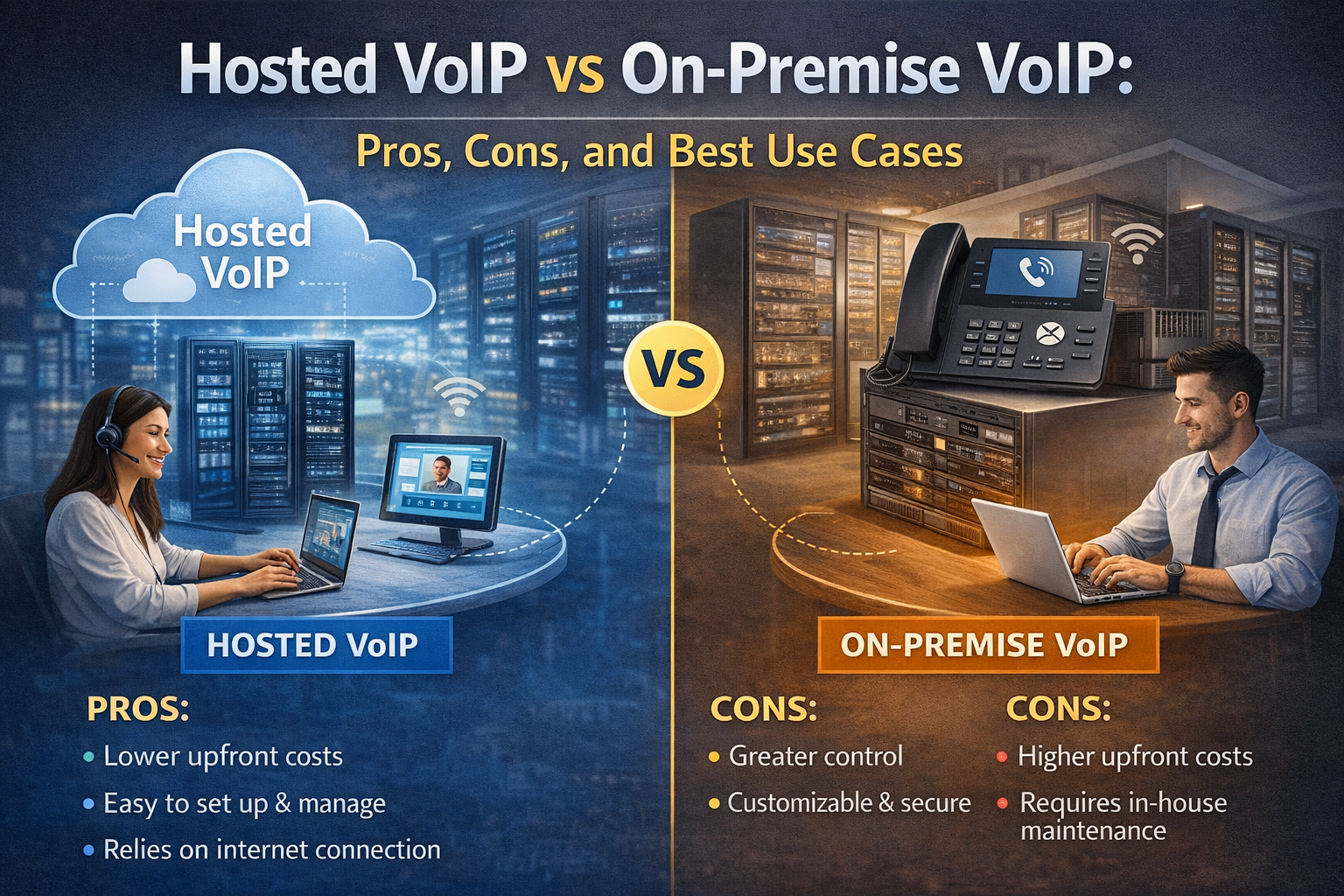
The Advantages and Disadvantages of On-Premise and Cloud Phone Systems.
We understand better now of both telephone systems, so we will look at some of the major differences between the two.
- Costs and maintenance
You have to keep an on-premise solution running once the lengthy and expensive installation is completed.
Luckily, with a cloud-based system, these concerns are off your hands. The most obvious plus sides would be the lower set-up costs and the fact that you do not have to undertake any maintenance (the host provider does it).
- Remote-team flexibility.
A cloud-based system is far more adaptable to distributed and remote teams that are in different locations. Workers do not have to access their personal machines out of the office or when they are working at home. Their business phone number can be used on a cell phone to call and receive work calls.
A on-premise phone system is not as flexible as a cloud-based solution when used by remote and distributed teams and the physical nature of this system prevents it to easily scale to the demands of an expanding remote workforce.
- Reliability
It is also worth noting that hosted phone systems are occasionally more reliable than traditional ones. The maintenance, security and overall maintenance of your cloud phone system are taken care of by your hosted PBX provider. Naturally, you also need a working internet connection.
On-premises phone systems rely on the quality of local infrastructure, hardware and maintenance. And it is not connected to the internet, but, as well, vulnerable to local power outages.
What Is the Right Solution for Your Business?
It is already a well-known fact that on-premise solutions are often associated with high initial expenditures and a restricted feature set. That does not mean that you should dismiss them altogether, this alternative is still popular among certain corporations.
But do you necessarily require an on-premise system? Or do you have the switch to the cloud? The following four questions will help you determine what is best in your business.
1. What is your spending limit?
Perhaps the most crucial aspect to take into consideration in the process of selecting between hosted VoIP and on-premises phone systems is the cost.
When you ask both providers will provide you with the upfront cost and a monthly service fee. However, it is important to note that, as a whole, VoIP is considerably more affordable than premise-based phone systems in terms of total cost of ownership.
Yes, it costs a monthly fee to remain connected, but there is not so much in terms of maintenance costs as it is managed remotely by your provider without interfering with service. You do not need to have IT walk into a physical office to update or repair the network.
VoIP set-up is also less expensive and you can use what you already have. The personal telephones of the remote employees can serve as work phones. It is also possible to retrofit your existing analog phones or PBX configuration with a VoIP adapter.
2. Do you have a remote team?
A remote team member will find it more difficult to dial into a premise-based phone system. Physical connections are made within the office between data center and device. It makes them an inappropriate option to companies working remotely.
But cloud solutions enable remote teams to flourish. This system allows employees to access their business phone system anytime in the world using the Voice over IP. The only thing they require is a strong bandwidth and internet connection so that they can make and receive business calls.
You can always test your internet speed with our free network speed test to find out if your connection has enough bandwidth to support VoIP network.
The quality of calls has also improved significantly. VoIP applications transmit and encode voice waves into digitized files via the internet. Even when the end-user is not operating a VoIP system directly it has twice the bandwidth of a standard analog phone call.
3. Are you expanding your team?
A hosted phone system is more scalable, compared to an on-premise alternative. The reason is that you do not require additional wiring to your on-premises data center.
Rather, your online hosting partner could put one more line on your account. An account of any new team member can be created in a matter of minutes. And because they already have access to the technology, their work laptop or mobile phone can also be used as their business communications device.
This implies that hosted VoIP gets the system even better to grow with a team. Call management is also simpler with a hosted provider in case you intend to expand your contact center or recruit more staff in the coming years.
4. How much control do you need?
Do you have to have total control over your entire network? In that case, an on-premise solution may be more appropriate for your business needs. When the system is in your office you have direct control over it and you will have access to an in-house IT team that will likely have a better idea of the intricacies of your network.
However, in case you want to leave the management and maintenance of your business phone system to someone, a hosted solution may be the best. The maintenance is all taken care of by your provider, and, as there are no extra devices in your office, all you have to do is update the software on the devices you are working with. It’s that simple.
In Conclusion
Both on-premise and hosted phone systems are feature-rich. Some of the features provided are call transfer, call hold, voicemail to email, auto attendant, conference calls, and many others. The only significant distinction between the two is that in a hosted phone, you eliminate the maintenance and upgrades of the hardware.
Your service provider has complete control over it. You are able to save your time and work on other high-priority tasks. In an on-premise solution, you will need to keep a lot of hardware and physical lines.
FAQs
Q1. Which is a cheaper phone system to use, Hosted or On-Premise Phone System?
When it comes to hosted phone system, there is no need to invest heavily in equipment and dedicated IT personnel. All you do is pay a monthly subscription fee and everything is managed by the provider. Therefore these systems are less expensive as compared to on-premise systems which involve a massive initial investment.
Q2. Do hosted PBX have any hidden fees?
The pricing will be transparent by a good hosted phone provider. Nevertheless, the extra charges on additional features, international call rates, over-use charges, and custom integrations are always a wise step to take.
Q3. Are Hosted phone systems safe?
Yes, hosted phone systems are fairly safe provided you are contracting with a trusted service provider. A reliable service provides end-to-end encryption, firewall protection, data redundancy and backup, as well as adherence to standard regulations.
Q4. What will occur in case of my internet failure with a hosted phone system?
You might have temporary downtime with your phone system in case your internet goes down. It is a good thing to have a backup internet or a mobile connection.
Q5. Which system will be easier to expand with the growth of my business?
Hosted phone systems are an unconditional option as far as scaling up or down is concerned.