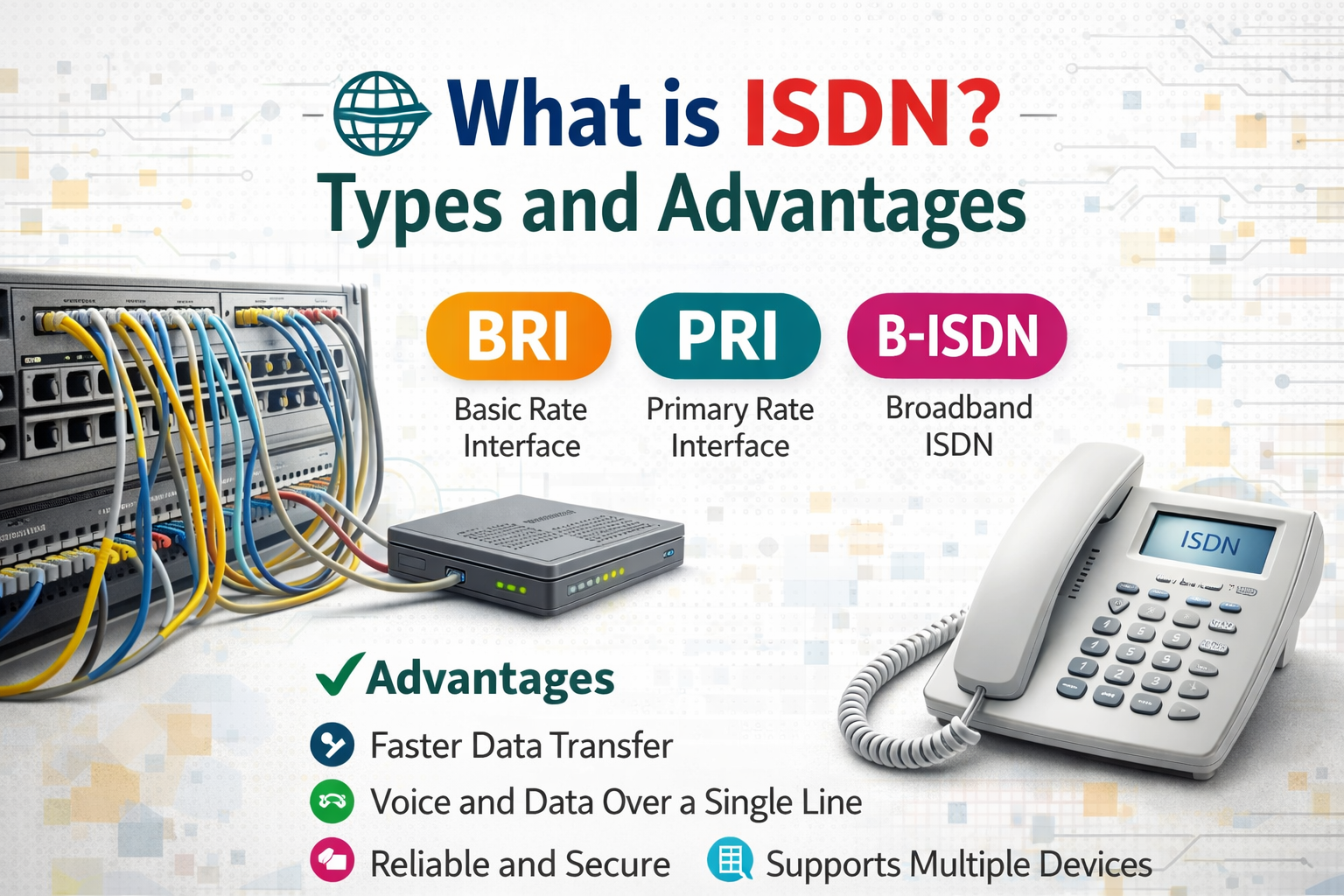
ISDN or Integrated Services Digital Network, is a circuit switching network system of telephone which transports both voice and data through a digital line. It can also be thought of as a standard of communication to pass the data, voice, and signaling.
These copper lines may be digital lines. It was meant to transfer the outdated landline technology to the digital world.
The ISDN connections are known to be faster and quality when compared to the traditional connection. The speeds and connection are also enhanced which makes data transmissions to travel more reliably.
The ISDN modernization would be via a SIP trunk provider – they take the data and pass it to a PBX and utilize it to serve business phone. This detailed blog will discuss what ISDN is.
What Is ISDN?
The integrated services digital network (ISDN) is a form of telecommunication, which enables you to transfer data, speech, video, and other network services. This digital information is transferred using copper wires by ISDN in at least two channels.
The history of this network dates back more than four decades to the commencement of work on ISDN at Bell Labs and became standardised in 1988.
This telecommunication system was however challenging to introduce as the provider side had been substituted but the customer had not. To address the challenge, phone system providers had to come into an agreement on how to digitise the equipment by the customer.
Telecommunication companies studied the integration of the two systems but failed to arrive at a solution on how to bridge the connection between the higher bandwidth and the analog lines with the twisted-pair lines. As such, there was disagreement as to which concept they were to be applied.
This system standardisation required eight years. This is because more recent and high-speed types of networks were available. Phasing out this network by so many telecommunication companies was the case.
However, this system continues to be applied in other areas. Specifically, a survey conducted in 2005 established that there are approximately 4 ISDN channels per 10 residents in Norway.
What are the different types of ISDN?
Having known what is ISDN, you must know that configurations of this network are founded on the speed of the transmission process besides the nature of data being transferred.
The key varieties of ISDN are the following:
1. Primary Rate Interface
Primary Rate Interface (PRI) is the most popular one. The PRI is mostly applied in large enterprises and organizations because the service is the primary one in this network. It is rather a reliable service on top of providing the speed of 64 Kbps with the capacity of up to 2.94 Mbps.
Further, another common method of connecting your system to a public switched telephone network is PRI. Nevertheless, remember that the highest speed of this network can reach is also determined by the number of channels which are frequently utilized in the country. An example is that the Europeans have 30B channels and the American countries have only 23.
2. Basic Rate Interface
Basic Rate Interface/Access (BRI or BRA) is a poorer version of PRI. BRI provided both long distance voice and other digital services. Thus, this network can only support 64 Kbps in both of its B channels, and 16 Kbps on its D channel. This network has a total of 128 Kbps of data that it can transmit.
It is not surprising that this network is not common with such a small number of data sent. Very few of them are used by small businesses and groups or homeowners who have no other choice. Nevertheless, the advantages of BRI are that it is cheaper (PS3.50 – PS9.50 per month) than PRI (PS500 per month).
3. Narrowband ISDN
The Narrowband ISDN has the lowest speed of the various types. In particular, narrowband uses a lower frequency and its speed is 64 Kbps.
It was simply meant to digitalise speech data, which was analog. This is only that it needs a bandwidth of other networks of small size.
4. Broadband ISDN
This network is referred to as the Broadband ISDN since it exceeds 1.544 Mbps. It can transmit 2 Mbps – 1 Gbps. It normally employs fiber optics in lieu of copper, therefore, because it has a broad bandwidth of approximately 10 Gbps.
With these fiber optic cables, this network makes you to have control over various kinds of services and transmits continuous information of one source to various users.
Besides this, it is linked to the Asynchronous Transfer Mode technology which minimises delays. But the users are not able to send information back they only receive it.
How ISDN Works and Who Uses It?
This kind of network is based on two kinds of channels:
- Bearer (B): This channel is used to carry such data as voice.
- Data (D): This channel carries signals and controls. Nevertheless, data packets may also be transmitted by D channels.
To know more about what an ISDN is and how it works, an example is given below:
Let’s say you call a friend. The content of your Hello is coded and sent in this network in one of the B channels. At the other end, your friend will greet you and also greet him or her. But a Hello of your friend will be passing on another B channel. It is due to the fact that B channels transmit information in only one direction.
This signal will be sent by the D channel after the conversation and clicking the End Call button and your call will be terminated.
With B channels, as many people can be on the call as there are B channels, and hence this network has been popular among large organizations like businesses. Businesses normally employ this network as an alternative of communication. Rural residents can also use this network because there are many instances when other networks cannot be accessed in rural areas.
The Advantages of ISDN
The following are the advantages of using this network:
- Faster Connection
The minimum speed offered by this network is 128 Kbps which is faster than dial-up connection. It outdoes the normal phones that only provide 2.4 Kbps.
In addition, scaling of speed can be to 1 Gbps by adding more B channels and fiber optics.
- Multiple Digital Services
There are various services that can be supported by this network. This is because of its various B channels. Also, this network is configured to electronicize information and relay it. Therefore, it can provide more services as compared to the analog phone lines. It can be used to transmit webpages, fax and speech as an example.
- Faster Installation
The network is also fast to install compared to other modems. Moreover, you are able to connect several machines to a shared copper wiring. Thus, there is no necessity to purchase numerous analog lines.
- Clearer Communication
This network does not lose data much because of its design. This will lead to fewer noise levels, distortions, and echoes on the phone calls.
In Conclusion
ISDN is a network that uses B channels and D channels in transferring data. It has speeds up to 1 Gbps and assortment of digital communication services such as faxing and the Internet. Its functionality to connect with several devices makes it the best option in businesses and large groups. It also happens to be an asset to the rural population since it is among the limited number of telecommunication systems available in the rural settings. ISDN could be the network to consider in case these benefits fit your requirements.
FAQs
Q1. What are ISDN lines?
ISDN is a collection of communication standards which employs utilization of digital transmission to call, transmit data and other network services across the circuit of the PSTN. ISDN provides voice, data and video in one line. Several equipment can be connected with this line.
Q2. What are the types of ISDN?
BRI and PRI are the two major types or basic standard of ISDN. There are also Narrowband ISDN (N-ISDN) and Broadband ISDN (B-ISDN) standards of ISDN that are not used extensively.
Q3. How does ISDN differ from PSTN?
The key distinction between the ISDN and PSTN is that in the former there is the utilisation of digital lines as opposed to the utilisation of analogue lines in the latter. They are both similar in that they both pass voice and data using a network on standard copper lines, but at the same time, unlike PSTN, ISDN is able to support multiple channels and applications using one line. All in all, ISDN is superior to PSTN and provisions more services.
Q4. What is the distinction between DSL and ISDN?
Both an ISDN and a DSL (Digital Subscriber Line) have the same type of network whereby they run signals on copper wires. The only notable difference between the two is that the ISDN lines should be installed because they would need an adapter at each end of the line. A DSL involves the utilization of existing telephone lines and it also utilizes a modem. It does not require laying down of wires provided that there is an existing line in the house or organisation.
Q5. Why ISDN is disabled?
ISDN is also an obsolete system and is not in a position to compete with the VoIP and cloud-based systems. Although still in operation, ISDN has not improved its infrastructure since the 1980s and lacks the ability of VoIP systems and features as well as reach.