Hosted or virtual telephony often referred as cloud telephony is a new way of handling business communication where cloud technology is used.
Rather than having old traditional on-premises telephone systems, cloud telephony enables a business to make and receive telephone calls, SMS, and administer voicemail via a cloud PBX system.
The communication requirements increase with the expansion of businesses. The process of handling of calls, SMS, and voicemails can be overwhelming, particularly for small and medium-sized firms.
Here is where cloud telephony comes in. The following blog will discuss a variety of advantages which can assist evolving companies to be well organized and efficient at a low cost.
What is Cloud Telephony?
Cloud computing involves remote servers that are stored in web platforms to keep and handle information within an online system. The cloud has numerous advantages compared to on-premise resources. These features enable the businesses to use cloud technology without concern on their IT infrastructure issues or constraints. Cloud telephony is a complex telecommunications service that is based on a cloud computing model.
Cloud telephony providers are those that are providing the phone systems whereby all equipment, software, and network connections are held remotely with which a company does its business. In this manner, companies will be able to conserve space, power, installation, and maintenance charges.
Cloud calling allows you to receive your phone calls on your business phones and any other device with an internet connection, like computers, tablets, smartphones, etc, anywhere on the planet, as long as there is an internet connection.
Consumers and businesses are moving towards cloud-based services more due to their capability to offer cost-savings, scalability, reliability, and easy usability.
How Does Cloud Telephony Work?
Cloud telephony functions through the VoIP which is an abbreviation of Voice over Internet Protocol. This form of cloud phone system functions in the same way as a normal land telephone, except that your voice is transmitted using the internet in the form of data packets. The VoIP technology implements a voice signal into digital data packets to be sent over the Internet; after that, it converts them back into an analog signal at a destination to be heard.
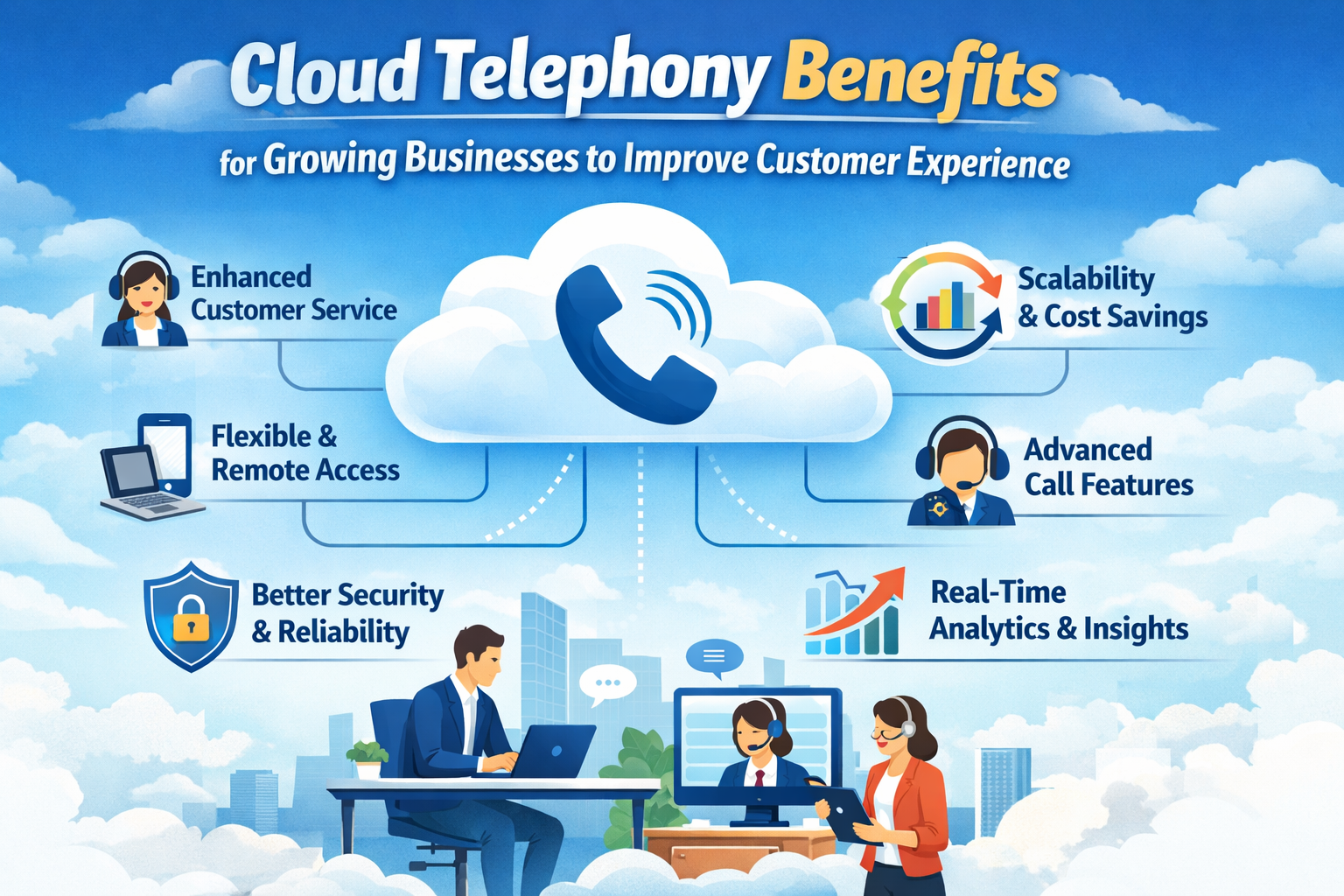
Cloud Telephony Benefits for to Improve Customer Experience
1. Omnichannel communication
Cloud telephony is a single system that integrates all the channels of communication. It can be email, instant messaging or even the old fashioned phone calls, it will all be under one roof. There is no more sending your customers around in circles even when your customers have several agents to deal with all the previous interaction becomes readily available, thus you aren’t wasting time sending your customers around.
It is also the best to avoid such frustrating missed messages since all the information is available to your agents within the same place.
Enhance with cloud-based systems including the unified communications as a service (UCaaS) or contact centre as a service (CCaaS) too.
2. Rapid problem resolution
The presence of a remarkable customer experience can be determined by the ability to fix issues fast. None of the customers would like to be on hold or make several calls in order to get the solution to a problem.
Cloud telephony saves on handling time and makes sure that the customer does not need to repeat a call every now and then.
Cloud telephony also incorporates Interactive Voice Response (IVR) in more straightforward issues that do not always entail the action of an agent. IVR allows the customer to manage some of the most frequent problems within minutes without holding on the line until an agent arrives and this of course leaves your lines free to attend to more complicated problems.
3. Enhance personalisation.
Personalisation transcends the standardised customer experience. Personalised relationship with each customer would be desired by everyone, however, it was not feasible in the past. The use of technologies such as cloud telephony has made it possible to personalised interactions to all businesses since all agents have all the information about their clients at their fingertips.
Your agent may not have talked to a certain customer ever, but he is already aware of all past interactions. It is this information that not only is able to drive a higher standard of service but also gives the platform on which to conduct upselling and cross-selling.
4. Call management without friction.
Customers desire to make a call to your company and find a solution to their issue. They do not want to be shared among different agents and departments.
Cloud phone systems have integration functionalities such as call logging and call routing to help the firms to manage the calls more efficiently. Such features allow you to route calls in the most suitable manner so that the customers can be channeled to the most qualified individual in real time.
5. 24/7 support
The 24-hours service is something the customers more than ever want. The old system of 9-5 working hours is tiring and contributes to dissatisfied clients. Naturally, the maintenance of this demand is expensive and time consuming to many companies and it would be impractical.
International presence of UK firms can now provide 24/7 support to the firm to provide them with competitive advantage. Automatic call routing will enable the communications to be sent to the available agents according to the time zones or trigger AI-powered virtual assistants.
Other companies also use virtual numbers to enable customers to call them using a local number without caring about incurring high charges on international roaming.
6. First Call, First Solution
Time is of the essence and the less time you have the customer on the phone the better, but without affecting the outcome or experience in a negative way. No one would like to make three or four calls to inquire on what is happening.
Cloud phone systems enhance the first-call resolution rates since the agents have real-time data which they can use to correct the issues during the first call. They need not pull the plug to go and find some information or even consult another agent on how to address an issue since skill-based call routing implies that customers are already in contact with the most qualified individual.
7. Always available
Any company that has had issues with its hardware will understand the amount of money it can cost. The cloud telephony does not need any hardware and is supported by stable servers, so you have a solution that will reduce your downtime.
Uninterrupted service ensures that your customers will never be bothered by the fact that you would not be available to serve them. In addition, your agents and customers will not experience undesired communication problems as the HD voice quality is crystal-clear.
Cloud telephony is the unquestioned leader in the market in terms of the uptime and reliability as compared to any other communication. This is why cloud-based communication is gaining popularity among more companies.
8. Flexibility
Cloud telephony provides the businesses with great flexibility and mobility. Using cloud-based systems, employees are able to make and receive call easily, administer voicemails and other telecommunication facilities using any device either through laptops, smartphones or tablets whenever they are anywhere.
This allows organizations to possess virtual workforce which saves them the physical office space and overhead expenses.
Cloud based telephony also enables business to scale its telecommunication requirements easily as its business expands hence giving it more flexibility and saving it on costs.
9. Advanced Features
Telephony system such as cloud, have various superior features that can greatly improve the operation and customer service of a business. These are AI-based Call Routing, voicemail-to-email, Multi-level IVR and call analytics.
The features have enabled the businesses to easily direct calls to the correct individual, so that there is no call missed by a customer. The voicemail-to-email enables one not to miss important voicemails and be able to access them anywhere.
Recording and analytics of calls allow companies to track and enhance their customer service by offering insights into the interactions between the companies and their customers. These new capabilities enable companies to remain to order, effective, and deliver an extraordinary consumer experience.
10. Cost-Effectiveness
The cost-effectiveness of cloud-based telephony solutions is one of the key benefits of such solutions. In contrast to the conventional on-premises telephone systems, which typically cost a lot to start off and also to maintain.
This implies that there is no need to pay more than the features and capacity required by the business and it can easily expand and contract to accommodate the changes in requirement which is cost saving. Also, cloud telephony eliminates the expensive hardware upgrades required in other systems, thus saving more money.
How to Select Cloud Telephony Service Provider?
In selecting a Cloud Telephony Service Provider, a number of factors are important to follow so that the right one to fit your enterprise is selected. The first one is the reputation of the provider.
A provider with a high reputation in terms of quality services and support is necessary. Also, the provider needs to have an excellent history of uptime and reliability and thus their system needs to be up and running all the time.
The offerings and capabilities of the provider are another critical consideration that should be made. One should select a Cloud Telephony System that provides the features and capabilities that are significant to your business and can assist your business development.
Also, one needs to seek a cloud telephony vendors that can readily integrate with other systems like the CRM tools. This will make the communication experience a smooth one.
Moreover, another thing to do is to find a provider, which has flexible payment options, and the pay-as-you-go mode. This will enable you to manage your costs and you only pay what you are using.
How to implement Cloud Telephony Solutions?
The process of implementing cloud telephony system may appear to be challenging, but it is rather simple. The initial one is to select a service provider and to subscribe.
As soon as you do so, the provider will normally give you a portal or control panel where you can configure and control your system.
The next will be to configure your system adding the users, call flows configuration, and call routing. A provider will generally give you guidelines on how to do this or you can even talk with a customer support worker who can assist you in configuration of your system.
Once your system is set up, you will have to advise your employees on the usage of the system. This can involve training in the use of making and receiving calls, management of voicemail and the advanced features of the system.
One should also test your system prior to going live to make sure that all things are going on well. This can involve making test calls, test SMS and testing voicemail.
Lastly, one should check on his system to ensure that everything is running well. This can involve the recording of the call information, the uptime, and even the troubleshooting of any new problems that can occur.
In Conclusion
Cloud telephony services are an effective communications tool that is useful to the growing business, as they provide a variety of features such as scalability, cost-effectiveness, flexibility, reliability, and sophisticated call center capabilities.
Through choosing a service provider of good repute and proper configuration of your system, you will be able to make sure that your business communication is always in smooth operation without any failure.
In case you want to try Cloud Telephony Solutions, multiple providers can provide you with a Free Trial, and it would be one of the most suitable solutions to your business communication problems.
You can make sure that your business communication infrastructure is modern and efficient at all times with its variety of features, ability to be expanded with various pricing options and integrated with other systems.
FAQs
Q1. What is Cloud Telephony?
Cloud telephony or cloud calling is a telephony system upon which the telephony functionalities are hosted in the cloud. It implies that the internet network of telephone services is taking over the normal telephone systems, and this leads to more flexible and scalable communications.
Q2. What is the working principle of Cloud Telephony?
Cloud telephony is also carried out by VoIP (Voice over Internet Protocol) technology. Telephone calls are placed and received via the Internet as opposed to conventional telephone lines. The cloud telephony CRM systems are compatible with the existing CRM systems to promote efficiency in communication.
Q3. How can Cloud Telephony help my business?
The advantages of cloud telephony are cost-saving, scalability, versatility, and additional functionality, including automated call an allocation, interactive voice Response (IVR), and connection to another business solution. Also, cloud-based calling solutions have greater disaster recovery and business continuity.
Q4. Is Cloud Telephony compatible with other business tools?
Yes, the integration of cloud telephony is also one of its benefits. It may be connected to the utilization of many different business applications like CRM systems, email marketing applications, and other productivity applications and enhances the overall business communication and customer support.
Q5. Is Cloud Telephony secure?
Yes, the cloud telephony companies adopt effective security solutions to safeguard your information and messages. These are encryption, secure data centers as well as meeting industry standards to ensure the confidentiality and integrity of your business communications.