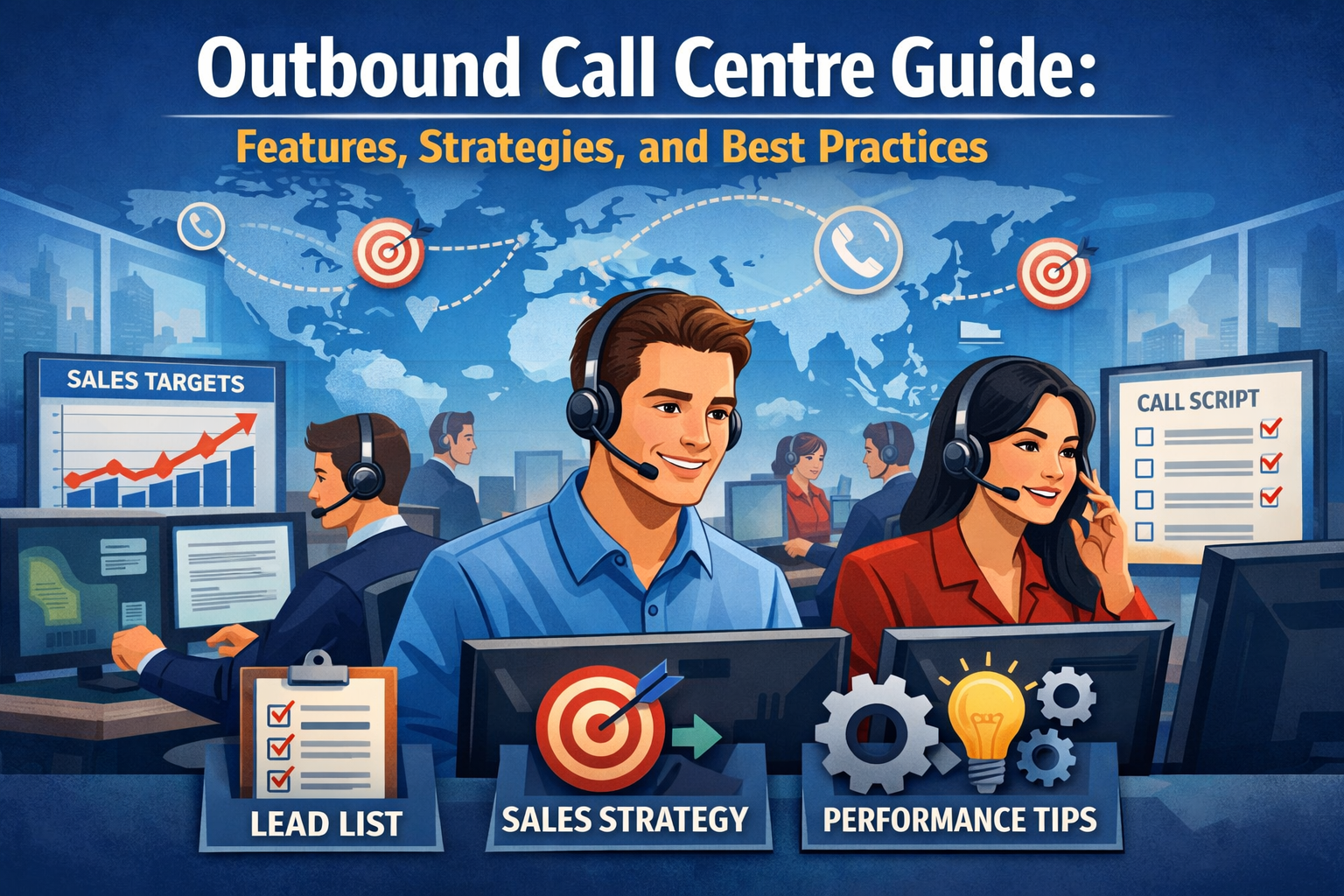
Your business communication strategy includes outbound call centers which make it possible for sales calls, manage customer relationships and offer a strong look at your target market.
Outbound call centers today focus on much more than simply making cold calls: they enable agents to give proactive help that can extend their revenue by as much as 30% and at the same time increase the number of delighted and loyal customers.
The following blog will give important information on outbound call center software functions, common applications, and tips to boost performance.
What Is the Meaning of an Outbound Call Center?
An outbound call center uses agents who actively phone customers or people who might become customers. Unlike those that only handle incoming calls, outbound call centers are set up to generate leads, make sales, survey clients and give proactive customer service.
High call volume at outbound call centers is managed by using specialized software and dialing tools by teams of agents. With the help of customer relationship management (CRM) tools, predictive dialers and performance analytics, contact centers optimize business operations and help companies reach their goals.
Which are the main characteristics of outbound calling software?
There are certain features that outbound calling software must have to help with making, distributing and judging outgoing calls and they are described below.
- Automated dialing:
Automatic dialing by the software helps call centers work much faster. It also makes less work for people and helps prevent errors.
- Intelligent Distribution:
Assigning calls to agents depending on what buyers ask helps an outgoing call center work smarter. Sending calls only to experts in a certain area means problems are fixed more swiftly and effectively.
- Working with CRM tools:
Is it easy for your call center software to talk to your CRM system? If this doesn’t meet your needs, you should look for a new app. Integrating CRM with your call center software can greatly help cut down on your staff’s tasks and save your organization time. You will be able to keep all your customer details in one place, making it easy to look up their records.
- Analytics and reporting:
Reporting and analytical features in a good call center software let you see what customers prefer and how efficient agents are. Real-time analytics let you compare productivity in your business and display which of your services/products are most (or least) appreciated by people.
Best Ways to Make Outbound Calls
Success depends on having a custom approach to outbound communications. In fact, following all ten of these ideas can greatly improve your outbound call results.
1. Use a Script that Improves Agent Assurance
A well-made script gives agents the guidance and answers they need to face client challenges. Consequently, agents deal with objections well which leads to smooth conversations and improved results for the company. Here is what should be included in a good outbound call script.
- Engaging introductory paragraph
A strong sales pitch begins with a sentence that draws the prospect’s attention right away. For example,
Good [morning/afternoon] to you. I am [Agent] and belong to [Company].
Your enterprise’s growth in the last year may require solutions that easily scale. Growth can be handled with ease on our platform. Is now a helpful time to look at how this idea connects with your expansion plans?.
- Handling Common Issues and Concerns
The script body should address issues and concerns that many prospects might have. Agents should know how to answer common questions in a straightforward manner. This is a helpful example for budget boundaries:
I am aware that the budget is something that you have to keep in mind. Within the first six months, our clients noticed that saving money on efficiency brought in a return on their investment.
- An Effective Finishing
The ending of a speech is very important. Scripts that are well made allow agents to explain major points and advise on helpful next steps.
Based on what we talked about, I believe [Product/Service] could make a real difference in your [specific pain point]. Let’s plan a demo for next week to go more in depth.
- Open-Ended Questions
Use open-ended questions during the script to encourage dialogue with your leads. This helps agent with getting and applying the information needed to make their pitch better. Questions like “What’s your most difficult part of [relevant area]?” often show the main issues.
2. Get the Necessary Technology
Maximizing efficiency requires heavy-duty outbound call center tools for high-volume contact centers and teams that make lots of sales calls. Proper technology can help companies increase their success in connecting, become more productive and find more opportunities. Look out for the following key criteria when working on your outbound strategy.
- Dynamic Scripts
Static scripts do not always address objections that prospects bring up. Evolving scripts let agents give answers that suit the ongoing pattern of the conversation. Because of this method, customer care feels more personal which makes it more likely for the outcome to satisfy the client.
- Automatic Caller ID Rotation
Many sales teams find it hard when prospects do not pick up the phone just because their number is unknown. It may make a big difference in the success of a call. The AI Auto Rotate Caller ID works by showing dialed numbers that appear local to the prospect. As a result, your calls are recognized and more likely answered which plays a big role in your outbound strategy.
- Conference Calling
In a B2B sale, many people might need to sign off, so using just phone calls can make the process move more slowly. Using conference calls helps your team gather everyone to look at problems together and decide quickly. This approach is most helpful when a sale is complicated and requires different departments to help.
- Power Dialer
Every second makes a difference in busy outbound call centers. Using automated dialing, the system moves agents on to the following call without waiting. With automatic dialing, your team saves time, can make more calls in the same amount of time and invest their energy in meaningful conversations with potential customers.
- Voicemail Drop
It takes a lot of time to record a message for every contact and it can result in mixed messages. With voicemail drop, agents are able to leave recorded messages to callers with just one click. That way, responses are identical and they leave plenty of time for more important interacting with users.
3. Evaluating Leads Based on Data
People are different in how prepared they are to purchase products. Although a few will decide to buy, a lot may never end up purchasing. It examines clients and marks them higher or lower depending on their chances of turning into customers. Leaders also determine and evaluate prospects by considering how likely they are to end up being customers. It involves reviewing several elements which are.
- How large the company is and what industry it is part of.
- People interact with a company through its website and email.
- How things are done on social media.
- Things your team has bought before or discussed earlier.
Through a good scoring and generating system, your outbound sales can focus on the hottest leads. This keeps you from spending time on leads who might not be willing to purchase. You can also specifically address each lead’s concerns, which helps your contact campaign work better.
4. Set up Social Listening.
Use listening tools on social networks before you make any calls to find useful information about your prospects. They allow you to monitor industry-specific talks, references to your product and talks about your competition. Also, discover individuals who are focused on similar challenges and track their activity so you have a list of active prospects.
5. Adopt a “Power Hour” method for your calls.
Figure out when your leads are most likely to be active and call them at that time. Most research suggests that 5:00 PM is the prime time to do cold calls and 11:00 AM to 12:00 PM comes in a close second.
Changes in these practices might depend on which industry you work in and your target audience. Try working out at various times and look at your results to discover your best time to train.
6. Use an omnichannel strategy to support outbound calls.
Most decision-makers are bombarded daily with so many cold calls that being noticed is very difficult for a single caller. An omnichannel strategy deals with this problem by contacting prospects on different platforms before and after you make your call. It allows you to be recognized as a person rather than an unknown person when friends call you.
7. Track the most important KPIs.
Not following up on call results limits how much you can learn and show your advantages. Looking at the main KPIs will show you the strengths and challenges your outbound call process has. You can adapt your call strategy repeatedly to help your conversion rates get better in time.
Best ways to run an outbound call center in your company
Your organization has set up an outbound call center service and a staff to start outbound communication campaigns. Even so, is their outcome always successful?
Though success in an outbound call center can vary, using these best practices can help your center do much better.
- Refine your data thoroughly.
It turns out incorrect or duplicate data damages your system more than you might expect. Getting structured data from demographics, regions and intents that comes from a reliable source is suggested and all the customers on the list have agreed to be contacted by sales and marketing teams. Arranging your customer data by the sales funnel allows your agents to provide personal solutions to each call.
- Make sure agents receive regular training.
Agents should learn to use the tools in the outbound call center, but they should also be excellent at making personalized calls to clients. Coaching your call center about data helps set a strong basis for how the agents work, regardless of the initial conversation outcome.
Those agents with good skills in listening and managing disagreements can guide fruitful and valuable interactions with those who may have reservations.
- Encourage team members to work together.
The fear of being turned down by customers often makes outbound calling seem very difficult. Set up your agents in the outbound call center with the needed tools to streamline their work. So, providing your agents with a clear script, a dialer that matches their needs, access to call history and regular feedback will allow them to get better.
- Set specific rules for call volumes and expectations.
People who work as agents often experience burnout. Whether managing calls that come in or calls that go out. Make sure to communicate your standards to the team and clearly state what they can and cannot do from the beginning (but don’t be too harsh with them). That way, both you and the agents are aware of the process.
- Observe metrics carefully.
Decide on KPIs for the team and keep track of calls daily and carefully. Focusing on KPIs such as how many calls connect, how long each call goes, the duration it takes to solve calls, how many machines detect the call and the amount of agent breaks will assist in running your outbound call center.
Bottom Line:
With the benefits and features of outbound call centers clear, we will show how sound outbound calling can improve a business in a real case study.
Being skillful in outbound calling means using a careful process that is not limited to calling someone. All steps, from preparing a strong pitch to timing your calls well, are important for boosting how well the campaign does. It is important to have the proper tools, watch key performance metrics and always be consistent with responses to help establish trust. By putting these approaches together, you can connect with potential customers better, handle objections and get better results.
FAQs
Q1. What is the best way to organize a sales call to prospective customers?
Begin with a statement that grabs people’s interest right away. Figure out what issues the prospect is facing and suggest appropriate answers. Ask open-ended questions to discover what their main problems are. Prepare in advance to handle customer objections. Conclude by briefly listing the benefits and recommending specific actions to be taken.
Q2. Do outbound call centers work well for gathering new leads?
Absolutely. Proper techniques and equipment at outbound call centers make it possible to find and grow potential customers into repeat purchasers.
Q3. What is the expense of installing call center software in an outbound call center?
Prices are influenced by the features included, how well the platform scales and the provider. Figure out what your business needs and see which provider can best meet those needs.
Q4. Are outbound call centers and contact centers functioning the same?
Not really. Making calls in sales, lead generation and market research is the main purpose of an outbound call center. But, an outbound contact center is built to support a variety of customer communication methods.
Q5. What are the steps to have a successful outbound call?
A successful outbound call requires good preparation, knowing your customer’s background, being clear about the objective, using a personal method, paying attention to what the customer says and meeting their needs attentively.