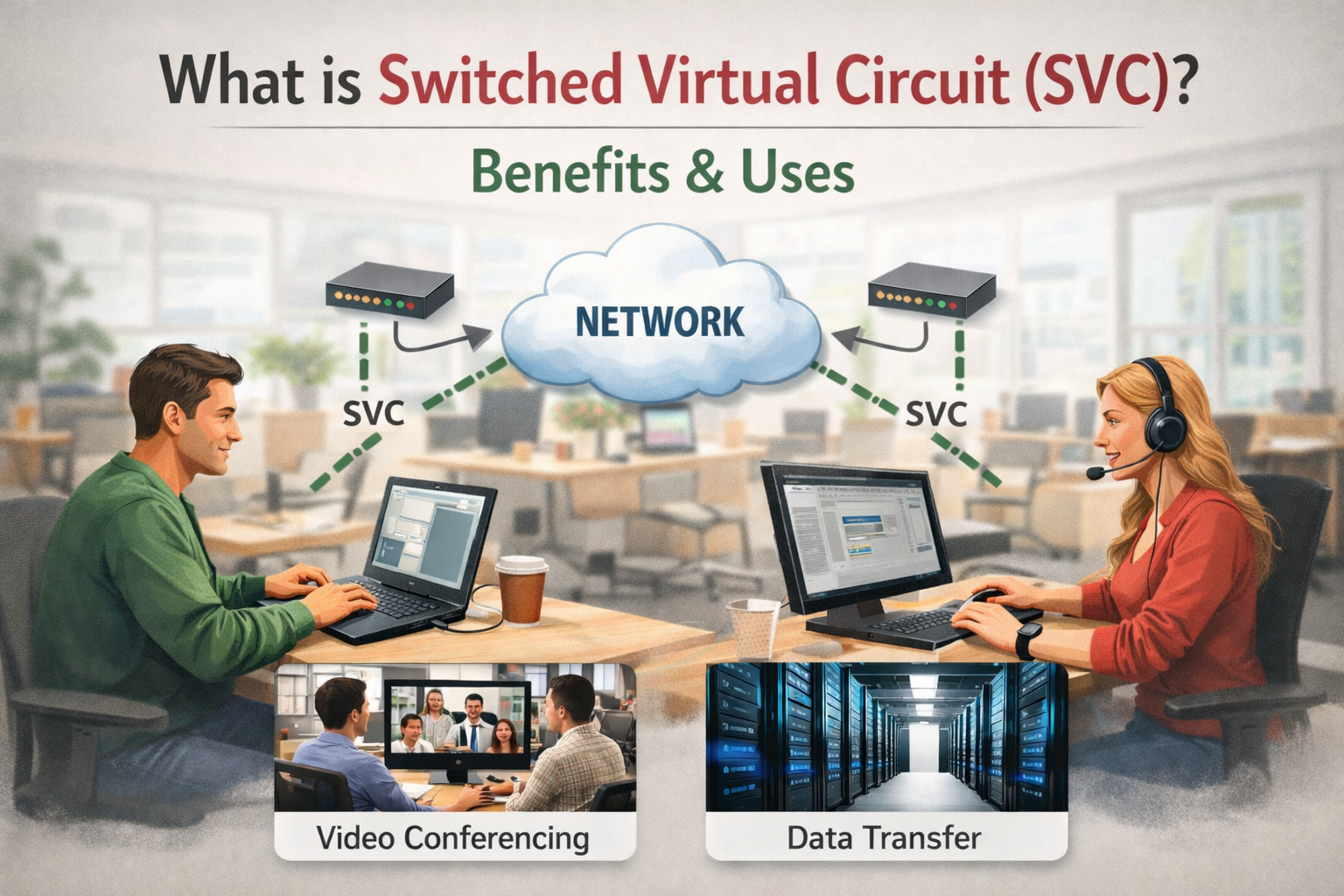
Switched Virtual Circuits (SVC) implement a provisional virtual communication channel between two points of connection, and this packet switching is adopted to exchange data among devices using the on-demand connection of the network.
As opposed to their permanently counterparts, SVCs are only in existence as long as a communication session remains to effectively accommodate and adapt to the dynamic network requirements.
This blog describes the nature of the SVCs, their operation, and briefly discusses the advantages of application in connection-oriented SVCs in the effort to streamline business communication. With appropriate use, SVCs will maximize the usage of resources, adjusting to the real-time state of computer networks and allowing them to create a connection in a cost-effective and reliable way.
What does a Switched Virtual Circuit mean?
A Switched Virtual Circuit (SVC) is a temporary network linkage which enables packet switching between two devices and enables data to be shared on demand only when two devices are communicating actively.
Whereas the Permanent Virtual Circuits (PVC) are fixed and on-demand, SVCs establish temporary network connections that are automatically closed after the communication session has been ended. Virtual circuit switching is best suited to those configurations and applications that may only need to have intermittent point-to-point connectivity.
Features of an SVC
- The establishment of temporary connections: The SVC is established merely when the need to make transfers of the necessary data arises. The exchange is terminated immediately after completion to allow network resources to be available and agile.
- Dynamic path allocation: As the logical connection is established, the network will calculate the best data transfer paths according to the current network states such as bandwidth availability, latency and traffic load.
- When the communication is complete, the connection is released back to other users and applications, and all resources are free.
Elements of a Switched Virtual Circuit.
The key elements that allow establishing an SVC and working with it are:
- Signaling Protocols: Network protocols such as X.25, Frame Relay and ATM are being used to configure and control SVCs. They deal with call requests, route outlay, bandwidth reservation and call termination.
- Switching Equipments: Switches and physical routers that direct data between equipments to set up the virtual circuits. The devices should be able to support the signaling protocols.
- End Devices: end devices are the customer premise equipment (CPE) such as routers that initiate requests to SVCs and end connections. They represent the terminals of the circuit.
- Management Tools: SVC monitoring, statistical and policy and QoS parameter management software.
Therefore, SVCs need support on network protocols, hardware, software, and tools to achieve efficient on-demand connectivity.
How does Switched Virtual Circuit work?
Switched Virtual Circuits are based on provision of a dynamic virtual communication path between the source and destination nodes within the network. This process occurs in three phases, which are connection establishment, data transfer and connection termination. All these three phases are united to provide safe, trustworthy, and cost-effective communication.
- Connection Establishment
The initial stage begins with a network connection request (also referred to as a call request) being sent by one device to another device indicating the endpoints or destination address. Signaling protocols on the network then form a virtual circuit between the two devices. Such protocols also identify the most optimum path available in the network by considering factors such as traffic load or availability of a certain resource. When the optimal path is chosen, the routes such as memory in routers and switches or bandwidth are momentarily subjected to support the traffic of the session. Then the destination device will be able to recognize the connection and indicate its readiness to exchange data.
- Data Transfer
After the connection is established, the data packets are relayed consecutively over the specified route. In contrast to datagram networks (with packets taking different paths based on the variables), with SVC, every packet in the session is directed to use the same path to minimize latency and ensure order. Switches and other intervening devices store routing information temporarily so that the packets can be directed to the appropriate destination.
- Connection Termination
After data transmission and transfer is complete, a terminating signal comes after. The network will then free up any booked resources to clear the way to other communication sessions or application requirements. The given termination process also helps to maximize the use of the network resources, reducing the waste of resources.
Advantages of Switched Virtual Circuit Usage.
Switched virtual circuits enable networks to perform optimally so as to avoid waste of resources. Other advantages of switched virtual circuit are:
- Efficient Resource Usage: SVCs ensure that resources are not wasted by not being idle or any resources lying on bandwidth wasting.
- Dynamic Adaptation: SVCs apply dynamic choice of paths to adapt themselves to the real network conditions and achieve optimal performance even in the presence of network failure or congestion.
- Cost Effectiveness: SVCs do not require permanent and underutilized connections in applications that only need intermittent traffic in reduction of the overall costs.
- Scalability: An SVC is temporary, which means that networks can easily be increased to accommodate a greater number of connections with fewer current resources.
- Reliability and Fault Tolerance: In the event that a network link fails, SVCs may be able to re-route the traffic by using dynamic path selection to reduce the number of disruptions.
Applications and Use Cases of SVC.
The industries that are served by SVCs have various cases of use.
- In telecommunication networks: SVCs are applied in Integrated Services Digital Network (ISDN) and Frame Relay systems, to offer temporary connectivity.
- For service providers: The SVCs also enable the service providers to maximize their current systems since they enable on-demand video, voice call configuration, and data applications.
- Financial transactions and banking: The banking industry has intermittent data exchange requirements such as communications between ATMs and banking server, and these are based on SVCs. SVCs provide transaction procession security.
- Video conferencing and streaming: SVCs are useful in video conferencing and streaming, and this means that they offer specific and high-quality paths when transmitting real-time data in voice calls over VoIP or in livestream. The dynamic character of SVCs maintain latency at minimal levels and reliability at high levels even at times of the high traffic of internet service.
- Contemporary networking: SVCs play a vital role in the contemporary networking by providing an efficient, scalable, and dynamic management of temporary communication requirements. The SVCs are universal and cater to numerous requirements such as financial transactions, telecommunication among others.
- Network Optimization and QoS: Dynamic allocation of paths, congestion control and temporary nature of resource utilization leads to optimism of networks by the SVCs and allow the businesses to adjust to the changing quality of service (QOS) and network management requirements.
Final Words
Finally, Switched Virtual Circuits (SVCs) offer a very versatile and economical way of controlling network connections particularly in a network situation where there is unpredictability or random communication requirements. The SVCs provide on-demand connectivity, which enables organizations to utilize network resources to the maximum and circumvent the expenses associated with having permanent connections.
Whereas modern technologies such as MPLS and SD-WAN have become the norm, the SVCs are still being used in legacy networks, which provide stable and efficient work to those companies that have need of temporary or burst based communications. Regardless of whether they are applied in enterprise WANs, ATM networks, or telecom systems, SVCs are a valuable instrument in the effective support of data transmission.
This knowledge of the operation of SVCs and their advantages can be used to make wise choices in the design or maintenance of the network infrastructure. SVCs may provide the solution to your network set-up in case your communication requirements are dynamic and need some flexibility.
FAQs
Q1. What protocols are applied to SVCs?
X.25, Frame Relay, ATM, MPLS, IPSec VPNs, and SD-WAN solutions are some of the protocols that support SVCs. One of the widely spread technologies to date related to the use of SVCs in IP networks is MPLS.
Q2. When is an SVC established?
An SVC is created during dynamic situations as long as a device requires communication with another device. The network signaling protocols have to deal with the automatic establishment of the SVC where necessary.
Q3. Are there assured connections with SVCs?
Yes, SVCs do not ensure connectivity at all times because they are demanded by demand. Request of SVC setup can be affected by network resource availability. So there are no guarantees.
Q4. Does an SVC have bandwidth allocated to it?
During the configuration of the connection, SVCs are able to allocate a certain bandwidth. This gives QoS since there is a minimum bandwidth that will be guaranteed to that SVC. Reservation of bandwidth can be done.
Q 5. What are the unique ways of identifying SVCs?
Special identifiers such as labels are used in protocols such as MPLS in identifying each SVC. Devices use these labels to attach data packets to enable the network to send this data via the appropriate virtual circuits. Schemes are addressed to identify SVCs.