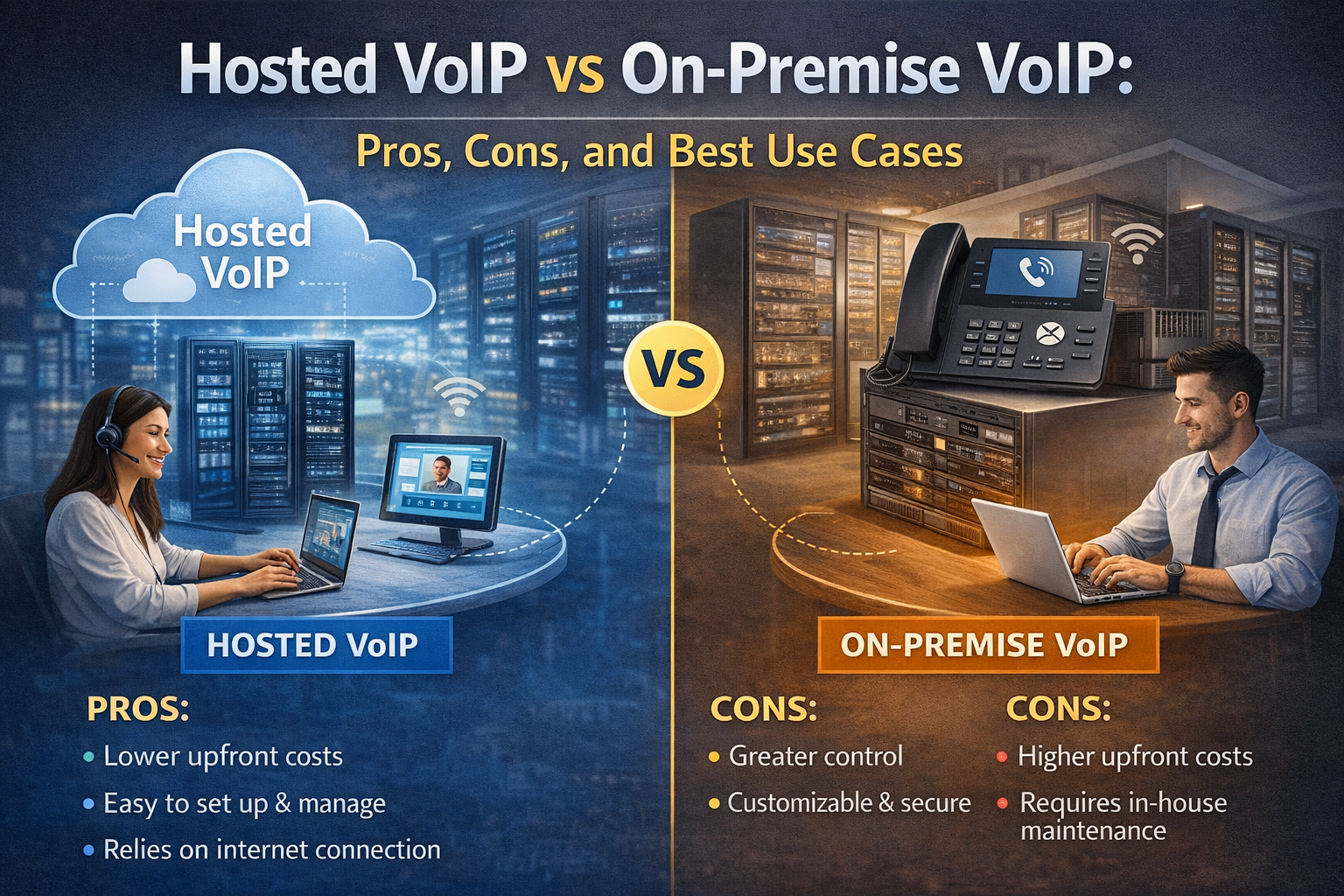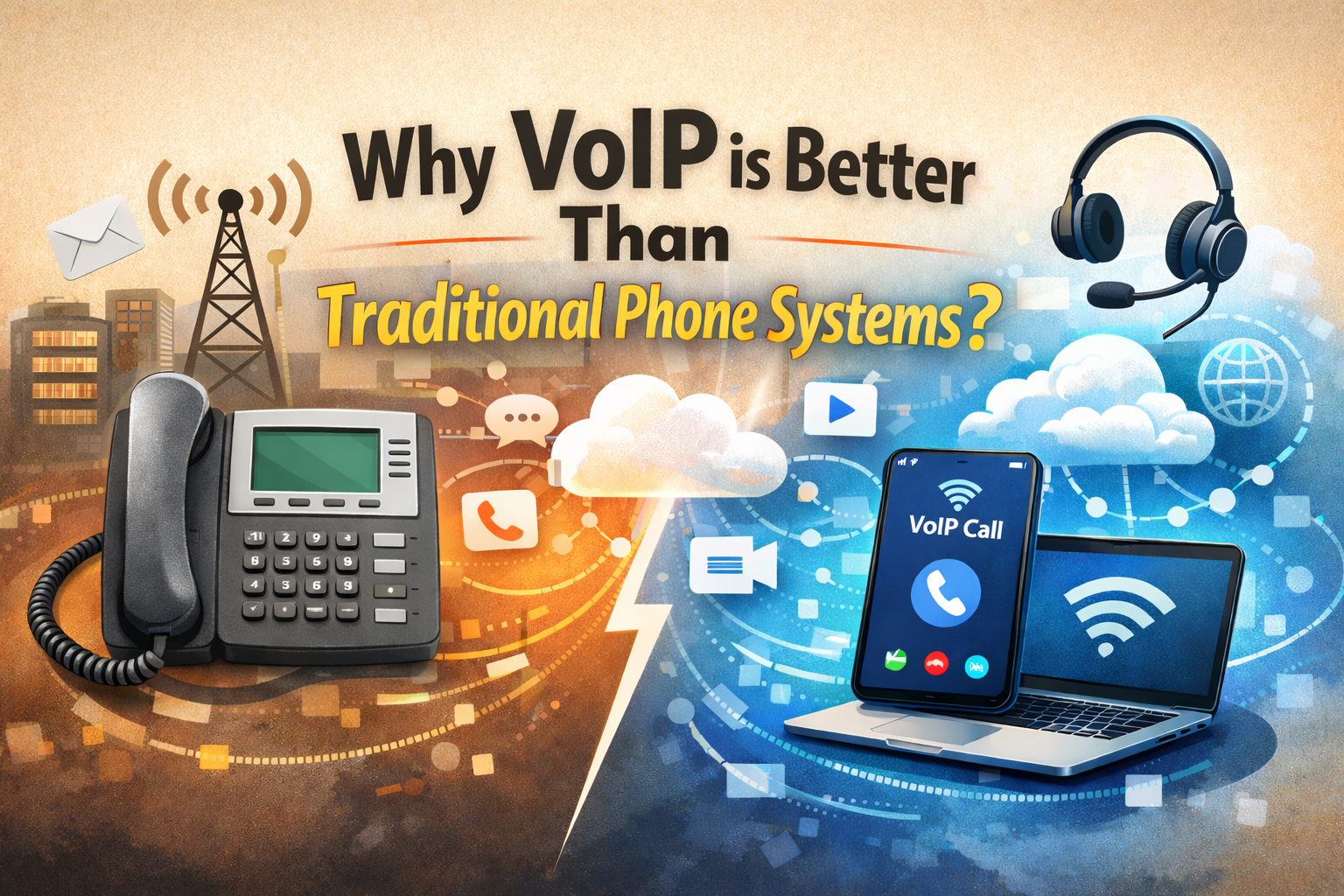
Organizations are considering the option of remaining with the conventional landline systems or switching to cloud-based voice over Internet Protocol (VoIP) systems. It is a very important business choice since the phone systems influence the internal collaboration as well as customer service, cost of operation and scalability in the long run.
VoIP has been gaining popularity due to its advanced features, cost-saving, and flexibility especially in remote or hybrid teams. The traditional landlines on the other hand are praised due to their reliability and simplicity which may still be necessary to the organization in some industries or localities.
To help you decide which business phone system will best fit your current operations, this blog gives a side-by-side comparison of VoIP and landline systems, comparing the costs, features, and reliability of each system.
What is VoIP?
Voice over Internet Protocol (VoIP) is a technology that transmits voice calls over the internet rather than over copper wire. The calls are turned into digital packets and pass through the IP networks and can be communicated using the desk phones, mobiles, or the computers.
VoIP is flexible and is very popular among expanding organizations as well as distributed teams. In reality, as the Federal Communications Commission (FCC) indicates, as of June 2025, there were 65 million interconnected VoIP subscriptions.
In addition to voice, most VoIP offerings have collaboration options such as video conferencing, instant messaging and productivity integration. VoIP can be a communication hub than a system especially to businesses that have a high dependency on data and customer interaction.
How Does VoIP Work?
The switch/ router on your Local Area Network (LAN) is linked to your phone. Once you make a call and entered a phone number, your IP phone instructs your VoIP service provider to make a call to the other party. VoIP provider defines the call and transmits data packets between you and your IP phone.
Pros and cons of VoIP
Pros
- Sensible and subscription packages.
- Video, integrations, and AI transcription are some of the advanced features.
- Very scalable and requires very minimal effort to install.
- Allows work-from-anywhere and hybrid working.
Cons
- Reliant on the internet connection and reliability.
- Needs good practices on cybersecurity.
- High-level features might require training.
VoIP and traditional telephony differences.
There are numerous differences between VoIP and traditional phone systems. Part of these distinctions are:
1. Call routing
The biggest difference between VoIP phone service and a traditional phone service is the mode of making and receiving calls.
VoIP calls are directed through an internet connection and regular phone calls through physical wires. Consequently, VoIP uses a lot less equipment as compared to a regular phone service.
In the traditional phone systems, the hardware needs to be installed on the premise of the location of the customers.
2. Features
The traditional phone services have the simplest features which include voice calling and voicemail like it is the case with most phone services.
VoIP, however, is compatible with UCaaS which enables you to use other communication products like video calling, screen sharing, and instant messaging in the same platform.
3. Cost
Cost is yet another big difference between VoIP and traditional telephony. VoIP solution is cheaper than traditional telephony due to two reasons.
- Hardware costs
The primary cause of the higher cost of the traditional phone service as compared to the VoIP solution is due to the hardware that a traditional phone service needs.
A conventional phone service involves installing of wires to make and receive calls besides hardware expenses like landline phones.
VoIP on the other hand makes and receives calls just in need of internet connection, thus you do not have to install or pay to use the expensive wires at your end.
Secondly, VoIP does not use a physical line and therefore it is not mandatory to purchase the extra phone.
Due to the internet calls, any device can be adopted to make the call like a computer or cell phone, which does not mean that a person has to spend extra money on buying phone.
- Maintenance costs
A VoIP solution also has a wide difference in maintenance expenses. VoIP has minimal hardware, therefore, there is practically no cost of maintaining your phone service.
Instead, the traditional phone systems may need maintenance in case of the hardware issues that lead to higher expenses.
The cost of repairing and replacing hardware is extremely high since traditional phone services are becoming a relic since there is no available part.
Why VoIP is better than traditional phone system?
Voice over Internet Protocol (VoIP) has rapidly emerged as the communication tool of choice in the current modern communication environment. It has definitely exceeded the conventional landline telephones in reliability and convenience.
Although landlines are not new, VoIP possesses certain facts that are actually beneficial and make it a more reliable choice both among individuals and businesses.
Here’s why VoIP stands out:
- Better Call Quality
In contrast to analog signals that may have a problem of static or interference. The reason behind it is that VoIP applies digital signals where calls are carried over the internet which are quality with clear and high-definition sound.
In addition, the current VoIP systems are able to automatically regulate audio quality so as to keep a connection steady even when your internet bandwidth has a tendency to vary.
- Weather and Physical damage Resistant.
The old phone lines use copper wires that result in damage during storms, floods, or other weather effects. This can mean outages. VoIP however, relies on the internet to send calls hence as long as your internet connection is reliable, your phone service will remain running and functional, regardless of the weather conditions. VoIP also does not get so much influenced by extreme hot and cold weather as well as damage of infrastructure.
- Granted Flexibility and Mobility.
VoIP can be used anywhere you have access to the internet unlike landlines which are limited in their use as they require to be connected to a given place. No matter where you are (be it at home, on the road or mobile), VoIP will allow you to make and accept calls using your smartphone, PC or tablet. This is because of the flexibility, and wherever you happen to be, you will never have to fear missing a call again.
- Back-up and Redundancy.
VoIP has superior backup features in comparison to conventional telephone lines. In case your main internet connection goes dead, VoIP can be configured in order to divert calls to a second internet connection or even a mobile phone. This redundancy provides limited downtimes and communication is maintained even in the case of unanticipated disruption.
- Reduced Costs.
VoIP costs less than traditional phone service, by a significant amount: up to 30-50 percent, some have estimated. The lower cost per month is attributed to one of the reasons as the VoIP bypasses the traditional PSTN and relies on fiber optic cable connections which are already in place. Besides, the businesses are charged per user, and they do not have to pay the seats that are not utilized this particular month.
- Improved Call Quality.
VoIP technologies make use of capabilities of the internet to send the voice signals, therefore in case of sufficient internet connections the sound quality is significantly higher than in the case of the traditional phone lines. VoIP is an innovation that was not existing in 1800s but it enables the enhancement of the quality of calls as compared to the traditional telecom.
- Easier Accessibility to Higher Use.
VoIP phones as well as traditional phones provide many features like caller ID, voicemail, or call forwarding, but the difference is that there are some other additional features that provide features like video calling, zoom, email among others. Since VoIP phones are digital and linked to a VoIP server, any additional functions and features are as easy as updating the server.
- Unified Communication Service.
VoIP solution represents a solution that provides unified communication that combines voice, messaging and video into one channel to simplify running of the business. Therefore, there is no need to make the agents alternate between the customer query applications.
Final Thoughts
To sum up, VoIP solutions have numerous benefits which make them better than traditional phone services in the modern globalized world. With cost efficiency and flexibility, up to the more advanced features and improved security, VoIP has transformed the telecom field and made businesses communicate better, collaborate more smoothly and become more efficient in their operations. VoIP has kept up with the current pace of technological advancement and is leading the pack in bringing new innovative features into the market and exceptional value to both businesses and individuals. The adoption of VoIP is not only an option in the context of the contemporary communication, but a future investment in the future connectivity and collaboration.
FAQs
Q1. Will my current phone number be retained in case I change my landline to VoIP?
Yes. VoIP providers like most also allow number porting, that is, you can move your old business number to their service.
Q2. Are telephone lines being eliminated?
Yes. Several telecommunication companies are slowly phasing out PSTN networks in a bid to use digital networks. Current landline investments in businesses tend to have inadequate prospects in the long term.
Q3. Is VoIP a secure business use?
No, when set in the right way. Major vendors are providing encryption and compliance solutions to fulfill the regulations, e.g., HIPAA or GDPR. Companies ought to also adopt effective IT security measures such as firewalls and multi-factor authentication.
Q4. Can remote working work better with internet-based phone systems?
Yes, they can work wherever you want to work since the employees are able to call and receive calls wherever they are, provided they have an internet connection.
Q5. What would happen in the case of an internet failure?
Quickly forward your primary telephone number to any phone number of your preference with instant forwarding capabilities. In making outbound calls, you can simply dial out using our mobile application as though you are using your handset physically and you are shown your DDI or main number with a professional touch.
Q6. Do VoIP phone systems provide a sense of security?
These systems are also susceptible to cyber threats compared to traditional systems though they can be safe. Your communications need to be secured using strong measures.
Q7. What is the cost difference between internet-based and traditional systems?
Internet-based systems tend to be more affordable in terms of installation as well as maintenance especially to companies that make frequent international calls.
Q8. Will I be able to retain my current telephone number on an internet-based system?
Yes, the number porting is provided by the majority of providers, and you can keep your previous phone number and transfer to the new system that is not based on a traditional one.Meta Title: