The use of phones has also taken an entirely different turn with the advancement of VoIP (Voice over Internet Protocol) technology. VoIP phone systems are also becoming popular as they are inexpensive, versatile and scalable. Nevertheless, most of companies remain reluctant to switch to VoIP believing that the traditional phone systems are all right as they are.
This is true – but it is also true that a landline is also working perfectly, and you actually do not have to have a cell phone. In this blog, we will discuss how a VoIP phone system can make you more productive and reduce distractions in your business.
What is a VoIP Phone System?
VoIP phone system is a system through which voice and data are carried using the internet. Some people call it an analog-to-digital converter because it takes analog audio signals (like the ones that are sent over copper wire in a conventional phone) and converts them into digital packets that are transmitted over the Internet. The VoIP phones will use the same network as the computer as opposed to the traditional phone systems where a special phone line was required.
As such, it is simple to extend to new phone lines, scale up or down when necessary, move from “in office” to “home office” and use features such as video conferencing and instant messaging.
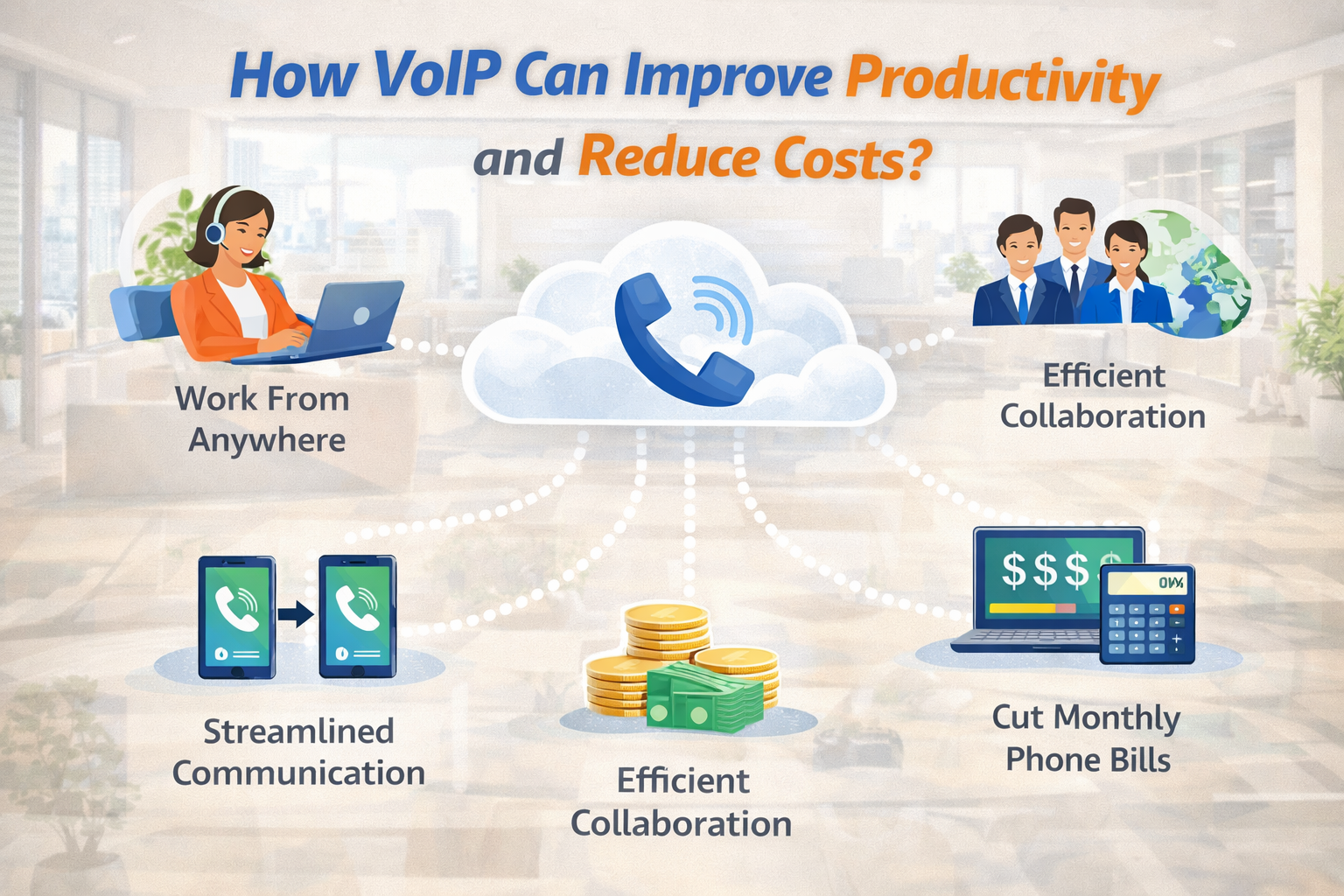
How does VoIP improve Productivity and Cost?
The development of the telephone was responsible for a phenomenal expansion of our communicative capabilities. Communications that would previously have taken days or weeks could come in the blink of an eye. For many decades after that breakthrough, the telephone seemed to have reached its highest level of potential to enhance human communication at a distance. The following are some ways in which VoIP reduces Productivity and costs:
- Remote working
With VoIP phone systems, you can work from anywhere. This is the number one reason that most people contact us for assistance with switching to VoIP. With a VoIP phone, you can call and receive calls by any location with an internet connection. This implies that employees are able to work at home, on the move or in a different country without experiencing interruption to their work. It may be a soft phone, a hard phone, or both, depending on how you prefer to work.
When you know that you will be occupying the same seat frequently (whether at home or your office desk) and you feel comfortable with the old-fashioned phone on the desk, then do it. This is called a “hard phone.” VoIP hard phones often look and feel very much like traditional landline desk phones, but typically have a color display where you can navigate through the various features that VoIP phones can provide.
However, if you are in a hybrid format or often work on the road or in other places, a “soft phone” may be more ideal for you. Soft phones are basically software that connects your computer, phone or tablet to the company’s phone system and lets you use the machine as a phone. This enables your chosen device to ring when you are called on your work number or extension and not on your personal number.
In case you like both concepts, a VoIP pro can even set it so that you can ring your hard phone at your desk first (unless you are at your hard phone) with your VoIP phone system and then forward to your soft phone, or you can forward to all devices at once and can answer the call at your convenience.
- Integration with other business tools
Wouldn’t it be nice to be able to simply click on that phone number on Salesforce or at the bottom of that e-mail and dial?With VoIP systems, you can.
VoIP phone system may be integrated with other business applications such as email, calendar, and even CRM (such as Salesforce, Microsoft Dynamics, HubSpot, etc.). This allows you to call, receive calls, and listen to your voicemail, and send messages without having to quit the application you are working with.
- Call routing
Imagine a prospective customer has taken the afternoon off to make some inquiry calls to a list of providers he has drawn up. He calls your business but he receives a busy signal. He takes your business name off of his list and goes to the next provider – who does pick up.
This nightmare scene happens every single time on conventional landlines. With VoIP, however, you have the ability to easily decide how you want to route incoming calls. VoIP phone systems provide the ability to route calls intelligently, meaning the call can be sent to the right person based on their physical location, availability, and if they are on call, their expertise. When the front desk is occupied and unable to accept the call, then the customers can be automatically connected to another person who can answer the call. VoIP helps customers avoid waiting on the phone and employees focus on what they are supposed to do. With VoIP, customers do not have to wait on hold and employees can concentrate on their main tasks.
- Voicemail transcription
The voicemails can be transcribed into text in a VoIP phone system, thus saving the employees the time of listening to long voicemails. Rather, a VoIP system can send email transcription of a message as soon as it is captured in the voicemail. The employees are then able to read the transcription and do the right thing quickly.
- Multiple ways to connect
Both hard phones and soft phones have a great variety of advanced calling characteristics enshrined in VoIP phone systems. VoIP also provides audio service, but it can also be used as a texting, video, and conferencing technology at the same network. This implies that employees will have an easy time interacting with fellow employees, clients, and service providers through their favorite communication channel without necessarily having to combine multiple programs.
- Companies Reduce Expenses
Through the strength of the internet, VoIP phone service provides the business with a cost effective method of communicating that can save money in a variety of ways. VoIP offers businesses tremendous cost savings as compared to traditional telephone systems with reduced call rates, the elimination of any long-distance charges, and some other advanced features.
- Lower Phone Bills
The best thing about VoIP phone service is that it can also save a significant amount of money on the phone bills. Conventional phone services are also expensive, particularly long distance and international calls. Since the calls are made and received through the internet, the businesses no longer need to pay high long-distance and international call charges.
Also, VoIP providers usually offer more affordable subscription rates than traditional phone services that allow companies to save money on their monthly rate payment.
- Lower Cost of Calls vs. Traditional Systems
Traditional telephone systems can cost businesses a lot in call minutes, long distance fees and other fees for add-on features like call forwarding and voicemail.
The voice and multimedia communication sent over the internet is performed by VoIP rather than by the usual telephone lines. This enables companies to make and receive calls without having to install expensive telephone lines and reduces expenses.
- Reduced Hardware Costs
Another feature of VoIP phones that saves money is the lower hardware expenses. The other cost saving aspect of VoIP phones is the reduced cost of hardware. Conventional phone systems make companies pay a lot of money to acquire hardware such as PBX systems, which they are required to maintain. Under VoIP phone service, hardware is handled by the service provider hence the companies need not worry about buying and maintaining costly hardware.
- Saving on Maintenance Costs
With equipment comes the need to maintain it. Fortunately, VoIP phone service also does not require you to spend on maintenance. Conventional phone systems would mean your business has to assume the role of maintaining and repairing hardware. It is costly and time-consuming and in most cases a business has no other option than to hire full-time IT department or outsource maintenance to a third-party service company. In addition, a traditional phone system may require periodic software upgrades or updates which may increase the cost of maintenance.
When using VoIP phones the service provider does all the maintenance which can save the business money in repairs and replacements. Remote monitoring and maintenance will frequently be offered as part of the VoIP provider and this implies it will be able to troubleshoot and fix any problems with the system as soon as they are detected. This could be used to make sure that the system is at the optimal efficiency and that it never goes down at all.
Furthermore, most VoIP companies update and upgrade software automatically, hence companies need not worry about updating to the newest version of the software. This will save companies time and money since they do not need to allocate resources to software upgrades or updates.
Bottom Line:
As VoIP technology continues to mature and grow into its own, businesses are realizing the inherent benefits that VoIP has to offer for enhancing how they work. While it may sound intimidating to think of switching from a phone system that you are used to, the productivity – not to mention the cost savings – that VoIP offers are worth thinking about.
FAQs
Q1. What are the money savings by VoIP over traditional phone systems?
VoIP saves money because we use the internet when making calls to replace expensive phone lines, cutting down on infrastructure and maintenance costs.
Q2. Will VoIP help enhance employee productivity?
Yes, VoIP offers adaptable communication, new functions, and connectivity between business resources, which allows the employees to react more quickly and cooperate more effectively.
Q3. Can VoIP serve remote teams?
Absolutely. VoIP also allows employees to call and receive calls anytime and this may also make them work and cooperate as a team as they can work anywhere.
Q4. Is any special equipment required with VoIP?
VoIP is compatible with the existing computers, smartphone, or IP phone. Not all businesses will require specialized VoIP phones, others may prefer to use them.
Q5. Is VoIP international?
Yes, VoIP can be used in worldwide communication, usually at a small fraction of the expense of a conventional phone system.