Every business needs effective and reliable business communication to smoothly run its business operations. Today, this means cloud-based communication system for businesses that works through the internet. The scalability and flexibility of cloud-based phone systems make them valuable and attractive for every business, from small businesses to large enterprises that are working as call centers.
But the question arises here, Is this the best choice for your business?
In the following blog, we will take a closer look at the pros, risks and implementation tips of cloud VoIP.
What is Cloud VoIP?
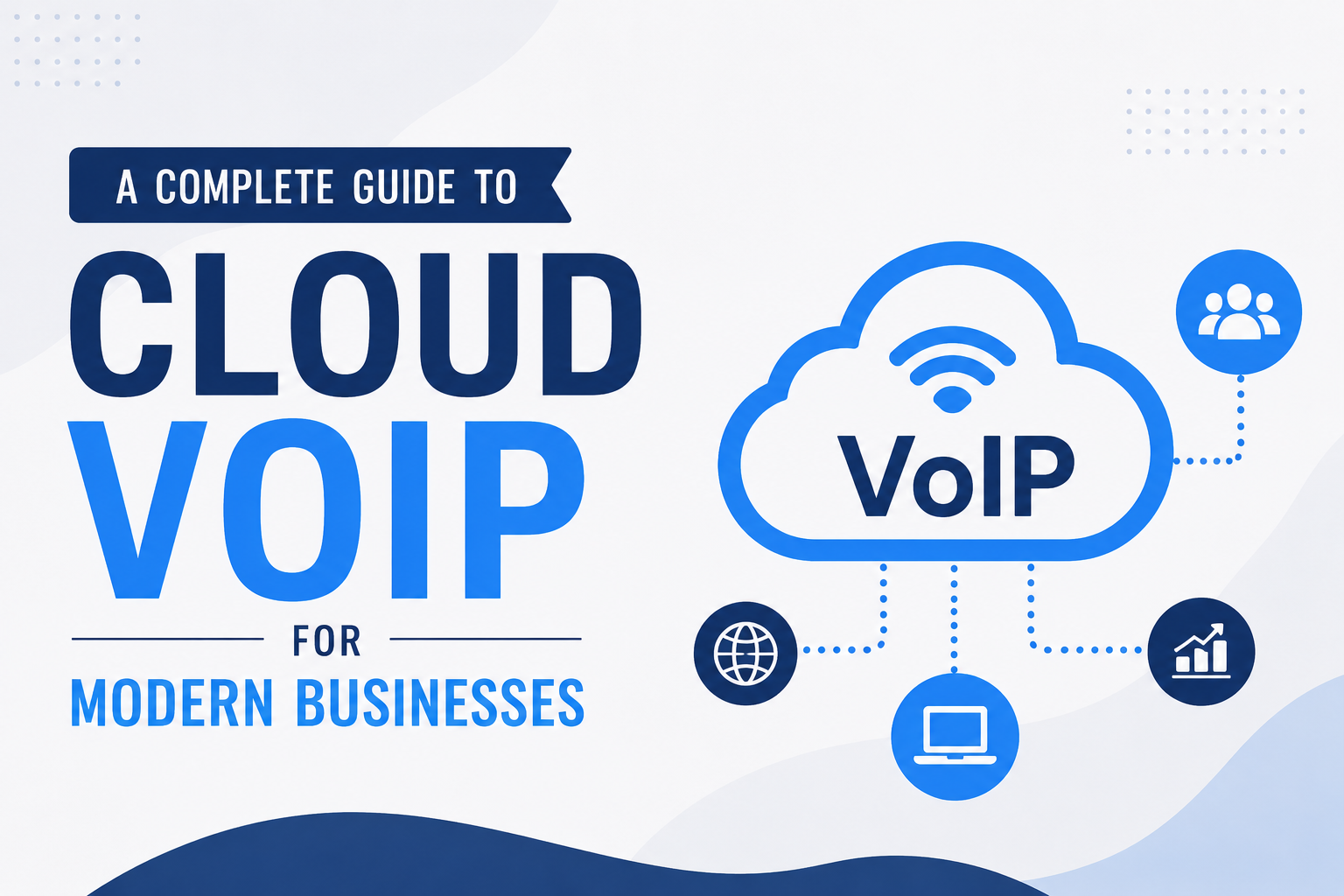
Cloud VoIP is a phone system hosted in the cloud that uses Voice over Internet Protocol (VoIP) technology to make calls.
Unlike traditional landline phones, Cloud VoIP phones don’t need any special software or hardware. You don’t need to rely on coppered wired networks to make phone calls like conventional landline phones. You just need a high-speed and stable internet conection to make and receive phone calls.
Cloud VoIP is making it convenient for businesses to start using cloud-based phone systems and enjoy the advantages of this technology like low monthly costs, more mobility for remote or hybrid businesses, and hardly any maintenance.
Every company requires a good and trustworthy communication medium. In the majority of firms now, this is cloud-based phone system which operates over the internet.
Cloud-based phone systems are appealing to businesses of all sizes, including small businesses operating in the future and larger businesses operating call centers.
The benefits of Cloud-based Phone System.
The use of cloud technology is becoming the default, and this is highly beneficial to enterprises. These systems are revolutionizing the way employees connect, collaborate, and communicate, among other things, including flexibility, remote working benefits, and so on.
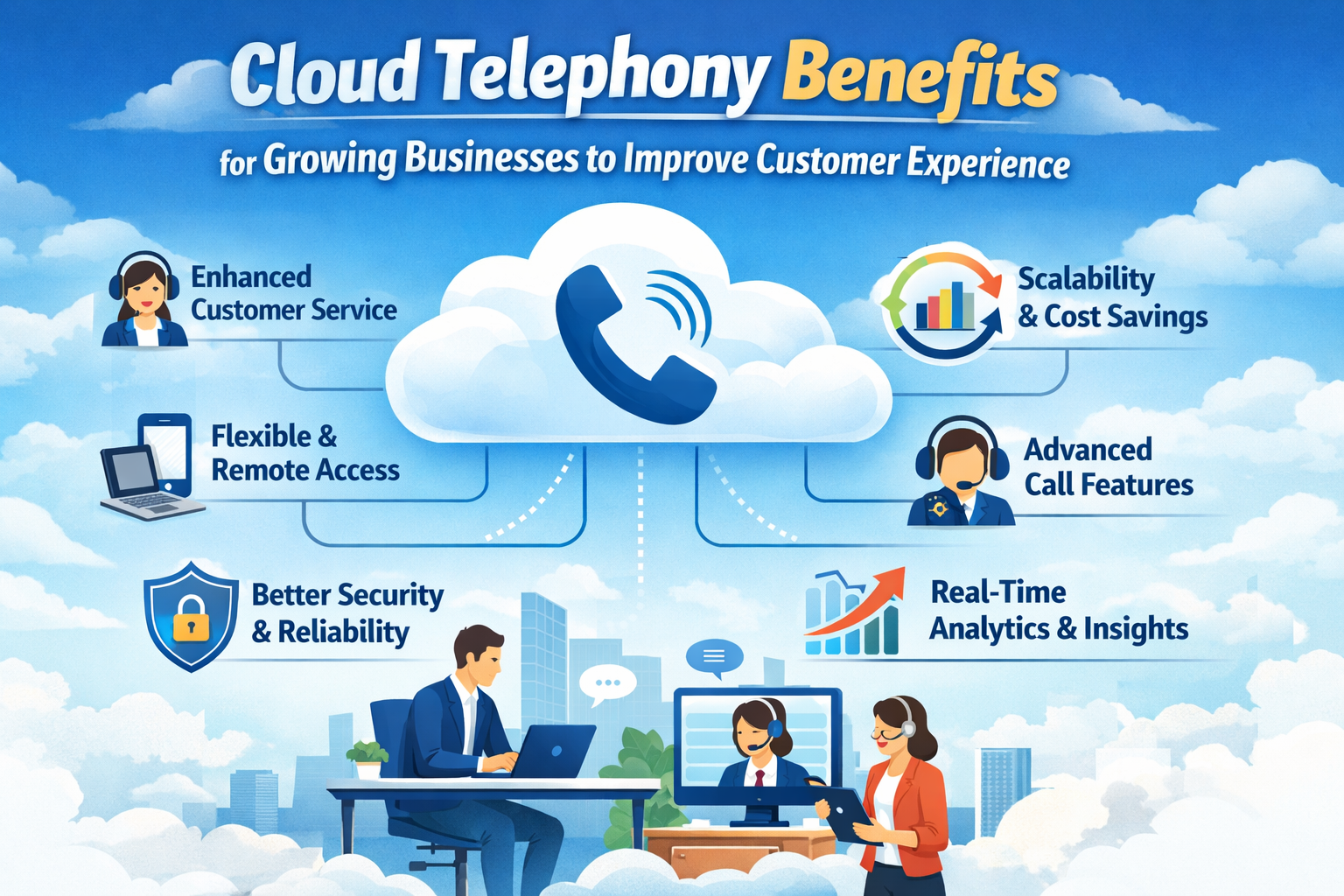
To explore why cloud-based VoIP phone systems are a smart decision in growing businesses, let us have a look at the benefits.
1. Lower costs
Phone systems that are based on a cloud are cheaper than conventional telephone systems.
A typical landline phone system charges the business an average of 50 dollars per line per month when it comes to local or domestic calls. By comparison, VoIP plans begin at under 15 dollars per user per month with unlimited voice calls, video conferencing and many other applications.
One solution to reduce the cost of communication is to use cloud phone systems. You just need a stable internet connection and software that would allow you to utilize VoIP.
This will allow you to reduce old phone-related costs that you would have otherwise incurred, including:
- Installation fee and initial capital expenditure of an on-premise Private Branch Exchange (PBX).
- Maintenance costs that are recurring.
- Features such as auto attendants, voicemail transcription, call queueing etc are add-ons.
- VoIP offers you free local numbers, toll-free numbers and cheap international calls.
2. Improved reliability and performance.
A cloud-based telephone system serves well as a backup to your business continuity plan – in case something goes wrong that is out of the ordinary, such as a natural catastrophe or a cyber attack, shuts down regular business.
A traditional phone system located at a single place would put your business at risk and make it offline. However, a cloud-based phone system is hosted in remote data centres with in-built backup and redundancy strategies. In case of a problem in one of the data centers, it is replaced automatically by others.
This will keep your business running and your customers will not be affected. Their data is safe and easily accessible to your team, and you will not lose connectivity.
Cloud telephone services can therefore provide a secure backup as well as reliable performance to ensure that your business remains online even in unpredictable difficulties.
It is also a more reliable option on daily business. It is less vulnerable to interruptions since there are fewer break points that when failed, would affect the service. This consistency makes it a good bet to continue with business-as-usual operations.
3. Quicker to execute and install.
Your telephone system should not be used to hold back your business.
The process of adding scale with the use of a traditional phone system can be time-consuming and costly. It would require you to add new phone lines and ports to assign each new employee their telephone number which can take weeks. A lot of productivity wasted.
Cloud VoIP phone system enables you to grow your business at any time. It grows as your team needs rise without interrupting all your business communications.
4. Less maintenance
Maintenance is an unneeded overhead that might adversely affect the experience of the employees. And the maintenance work and the cost of it can become very expensive.
In addition, companies do not consider the time and efforts which they put into troubleshooting malfunctions and repairing. This not only affects the morale and productivity of employees, but also slows down business development.
Rather, in the case of a cloud PBX system, all these pain points are professionally managed by your VoIP provider. They handle the phone system completely off-site in the cloud and make sure that it is available on priority.
They also offer strict service-level agreements (SLAs) and 24/7 customer service to help fast-track the problem-solving process. And without interfering with what your team is doing or with the quality of business communication that your customers want.
5. The availability of strong call capabilities.
Cloud based phone system has state of the art VoIP features that improve business communication. The following are some of the common characteristics that business owners consider valuable:
The features that cloud-based phone systems include are obvious, and they can help to balance your business communications. In addition to that, features allow your team to interact with customers more effectively, always raising the quality of customer service.
Cloud VoIP based phone systems enable you to operate a call center, especially when you run such. You can also combine your phone system with third-party applications such as CRM or accounting software to create a centralized database of your team.
6. Better customer experience.
The current customers have outgrown being price sensitive. Actually, they are not afraid to pay a lot of money to get a good customer experience. In addition, they will buy the goods and services of such firms more frequently in the future.
This is attested by recent customer service statistics:
- Forty-two percent of customers would be willing to pay extra to receive a warm and inviting customer service experience.
- A total of 91% of customers will repurchase after an excellent customer service experience.
- Sixty-eight percent of customers indicated that a positive customer experience greatly enhanced their loyalty to the brand.
Cloud telephony provides organizations with greater scalability, flexibility and accessibility to provide a positive customer experience.
7. Supports remote and hybrid work without complication.
Working at the office a few days per week and working at home a few days per week has now become the new normal.
This is a two-fold problem with businesses that continue to utilize old phone systems. To begin with, they must support the infrastructure that is already present at the office. Second, they will be forced to devote time and resources to empowering their remote workforce.
This also involves supplying employees with the proper equipment and all the details of the customers that they require to perform their duties effectively.
This is exactly the type of use that cloud-based phones are ideal. Remote work functionality is provided off the shelf and does not require a complex configuration. VoIP desk phones can be used in the office and you can use a business phone app when not in the office.
Regardless of where he or she works, each of your team members can:
- Use the same phone number and be approachable by customers and colleagues.
- Place and accept phone calls using a VoIP softphone application.
- Take advantage of the more advanced features such as virtual voicemail, call forwarding, and call recording.
- Talk intelligently with much higher quality of calls owing to HD Voice.
8. Unified communications
Cloud phone systems allow you to host all your business/telephone communications in one platform without having to alter the current infrastructure or technology of telecommuting.
This is known as Unified Communications as a Service (UCaaS) and it includes phone calls, video conferencing, instant messaging, conference calls, and file sharing.
UCaaS enhances the productivity and cooperation among the staff on-site and remote workers. Each and every person can access the corresponding communication tools one requires in his daily life.
Cloud phone services improve the speed of onboarding employees and make virtual meetings easier. It breaks down the boundaries and silos that come with the outdated communication systems such as traditional phones which usually do not have any of these new features.
Risks of Cloud VoIP phone system.
On the one hand, cloud-based phone systems have a number of drawbacks, but there is no technology that can be considered perfect. Cloud-based phone systems are not such a common option due to some intrinsic challenges that may be of particular concern to your business.
The following are the possible negatives associated with operating your business phone system all over the internet.
1. Prices can add up
Most cloud-based phone systems today are typically billed per user, monthly. Such expenses may accumulate over time.
You can pay more on add-ons features you are not even planning to use or on metered prices of other features you are very active on. In small business, subscription rates may be high with regard to just using the traditional phone lines that are available.
But the majority of cloud telephone systems nowadays include collaboration features. It gets rid of expensive collaboration software like Zoom, Slack, or individual conference bridges.
On top of that you also save on time, money allocated to support IT, repairing system failures, and maintaining security and compliance to mention but a few.
The monthly price of these cloud-based phone systems can be compensated by all these advantages and thus it is less expensive than traditional phones which seem cheap.
2. You require speedy networking devices.
The phone systems based on the cloud require fast broadband internet connections.
Cloud-based phone systems are operated by Wi-Fi, which is not the type of thing that pushes through walls. Unless your office has performed a wireless site audit, you may get dead spots.
However, this problem has easy solutions and solutions that are affordable. To avoid low voice quality and jitter, you may have to use Quality of Service (QoS) on your network.
For larger offices, it is advisable to implement a mesh Wi-Fi network to ensure optimal speed and coverage.
3. Can not operate without a stable internet connection.
Moving your phone system to the cloud can be a great idea, but one thing can ruin all the advantages of the move: your internet connection!
When there is a failure in your internet connection, your cloud-based phone system may stop working. However, only one system requirement exists with cloud-based phone systems and that is a reliable internet connection.
Internet has become faster and more reliable over the last ten years. Speeds of 100+ Mbps are typical either at home or in the workplace. More than 1,000 VoIP calls can occur on this bandwidth!
4. Emergency calls can not trace location in some areas
Most people will not have a problem with this, but internet-based phone calls to 911 do not always have the correct location data attached.
When calling an emergency call center (also called a PSAP) online, operators are not aware of your location or phone number. By default, the calls are received at the closest PSAP according to the address of the account holder.
To avoid this, change the fixed address of your cloud phone system that is given to every business phone line. This place is referred to as Enhanced 911 and you ought to get acquainted with it. You need to keep it up to date when the workers are at home or not at work.
5. Poor integration with analog devices.
Unless you are fond of old phone equipment such as fax machines, cloud phone systems will not really excite you. This equipment was at its best during the 90s, but this time period is limited nowadays.
It becomes a little harder when you require PSTN connection between your security systems or gates so you may require an analog telephone adaptor or a short form of ATA. On the other hand, these services are also available through cellular connectivity and are very reliable.
Implementation Tips for Cloud VoIP
1. Have a Back-up Broadband Connection.
Businesses are becoming very dependent on their broadband connection, and as such, it is worth installing a backup connection just in case your main connection fails. This will mean that you will not experience any downtime with your VoIP phone system in case of a connection outage.
2. Understand Your Network
VoIP traffic will add a massive load to your broadband network and knowing the terminologies associated with your network will provide you with an edge to prepare your IT to handle the added load.
VoIP traffic must be prioritized over data traffic so that no delays, muffled communication or even dropped calls occur. Site surveys and performance tests would allow you to understand whether you will require additional bandwidth to deploy VoIP. You should also survey your network, post implementation of your VoIP phone system to gauge traffic flow and check switches to identify bottlenecks.
3. Utilize Quality-of-Service Measures and Conduct Systematic Studies on Communication.
Quality-of-service (QoS) implementation is a system that prioritizes data traffic, in such a way that data packets of higher priority arrive at their destination within a predefined time. Voice stream data packets are given a higher priority and not guaranteed quality of service, so calls may sound like they have been turned down, become jittery, or they may be dropped.
The quality of the calls will be poor thus causing dissatisfaction among your customers and employees. QoS can offer stable network service delivery in that it supports dedicated bandwidth, enhances the packet loss property, reduce network congestion, and it may also shape network traffic and priorities throughout the network.
4. Secure Your Network
You must know possible security threats to telecom business systems deployed on VoIP technology because most IP-based attacks are external to the company. The installation of a security network will ensure that hackers do not access. Though there are cloud VoIP systems that apply firewalls in blocking external attack, majority of firewalls can only work between data encryption, switching and transportation among hosts. A VoIP system, however, is based on seven layers, one of them being applications, the level that is customer facing and where the majority of QoS services reside. Instead, implement a Session Board Controller (SBC) in order to protect every level of your enterprise on various platforms. Another advantage is that real-time security alerts need not be received by employees who are physically present in the location where the SBC is located.
5. Select the best SIP Solutions Partner.
VoIP phone systems terminate the IP call to the PSTN by a Session Initiation Protocol (SIP) trunk, permitting the optimum, most economical voice traffic. Any number of options exist, such as least-cost routing providers that might have competitive SIP trunk pricing. However, think about your voice traffic requirements before contracting since the call quality can suffer due to LCR practices as the various carriers will be chosen to carry out calls.
VoIP phone systems are a low-cost and easy-to-use business solution to your voice traffic, but they come with certain considerations to their implementation. VoIP is an effective business solution at the enterprise level, and creating a VoIP implementation plan that provides optimum utilization of your network without jeopardizing its security can be a legitimate value add to your business.
Final Words:
Cloud VoIP is an innovative technology that has numerous advantages over the old premise models. Cloud-based VoIP is an effective communication tool that can provide businesses with flexibility, cost-effectiveness, and additional features to improve communication and collaboration. This technology is the most appropriate solution to businesses that need to streamline their communications today because it offers a scalable and reliable alternative to the older systems they use by taking the place of the old phone lines with the internet.
FAQs
Q1. What is the reason to switch to cloud-based phone system?
A move to cloud-based phone system will be more scalable, cost-effective, more mobile, and be easier to integrate with other business tools.
Q2. How to configure a cloud phone system?
Install a cloud phone system by buying a subscription with your provider, downloading the software, buying a phone number, and entering the app.
Q3. How much can you save using a cloud phone system?
It is estimated that teams can save about 10 dollars a month per user by replacing a landline phone system with a cloud based VoIP system.
Q4. What is the difference between Cloud VoIP and Hosted VoIP?
Hosted VoIP and Cloud VoIP are closely related terms and are used interchangeably, although there can be slight differences. Cloud VoIP generally means that the provider owns and operates the VoIP infrastructure completely over the internet, and is usually more flexible and scalable. Hosted VoIP may include dedicated servers that are managed by a provider but may still be located in particular data centers.
Q5. How secure is Cloud VoIP?
Cloud VoIP may be extremely safe when the service provider undertakes effective security protocols that include voice data encryption, secure data centers, periodic security audits, and industry standards. The business can also implement security measures, such as using strong passwords and educating staff on potential risks, like phishing.