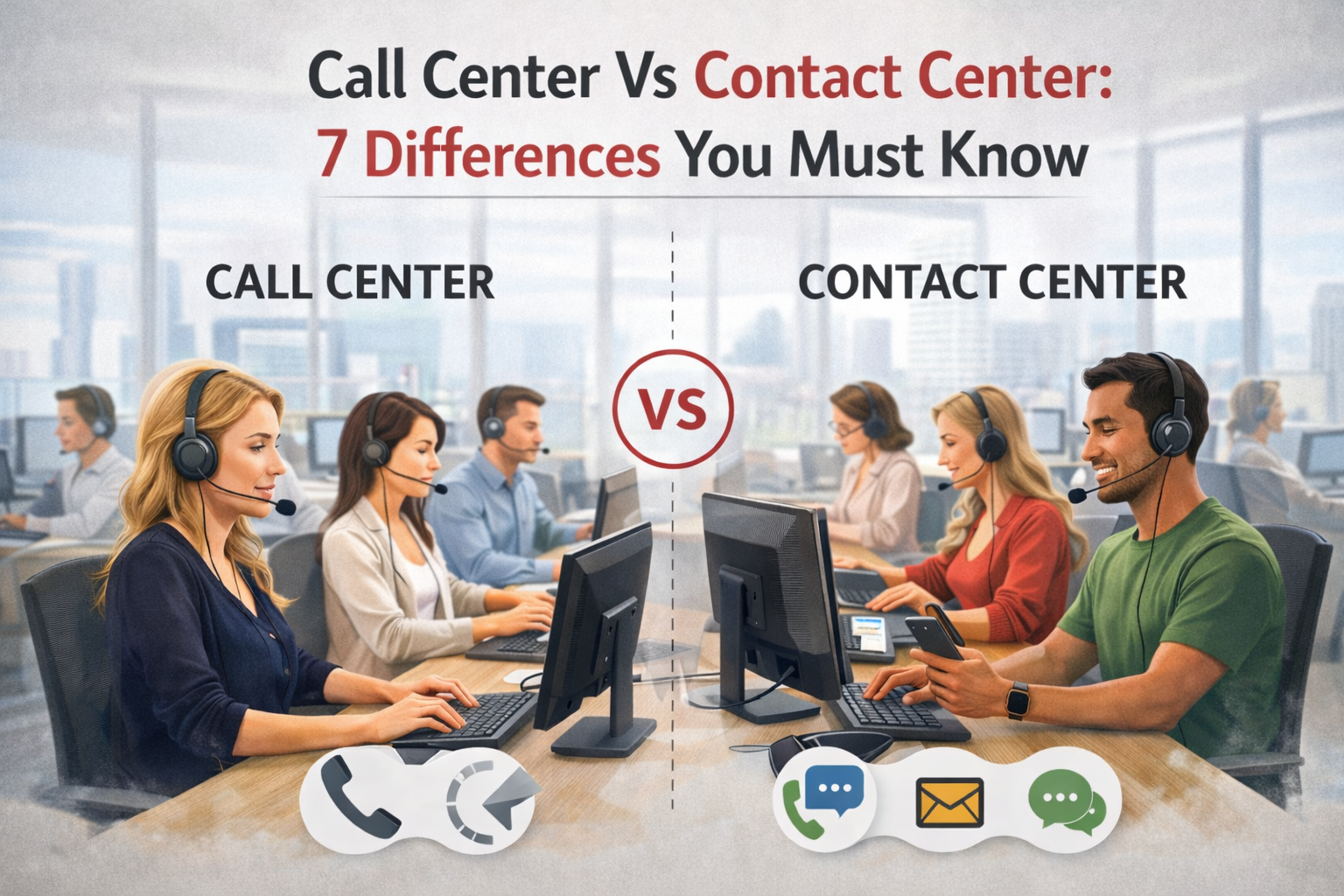
Companies tend to interchange the terms which are call center and contact center with reference to customer service. The two are however marked by some differences.
A Call Center usually deals with the large numbers of calls that come in and out and the main communication method used by the agents is through telephones or virtual phone systems.
Conversely, contact center uses a broader scope of communication tools including email, chat, social media, SMS, and video, to deal with customers.
This blog will discuss seven major differences between a call center and a contact center and this will enable you to be aware of which one will best suit your business requirements.
What Is A Call Center?
A call center is a central location that is established to receive and process huge number of incoming and outgoing telephone calls by customers, clients and other interested parties of a given organization.
The agents in call centers are usually trained to deal with many categories of call including customer care enquiries, technical support calls, sales calls among others.
They find application in a very diverse group of organisations, retail businesses, financial institutions, health care providers, government agencies, and many others. They may be in-sourced or may be outsourced to a third-party operator.
The kinds of technologies that are used by call centers to handle calls include automatic call distribution (ACD) systems, IVR Systems, and customer relationship management (CRM) software.
What Is A Contact Center?
A Cloud Contact Center will be established to support the different kinds of interactions with customers on different channels such as phone, email, chat, social media among others.
A contact center resembles that of a call center, except that it includes other channels other than the telephone in offering a holistic customer experience.
It can also be called a customer contact center, a customer interaction center or an omnichannel contact center.
It is usually manned with agent workers who are trained to work with customer enquiries, customer services, and issues, as well as selling products and services.
Other tools that are applied in contact centers include conversational AI, email management systems, chatbots, and social media management tools, besides AI-powered IVR, ACD, and CRM.
Contact Center Vs Call Center: 7 differences.
1. Communication Channels.
The call center software is usually restricted to voice calls as the communication channels, where the agents will interact with the customers calling in with questions, concerns, or complaints.
Contrarily, a contact center involves several channels of communication such as the telephone, email, chat, social media, and other digital communications.
It is developed to manage different interactions of customers, irrespective of the channel through which the customer contacts the company.
Contact center agents can apply various tools and programs or UCaaS (unified communications as a service) to handle customer interaction through a variety of channels.
The contact center software is also more versatile than the call centers, in that the agent can alternate channels to deliver a seamless personalized support to the customer.
2. Scope Of Services.
Unless otherwise, call centers are structured into groups of agents specializing in certain areas, including technical support, billing, or customer retention.
They can also use the call center agents to make Outbound Calls to the customers either through customer survey, upsell or follow-ups of service requests.
Alternatively, contact centers can also deal with customer queries through emails, chat, social media, and other online platforms on top of responding to phone calls.
They are meant to offer a more integrated and smooth customer experience across various touchpoints that enable the customers to engage with the company through the most convenient way.
Contact centers are gaining popularity as a customer is increasingly demanding companies to support them through many different support channels and companies are appreciating the value of being more integrated and personalized in the way they are meeting the needs of their customers.
3. Agent Skills
Although the similarities between the two are present, at the same time, there are significant differences in the skills needed by agents in each form of operation.
The agents in call centers are also trained to be able to service a large number of calls within a short period and be friendly as well as professional.
They are normally charged with the responsibility of solving customer problems, asking questions as well as offering information regarding products or services.
The agents of the call center should possess good communication skills, which include active listening, clear pronunciation, and communication of information.
Contact center agents, in contrast, have to sometimes deal with a variety of channels simultaneously, and can sometimes be expected to switch channels without difficulty.
The agents should possess great skills of solving problems, navigation across various systems and applications at the same time, this is what contact center agents must possess.
4. Pricing
Call center and contact center software may have different prices depending on their various features, capabilities, and the models to which they can be deployed.
Call center software normally centers on voice communications and is being sold according to price depending on number of agents, volume of calls and Concurrent Calls.
VoIP contact center software, in turn, is capable of managing several channels of communication, and is sold at a broader range of features, channels, and customization options. Moreover, other sophisticated workforce management and omnichannel routing should be mentioned among other features of contact centers.
In general, both are also available as virtual, and it includes a subscription fee which is charged monthly, annually or on a pay-as-you-go basis.
5. Staff Training
The staff training programs in these two kind of centers might not be identical.
Inbound and outbound call center are often interested in a call center in terms of taking in and making out calls and the training of personnel working in a call center is often based on the effective communication abilities on the phone i.e., active listening, empathy, articulate speech, etc.
Staff training at a contact center can go further and include not only training in phone communication but also training in writing skills in email and chat communications, social media etiquette and contact center software and other digital skills.
6. Workload
A call center is normally concentrated on the incoming and outgoing telephone conversations.
The call center agents might be tasked with answering the questions of the customers, giving them technical support, taking orders, and addressing complaints.
A call center may receive a lot of calls and the agents should be in a position to attend to high number of calls but at the same time offering quality services and excellent customer care.
On the contrary, the workload of a contact center is more diversified and complex because agents should be capable of working with diverse communication methods: emails and chat, social media, as well as phone calls.
The contact center agents might have to use various communication channels quite often which they should be trained to use effectively.
The number of contacts in a contact center can also be numerous and the agents should be capable of handling a number of contacts within a short duration without compromising the level of service.
7. Data Reporting and analytics.
Phone-based metrics are the only ones that are generally measured in call centers. They evaluate such metrics as average call handling time, average speed of answer, call abandonment rate, and others.
However, to have a holistic picture of the performance of the agents, contact centers should monitor the Performance Metrics of all channels that they are supporting. They have to monitor such measures in each of the channels that they handle like mean response time, first call resolution, customer satisfaction, customer churn rate among others.
This method will enable them to discover areas which require improvement, make good resource allocation and deliver an excellent customer experience through all channels.
What is more suitable for your Business Call Center or Contact Center?
Whether to have a call center or a contact center depends on a certain need of the business and the customers.
The factors that a business should take into consideration include the number of inquiries, complexity of the customer request, requirement in a personalized customer experience, and the resources at their disposal to handle the customer support.
In general, however, contact centers are a good place to be since they are adaptable to customers to call through their choice channels. Contact centers have some advantages, which are:
- Multi-Channel Support: Contact centers are providing support in different channels, which include: phone, email, chat, social media, and others. This implies that customers have the option of selecting their preferred channel to consume their products and also get services that are more helpful to them.
- Better Customer experience: With the assistance of multi-channel, contact centers deliver a differentiated and authentic customer experience. The customers will be able to move between channels without necessarily restating their problem, which may result in more satisfaction and loyalty.
- Greater Efficiency: Contact centers can also use more automation than IVR In Call Centers, including chatbot systems, to address simpler questions, leaving agents to work on more complicated problems. This has the ability to make it more efficient and shorten the wait time of customers.
In Conclusion
Despite these highly differentiated difference between call centers and contact centers, you will still discover that the terms are in most cases used interchangeably. Nonetheless, contact centers are obviously different, more agile, functional, and practical in the current unpredictable and fast business environment. Being aware of these distinctions and being familiar with their implications on a business is crucial to any network engineer or telecom specialist utilizing such services.
FAQs
Q1. What are the categories of the call centers?
A call center is available in a number of different forms such as inbound call centers, outbound call center, blended call centers, virtual call center, offshore call center, onshore call center, in-house call center, and outsourced call center.
Q2. What are the characteristics of the contact center?
Omnichannel support, IVR call routing and queuing, analytics and reporting, CRM integration, quality monitoring and coaching, best IVR software, and predictive dialer are some of the features to look in when selecting contact center software.
Q3. How to set up a contact center?
A contact center will require the establishment of the type of contact center to be started, the place to be started, purchase of hardware and software, agents to be employed, training of the agents, the process and procedures of call management and agent enhancement performance.
Q4. What is the best way to select contact center software?
Business requirements, scalability, user interface, integration feature, security and compliance, pricing, and customer support are some of the considerations to make in selecting the appropriate contact center software.