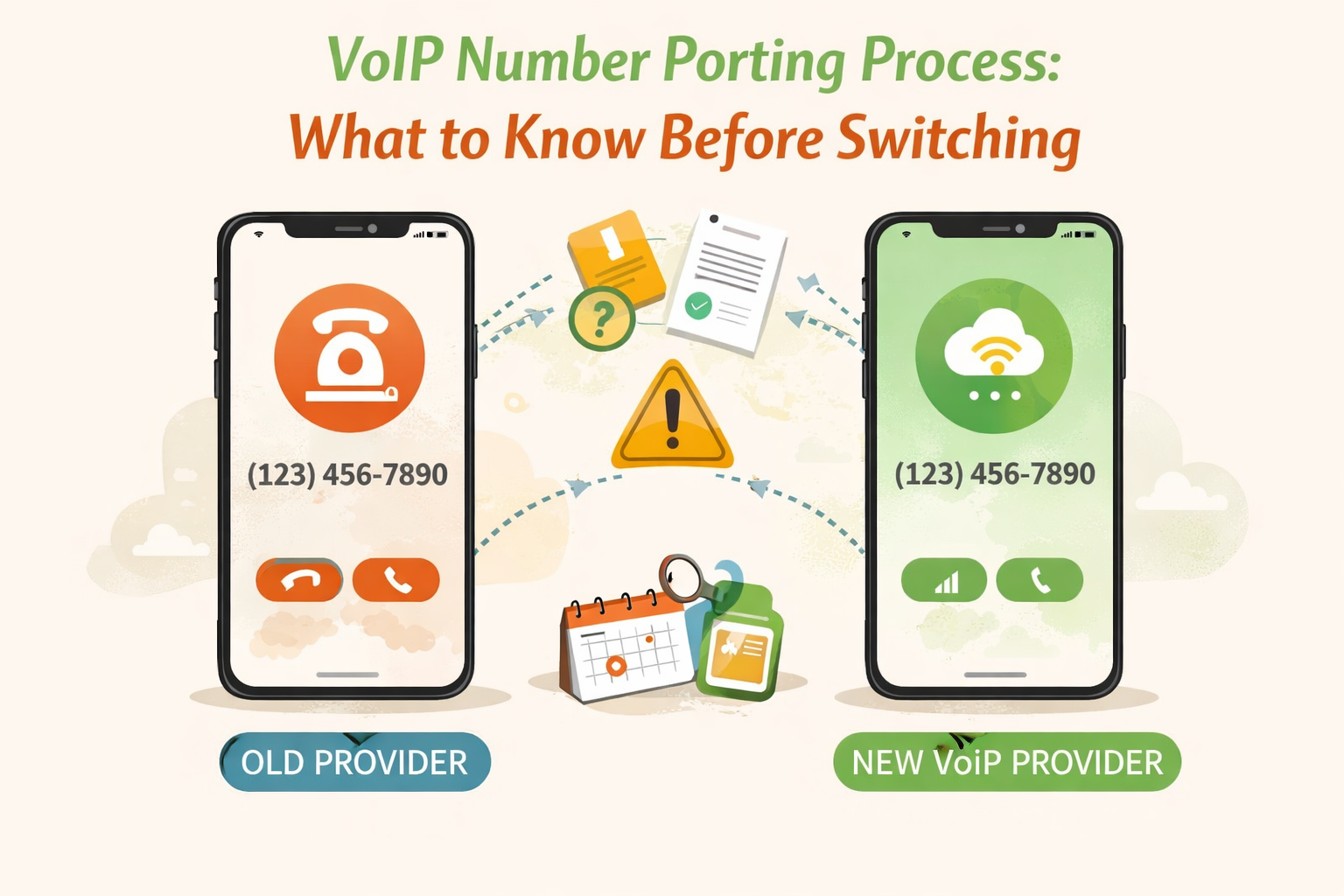
The conventional landline is rapidly being phased out as companies change and the technology improves. VoIP (Voice over Internet Protocol) systems are increasingly being used by businesses seeking to streamline their communications and save money and be able to access new features that landlines can never be able to offer. You are probably making the switch and have some questions about how the process of transferring your current landline number to a VoIP system (also called business number porting) works. The following guide will tell you all you need to know about transferring a landline to VoIP, as well as the steps involved and its advantages.
What is VoIP?
VoIP (Voice over Internet Protocol) is a technology which allows you to make voice calls using a broadband internet connection instead of using a telephone line. With VoIP companies can integrate voice messages with other forms of digital technology like video calls, instant messaging and file sharing. This combines all of the communication to be easy and makes it more productive and collaborative.
Benefits of Migrating from Landline to VoIP
- Cost Savings: VoIP systems tend to charge cheaper rates on international and long-distance telephone call than the normal landlines which means that there is a huge cost saving to the businesses.
- Scalability: VoIP systems are easily scalable up or down to support a small business or a large company without having to install complex hardware.
- Improved Functions: VoIP is overloaded with functions such as call forwarding, voicemail to email, call analytics, call-CRM system integration and much more versatile and insightful.
- Mobility: VoIP allows employees to make and receive calls wherever they are, as long as they have access to the Internet, which allows them to work remotely and improves flexibility.
Why do you need to replace a landline with VoIP?
Companies that have already made a move to abandon landlines and transition to VoIP have benefited by having better call quality, faster conversion rates, increased engagement and a massive reduction in costs. When you switch landline to VoIP, the following are several major advantages that you get:
VoIP is cheaper compared to landlines
With the move to VoIP, you are also getting rid of all those wires and all those hard phones. It implies that changing to VoIP does not require in equipment. All you need is the presence of a working internet connection and your gadget though which you would make and receive phone calls e.g, your phone, laptop, tablet among others. Signing up to VoIP does not require a lot of money, you only require a subscription fee to use the service, as VoIP switching whether on monthly basis or annual basis.
VoIP is more flexible and mobile
VoIP being hosted on the cloud means you can work anywhere in the world. By having an active internet connection, you are in position to use all the VoIP services and this is unlike landline phones where you have to be in your office to make or receive calls. VoIP is a versatile option compared to landlines because it allows flexibility of operations and this fact is one of the major reasons why 60 percent of small businesses have converted to VoIP at the expense of landlines.
VoIP is not just about making calls
VoIP is not merely a follow-up to calling, with calling and a few features as a somewhat necessary addition; but it is a business-wide solution to communication. Immediately you switch and forward calls as well as you collect and deliver text messages, both integrating with the existing tools and reviewing the specifics of a calling activity; you can do a lot more with VoIP than with the landline. It is also another significant cause of reasons why companies desire to migrate landline to VoIP.
VoIP will allow you to expand your business
Voip will allow you to expand your business to as many users or locations as you have ever wanted to pay a nominal fee. It does not require any additional equipments like the case would be with the land lines and it does not cost much. VoIP is simple to scale and is a blessing to small business organizations that require growth.
VoIP has a higher quality of the call
VoIP has high uptime and good sound quality of calls compared to landline telephones. In case the quality of the call itself is poor, the user experience is interrupted and, therefore, leads to inappropriate interactions and a lack of quality service. In order to correct all these shortcomings, VoIP, as to why businesses seek to initiate landline to VoIP replacement, is the improved quality of call.
VoIP is compatible with current tools
VoIP is also compatible with other business tools, to help simplify business. As an example, when a patient calls your healthcare business, you do not have to lose the pages and find their data on your device by hand. Having VoIP built to your EHR/PMS would give you an option of a feature by the name of Call Pop that show you everything about a patient before you click on that call. This is the strength of integration. It assists you to work without context switching.
VoIP is safer compared to landlines
Landline telephones are facing the danger of being intercepted all the time. This is not so with VoIP since VoIP has end-to-end encryption, which guarantees that the content of a phone conversation can not be accessed by any third party. Businesses are moving towards VoIP because of the necessity to have better security and encryption.
Considerations to make during a landline to VoIP switch
Considerations taking that significant step of switching landline to VoIP, the following are some of the points that should be put to mind before you make this important choice:
1. You should have a good internet network
In the process of switching landline to VoIP, it is only that it needs good internet connectivity. Ensure that your internet connection is VoIP worthy. Enhance quality internet providers where necessary.
2. You need an emergency system in the event of an outage.
VoIP uses the internet to work therefore when you switch to VoIP you must make sure that you have a power backup in case there is a breakdown. In the absence of a system, all you data can be lost.
3. You should be able to make emergency calls.
Ask your service provider if it is possible to make emergency calls using your VoIP phone. This feature would be useful for you in case of emergencies.
4. Verify whether you are able to use your landline number
In case you are changing your landline to VoIP and you wish to maintain your landline number to communicate, then you can do it. The landline number will be ported and text enabled. Ask your VoIP provider whether you are able to bring a landline to VoIP.
5. Your VoIP system must be able to bend with your existing tools
Switching to VoIP means that the VoIP provider you subscribe to will be integrated with your existing system of record including your CRM, EMR, ATS or field service software. Through such an assimilation you can:
- Make sure intelligent call routing among new and existing customers
- Monitor and follow up the conversation rates of your incoming calls which can not be done with the landlines
- Install intelligent call trees in the intent of the customer, E.g. you can organise a call tree where the customer can press 1 to receive a text, press 2 to check an appointment, press 3 to change an appointment, etc.
- You need to make and receive calls and send and receive texts on the same number.
6. The same VoIP phone should be able to call and text.
Your VoIP company must assist you in text enabling your landline number in order to be able to send and receive text messages using the same number. The use of different phone numbers to call and text may be confusing to the customers. Moreover, the use of different systems to call and text is not effective and therefore can not be scaled. It is then preferable to have just one number to be used to call and text.
7. Text and call support should be provided in the VoIP system
VoIP systems will require some learning curve on the first use, or you may be facing a problem that requires fixing as soon as possible. In this case, email support is not possible. You should make sure that your VoIP company provides text and voice chat support in real time so that you could work efficiently.
8. Your VoIP must be AI powered.
VoIP systems will require some learning curve on the first use, or you may be facing a problem that requires fixing as soon as possible. In this case, email support is not possible. You should make sure that your VoIP company provides text and voice chat support in real time so that you could work efficiently.
Key Steps To Follow for Migrating from Landline to VoIP Without Disrupting Business
Step 1: Fully analyse VoIP providers and ensure that they are number portable.
The first and only thing to do when moving off landline to VoIP is to carry out thorough research of VoIP providers which suit your use case. Whatever VoIP company you decide to go with, ensure he supports number porting, and also assists you text enable your landline number.
Step 2: Acquire all information needed to port your numbers with your VoIP provider.
Do not discontinue your contract with your existing landline provider until you are subscribing to your preferred VoIP provider. Get all the relevant data on number porting with your VoIP provider like how to do it, typical number porting schedule, details needed, etc.
Step 3: Subscribe with your favourite VoIP provider.
The second approach is to subscribe to your preferred VoIP provider and have it installed. Remember to do all procedures such as transferring the number you are using, and enabling it to be used to send text messages. Ensure the provider you select does not have any hidden charges and has end-to-end support services together with advanced VoIP features.
Step 4: Wait until successful number porting and account activation.
After registering and telling the preferred VoIP provider your needs, now you have to wait until they complete activating your account.
Step 5: Cancel your service with your previous service provider.
After your subscription to the VoIP service is active, you are then able to cancel your landline subscription.
Step 6: Have all your VoIP services with your new provider.
Now every step has been done! Use everything your VoIP company has to offer.
Which VoIP Phone System should be selected?
Selecting the appropriate VoIP phone system is critical towards optimising the advantages of the current communication technology. The following are some of the key considerations in selecting a VoIP provider:
- Features: It is important to review what features are being offered by different VoIP providers and which features might be valuable to your business. Locate business that offer call forwarding, voicemail, conferencing and CRM integration.
- Scalability: This is the VoIP system scalability. Make sure that the provider can assist your business to grow and provides plans that will meet your evolving needs.
- Price: Compare prices of different providers and analyze the cost-effectiveness of each of them. Consider things such as monthly fees, call rates among other charges.
- Reliability: Select a provider that has proven to be reliable and provide customer support. Check out the reviews and testimonials to understand the satisfaction of customers and the quality of service that they provided to the customer.
- Integration: In case CRM integration is a significant aspect of business, make sure that your VoIP service provider can integrate with your current CRM system.
Which VoIP Phone System should be selected?
The transfer of your landline number through VoIP is a good strategy that can play a significant role in facilitating your business communications. The adoption of VoIP technology will also save the business some cost, offer more features and additional flexibilities that lead to good customer interactions as well as better performance. By following the instructions given in this extensive guide, you will be in a position to smoothly go through the procedure of migrating your landline number to VoIP.