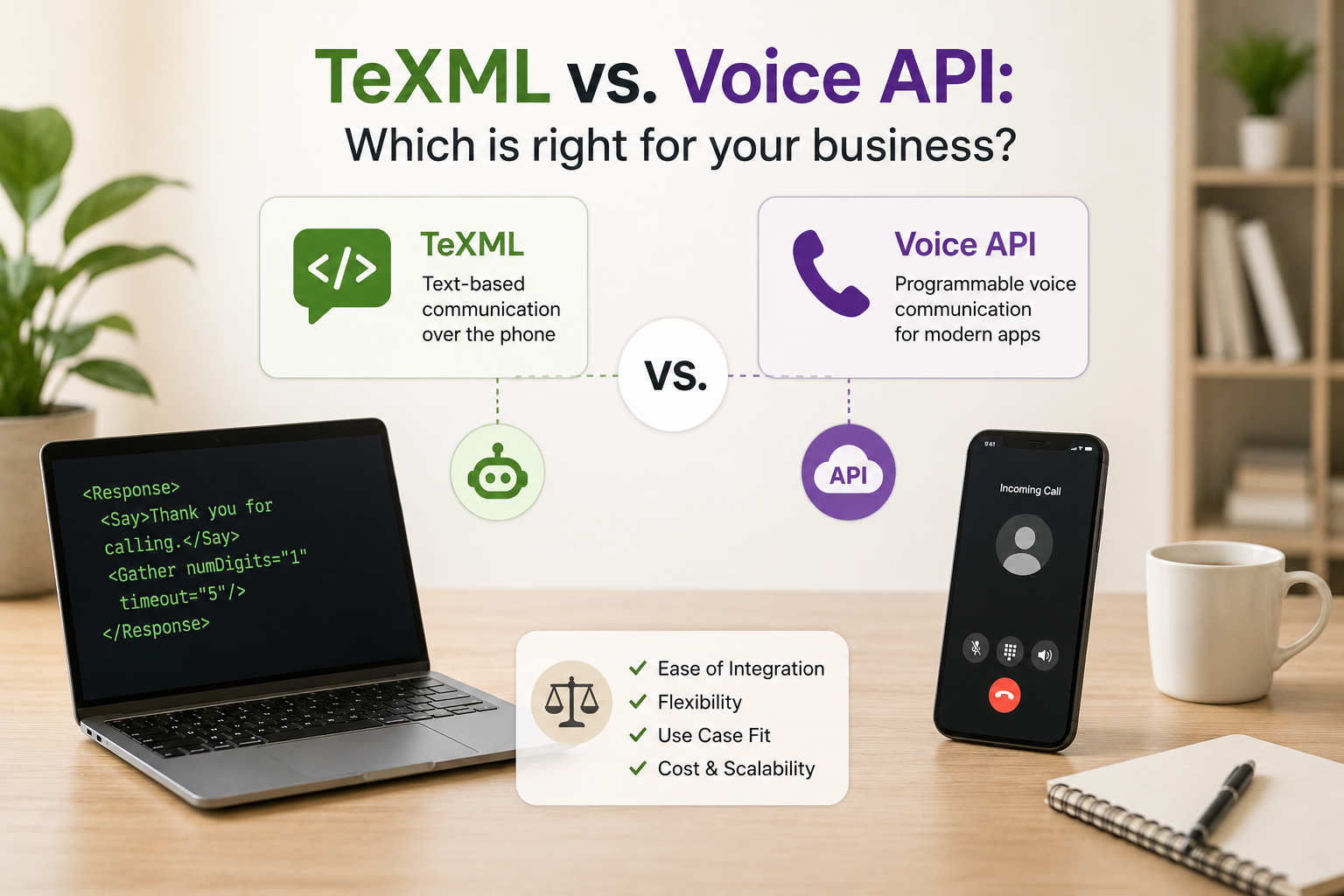
The voice functionality is the first step to building your product and the decision-making regarding voice functionalities depends on the degree to which you require control.
TeXML provides an effortless means of managing foreseeable call flows. Voice API provides all the freedom to create the experience in real time. Although both tools are useful in programmatically controlling calls, they fit various business requirements. The appropriate tool to use will help you save time that would otherwise be spent trying out different tools before getting the right one, and create a final product of better quality.
In this detailed blog, we are going to discuss TeXML vs Voice API.
What is TeXML?
TeXML is an XML-based voice call flow construction language that is simplified. It is ideal for configuring typical voice functions such as forwarding, auditory or notification. You submit your TeXML script to Inum and when a call is received, we run those instructions automatically. It is best applied in scenarios where the calls have a distinct format and need no real-time logic. Consider it as an auto-tune voice type of tool.
Key benefits of TeXML:
- Easy to write: Defining call flows with plain XML is easy.
- Migration-friendly: Replace TwiML at Twilio with minimal modifications.
- Speed to deploy: Discover basic call flows quickly.
Common TeXML use cases
- Basic IVR
- Referral of incoming calls to other teams.
- Playing of recorded messages or prompts.
- Installation of call routing off-hours.
What is Voice API?
Voice API is more versatile and developed. You can dynamically control calls in real-time using REST APIs and webhooks rather than predefined scripts. This allows you the liberty to act on user input, connect to databases, intelligently make calls and cause actions across systems.
Teams that require scaling and customization are better served by it. Voice API is your product in case you are creating something interactive, real-time, or supporting conversational AI flows.
Key benefits of voice API
- Real-time call control: Control behavior during the call based on the context or data.
- Integrations: integrate with AI engines and CRMs and manipulate the call flow in real-time.
- Flexibility by developers: Provides a high level of total customization.
Common voice API use cases
- Dynamical call routing according to the profile of the customer.
- Connection to real-time updates to backend systems.
- Tailored analytics and surveillance processes.
- Artificial intelligence virtual assistants.
- Departmental or regional advanced call orchestration.
- Comparison of TeXML and Voice API.
Which teams are to utilize TeXML or Voice API?
The goals and the resources of not all teams are the same. When you are a small team and need to start a small enterprise, or simply need to make or receive calls in a simple, trusted manner, TeXML can get you there within a short time. It is ideal in operational teams that desire a solution with no in-depth code.
Voice API is your enabler, in case you are developing a product that is voice-focused in experience, involving voice AI agents, automated routing, or CRM connections. It is built with engineering teams, CX platforms and fast-scaling startups in mind that desire total control and customization every step of the call.
An example of a local clinic would require a basic IVR which would allow the caller to make an appointment, listen to office hours or get to the front desk. TeXML is ideal here. One of the largest hospital networks, however, has thousands of calls each day. It must be directed by urgency, cause updates in their EMR, and offer AI-guided service in various languages.
Which one is right for your business?
For simple services or small businesses (such as clinics with a fixed IVR, help desk hotline, and appointment notifications), TeXML may be sufficient.
Applications that are voice-first (AI agents, smart routing, voice workflows that tie into CRM), for the Voice API, are a more solid platform.
If you are not sure, start with TeXML because it is fast, and then switch to Voice API when complexity requires it.
In Conclusion
The decision to go with TeXML or a Voice API depends in the end on how complex your voice conversation requirements are. TeXML is most applicable where the business needs simple, predictable call flows, and preferably those that are rapid to configure and need very few technical skills, so it is ideal when working with small teams or simple applications.
Conversely, when your company focuses on dynamic, real-time interactions, e.g., CRM integrations or analytics or AI-driven workflows, a Voice API gives it flexibility and scale to meet more advanced and evolving needs. To address the speed, cost-effectiveness, and long-term flexibility, depending on TeXML to address simple call flows and move to a Voice API as the requirements expand is the most convenient choice in many organizations.
FAQs
Q1. Is it possible to change TeXML to Voice API in the future?
Yes. There are numerous platforms that support both (such as Telnyx) and thus you can use TeXML to begin with simple applications and switch to Voice API as your needs develop.
Q2. Is TeXML simpler to use?
Yes. XML scripts employed in TeXML have preset tags, and thus are far simpler to implement by teams whose coding background is relatively weak than to full API integrations.
Q3. Does using TeXML reduce my flexibility?
Somewhat. TeXML is optimal with static call flows. When you require live routing, AI assistants, or access to databases/CRM systems, you will run into limitations and require a Voice API.
Q4. Which is more cost-effective?
TeXML tends to be less costly and quicker in deployment on simple call flows only. However, with complicated or dynamic workflows, a Voice API can be economical in the long run due to its flexibility and scalability.
Q5. Can both be used together?
Yes. Other businesses place simple call handling (such as greetings or IVR menus) on TeXML and add a Voice API when required to have advanced and dynamic functionality.