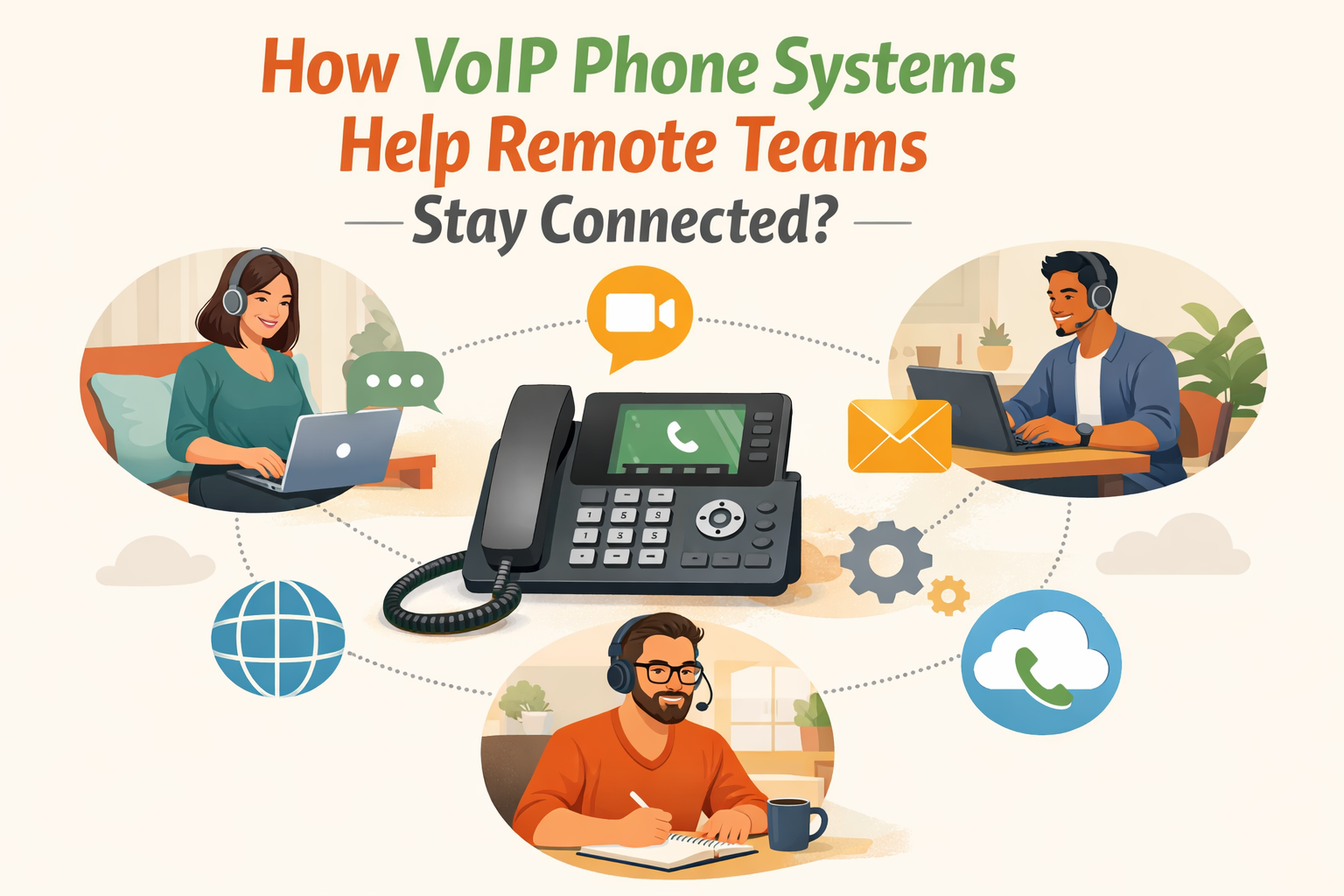
Have you ever hurried back to the office, because you did not want to miss an important client call on your main business number? A conventional telephone also tends to make you physically present at your desk so that you could make or receive important communication, which does not provide you with the flexibility.
Traditional phone systems can also pose a significant challenge to scaling: adding another line or extension requires arranging technicians, working with extensive wiring, and incurs additional expenses. These restrictions restrain small companies, particularly at times when speed and reaction are key to expansion.
VoIP addressing solves these specific areas of issues with legacy phone systems, including offering more flexibility, reduced costs, and scalability. In the following blog, we will discuss why smart businesses are switching to VoIP.
Reasons why Smart Businesses are choosing VoIP
- Simpler Management
Installing a traditional phone system in an office can only be done after a technician from a service company comes to install the equipment and even runs the wiring in a specific way just because of the phone system. Although this is hardly a constant problem, it is definitely an inconvenience when you have to install it initially or perform any major modifications to your phone lines.
VoIP is easy to get started with. All you require are handsets that will share the same wiring and switches with your LAN. Actually, we are discovering that a great number of clients are choosing soft phones and do not even use phone handsets any more. Or, when they use handsets, it is limited to a number of employees. Although the level of vendor support may vary, a minimum of internal knowledge and skills is required to get your business hooked up to hosted VoIP services.
- Add-on Features
VoIP is hosted and can be scaled. There are some newer startups that might only require a few features to start minimally as cost-effectively as possible. Well-established larger enterprises might be seeking to open up as many functions as they can to more integrated communications.
Whether you represent the one end of this spectrum or the other, collaborating with a hosted VoIP supplier who provides the entire range of VoIP add-on capabilities can revolutionize your corporate communications. Some of the popular add-ons worth considering are:
- Data Integration: Voicemail-to-email transcription
- Automated Call Distribution: For contact centers or high call volume needs
- Interactive Voice Recognition: Smarter call routing through intelligence that is embedded in the system.
- Remote Management: online administration for adding phone lines.
- Chat: To communicate internally and externally, which can also be built into your customer relationship management (CRM) tool.
- Teleconferencing, video chat.
- Flexibility and Scalability
It is not always easy to add another line of phone when you are using an analog or PRI phone service vendor. You will have to be on the phone with customer service, make an appointment with an installer or even spend a significant amount of time doing so.
It may be time-consuming, expensive and irritating.
VoIP enables you to add phone lines in just a few minutes, sometimes with just a few button clicks, at a fixed monthly cost. It only takes a web browser and the possibility of making a few clicks, but you should only allow your company to do so. VoIP can be easily scaled and customized to fit any business that has seasonal workflows or a business that is growing rapidly.
- Data Integration
Delivering a favorable customer experience requires you to coordinate your communications in a cross-channel manner. This may necessitate a combination of social media, phones, email, voicemails, chat and any other channels your customers may use to communicate.
Using a VoIP service, which is integrated with your customer relationship management tool, you can gain an understanding of all communications a customer makes with your company. This may include:
- Voice to email transcription.
- Mobility
- Chat
- Social media messages
- Unified Business Communications Potential
You may not be prepared to jump into integrated business communications today–not a bad thing. You have a VoIP vendor that can provide you with a complete set of business tools to jump wherever you want. By placing your phones, add-on services, internet connectivity and data on a single network you can attain:
- Quicker troubleshooting
- Higher employee productivity
- Heightened teamwork.
- Enhanced customer satisfaction as a result of transparency.
- Improved customer service
- Cost Savings
VoIP has a huge potential in terms of cost savings. Some initial investment in handsets, and you can pay a flat rate per month for individual phone lines and add-on services. According to researchers, the average company will save 40 per cent in hosted VoIP compared to analog and companies that require high volumes of international calls may save 90 per cent.
Another thing worth noting is that VoIP can also save your company money elsewhere as well. You will not lose productivity when traditional phone lines go off. You will not suffer data leaks (and resulting data cleanup expenses) due to phone tapping. VoIP simply makes sense in terms of finances.
- Mobility
Although not every provider provides the same add-ons to VoIP service, mobility is one of the most frequent advantages companies gain during switching to hosted VoIP. You can also allow phone calls to be simultaneous to desk and mobile phones (depending on your vendor and settings), allow mobile call transferring, or even have mobile failover in the infrequent event your internet connection goes down.
The productivity and customer service of VoIP mobility are impressive in companies where employees can work anywhere or face travel requirements. The confusion of lost or missed voicemails or having to use a desk line and a mobile number can all be completely removed.
- Customer Service
In simple words, customers adore VoIP. The appropriate interactive voice recognition system can minimize the bouncing around feeling when interacting with different reps, and can make them communicate with the right person on the spot. It will also imply fewer busy indications, call quality, and quicker responses to question inquiries with the appropriate add-on features.
Also, when you have the right vendor of hosted VoIP, you might get an advantage of having much better customer care than when you had an analog phone vendor. You can enjoy 24/7 expert support, the online knowledge base tools, enhanced business continuity and many other advantages.
Bottom Line:
Many businesses can make great progress by switching their landlines to VoIP phone systems. It also makes communication easier and more effective, and enables employees to work at their convenience and offers more advanced features than traditional phone systems. It is associated with fewer risks of service interruptions, incompatibility, and other errors as most of the providers provide comprehensive customer service.
Any business can enjoy the benefit of switching their phone system by selecting a trusted VoIP service provider.
FAQs
Q1. Are VoIP solutions right for my business?
VoIP solutions suit all sizes of business. They are user-friendly, scalable and reliable making them the ideal business choice to maintain contact with employees, clients and partners. All VoIP providers have free trial offers and various payment options, hence there is no excuse not to give it a go.
Q2. Will my existing internet connection be compatible with a VoIP phone system?
Yes, there are systems that are compatible with the existing internet and are provided by most VoIP providers. Provided that you have DSL or another high-speed Internet connection, your telephone calls will be crystal clear. Verify with your internet service provider to ensure that you have a compatible internet connection with VoIP.
Q3. Should I have a landline in case of any emergency e.g. fire or power cut?
Another advantage is that traditional landlines are not connected to the power grid, meaning that even during a power outage, it will still work. But once you turn off the power in your office, you can still make and receive VoIP network-based calls using a mobile device.
Q4. Are there any drawbacks to VoIP phone system?
It would be difficult to come across any actual cons to the use of VoIP systems. Poor internet connection may have been a problem with VoIP phones in the past with businesses that had less internet access. Even so, the majority of modern internet connections are capable of supporting a VoIP business phone system without any problems.
Q5. What are the reasons why VoIP phone system is less expensive than a landline?
VoIP phones are usually less expensive than landlines since they do not need the same infrastructure a traditional phone system would. Moreover, VoIP systems are more featured and functional than traditional landlines in order to receive more money back.