When small and most medium-scale business owners have a good base and have loyal customers, expansion is the dream. Nevertheless, the problem of scaling up may become overwhelming and involves the delicate combination of the growth-related policies and the daily business activities. It is at such a time that effective communication is very critical.
This is facilitated by a good business phone system in businesses as it will join you with your team members and customers without any disruption. It helps you to maintain your focus and react fast using sophisticated capabilities; therefore, you can afford to maintain your growth projects and carry out daily routine tasks.
The blog post will provide you with information, in detail, about how an office phone system can assist your business in improving communication.
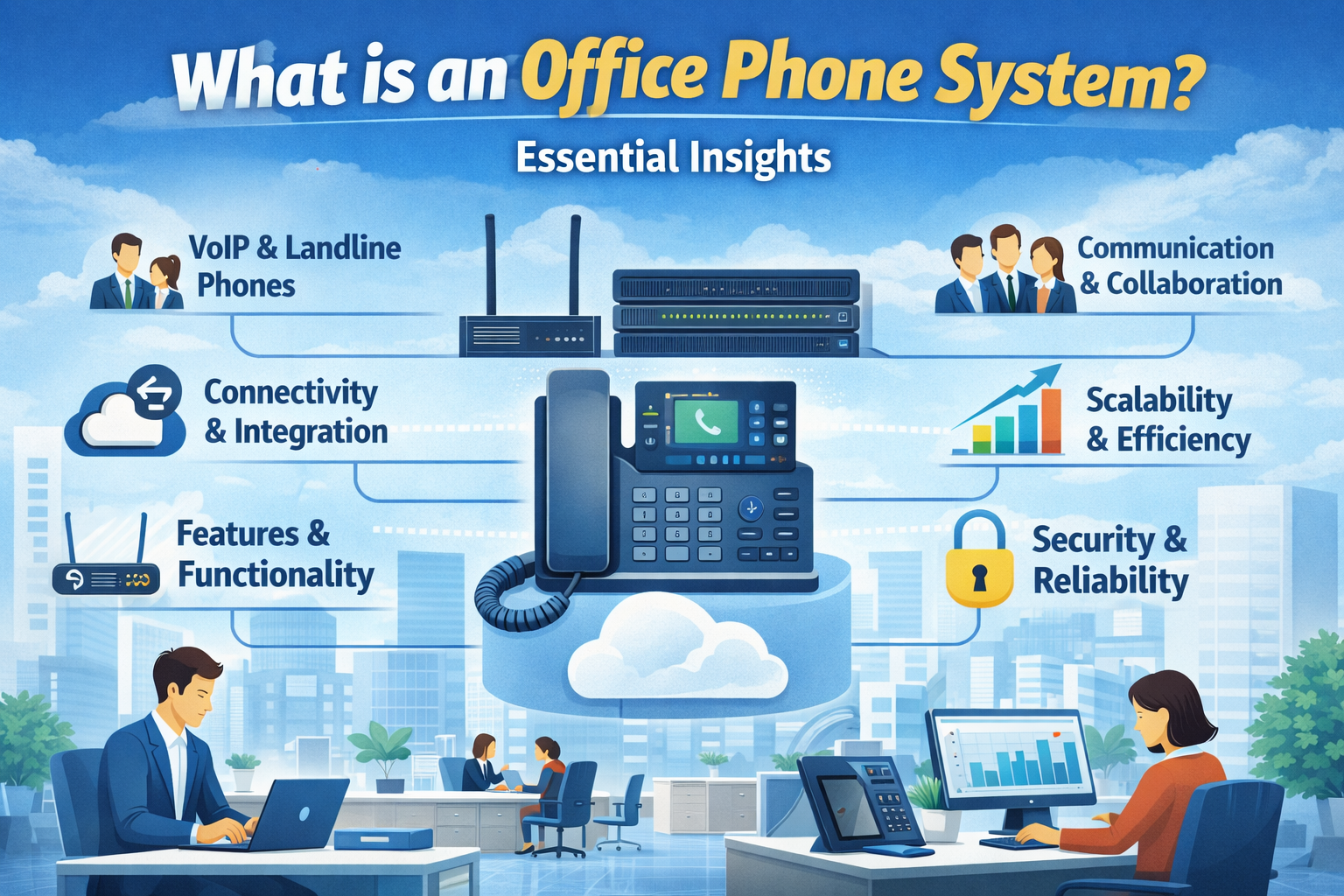
What is an Office Phone System?
A multi-line telephone system as the name implies is a phone system in an office which is used to conduct business. It incorporates Voice over Internet Protocol (VoIP) to get connected over the internet without any use of old telephone networks and weighty utility that are our generally accepted premises – just a regular bundle of equipment along with web-based access will suffice.
It has a number of telephones, which are interconnected to intra-departmental and inter-departmental communication and outside calls. It comes in a variety of sizes contingent upon the size of the business, with two handsets representing a small business, and interconnected corporate telephony systems in large corporations.
How do Office Phone Systems Work?
An office phone system literally involves integrating various technologies in communication so as to effectively handle calls and messages in a cost-efficient way. A breakdown of working is provided here:
- Voice over Internet Protocol (VoIP): An example of this is the utilization of VoIP by modern office telephone systems to route calls via the internet instead of traditional telephone lines. Hence, it is a versatile and low-cost option requiring a conventional device and internet access.
- Integration and Connectivity: It integrates other communication channels such as client relationship management systems (CRM) in a way that it forms a single application of communication and information which can be easily communicated and data handled.
The system supports features like conference calls and mobile connectivity which are long-lasting. Besides, it will give detailed information concerning the calling party and analytics which will be useful in monitoring performance and enhancement of customer service.
In essence, an office phone system enhances communication by deploying advanced technology and various features which can be modified to suit the needs of the organization hence making it to be more efficient in its operations.
Types of Office Phone Systems
Businesses use three categories of office phone systems to satisfy their communication needs.
1. Traditional PBX Systems:
A long time ago these were the phone lines that were utilized to conduct business communication but somehow they are not used anymore due to the high costs associated with the complicated hardware. They were using cloud PBX servers which required constant maintenance and were not expensive for small businesses. Such systems were no longer necessary with the emergence of the Internet.
2. VOIP Systems:
VoIP phone system is better, in that it is the best, since it is the most advanced chosen technology since it utilizes digital technology that enables it to convert and transmit voice signals using the internet. Due to the low installation prices, high voice quality and certain advanced services like IVR service, CRM integration and call handling, most of the businesses are currently adopting VoIP systems in place of the traditional telephone lines.
3. Office Phone Systems:
The service providers handle the office phone systems that assist in minimizing in the initial investment in addition to eliminating the physical hardware. The reason why most Small and Medium Enterprises like such systems is that they are user-friendly and the features more complex with the aid of web interfaces, whereas the payment options are often on a monthly basis.
The Key Features of Office Telephony:
There are numerous features that are offered by the current virtual office phone systems and some of them are as follows:
- Call Management: The call handling facilities of a phone are business-friendly in that it properly handles inbound and outbound calls. Agents and clients exchange information with ease, owing to certain essential features such as Call Waiting, Call Transfer and Call Hold.
- Voice mail Signing up: Under the voice mail system, one can leave their voice messages when the business is offline. These messages can then be used to get in touch with the recipients of the calls in a way that the authorized personnel can use. As an illustration, in case a call is made, and a call is not received, the call forwarding option directs the call directly to either the particular telephone devices or other prescribed telephone numbers to ensure that the call is not lost in the middle.
- Conference Calling: This feature allows different callers to communicate to each other, which fosters the spirit of teamwork and co-operation even with the constraints of space. This solution is crucial to organizations because remote workers can work together on project updates and make decisions together remotely without necessarily meeting in person.
- Automated Attendants: The automated attendants are much better than human receptionists but not limited to the ability to answer phone calls. There are also features like call routing and menu option plus the automated Interactive Voice Response System popularly known as the auto attendants that can also handle professional greetings that are very crucial in any business that must handle calls over the world.
What is the Reason Your Business Should Take into Account a Office Phone System?
The advantages of using office phone system to your business range. The following are the advantages of office phone system:
- Better Customer Service: The management and routing of calls is done in a way that significantly boosts quick response to customer inquiries.
- Improved Teamwork: Workforce is improved because of integrated communication channels.
- Greater Productivity: This simplifies the workflows with the help of features that have been enhanced like analytics making calls and connecting to business equipment.
- Flexibility: Workers are connected regardless of their location due to remote access and the use of mobile applications.
- Cost Savings: With VoIP, the general cost of hardware and maintenance reduces.
In Conclusion
When it comes to business competition, it is not only the communication device but the important component of your entire strategy to win in the business competition. To address the current needs of companies, introduction of office phone systems has proved to be a strong solution since it is flexible, can be expanded and more functionalities are associated with it.
Having a clear understanding on different phone systems, their features, and the benefits they bring, therefore, one decides to upgrade communication and customer service and drive growth.
FAQs
Q1. What is the process of obtaining a business phone number?
You can get a business telephone number by registering with a telephony company that provides the business telephone system. They offer a wide variety of options including local, toll free and international numbers.
Q2. Why then do small businesses favor office telephone?
Office phone system possesses the most suitable combination of the features to small scale enterprises such as affordability, ease of extensions and sophisticated features. Hence, they eliminate costly hardware requirements and enable the option to work anywhere.
Q3. What is the best way of selecting the right office phone system?
It should be based on the size of your organization, budgeting limitations and special needs of your organization when it comes to communication. To make an informed decision, you have to evaluate different suppliers in terms of their characteristics, prices and customer reviews.
Q4. What is the functionality of an office phone system?
The mechanism behind a business phone system is that it enables VoIP communication which divides voice audio into small bits of data that transports to its destination through the Internet after which they can be assembled again. VoIP telephony systems ensure that adding a phone number and extensions is simple since there is no need of laying copper wires. VoIP telephony implies scalable, mobile calling at any place where there is access to the Internet.
Q5. What is the procedure of establishing an office phone system?
The majority of business telephone systems do not demand much installation and can be used with your already available hardware (desktops, smartphones, etc.). A powerful Internet connection, a router, a modem, and several other important VoIP equipment will be required. The actual configuration of the system does generally involve the creation of call flow routes, the recording of IVR systems, the assignment of agents to extensions and call groups and so on.