In an era where information security is paramount, choosing the appropriate tool to share data is a significant choice for companies operating in industries such as healthcare, finance, and legal services. Although email is widely used in communication between various businesses, fax machines or safe cloud-faxing services remain the most important tools of communication in many enterprises. Faxing has been rated to be the best communication method across industries because of its high levels of security despite the fact that email is the most popular mode of communication in the digital age.
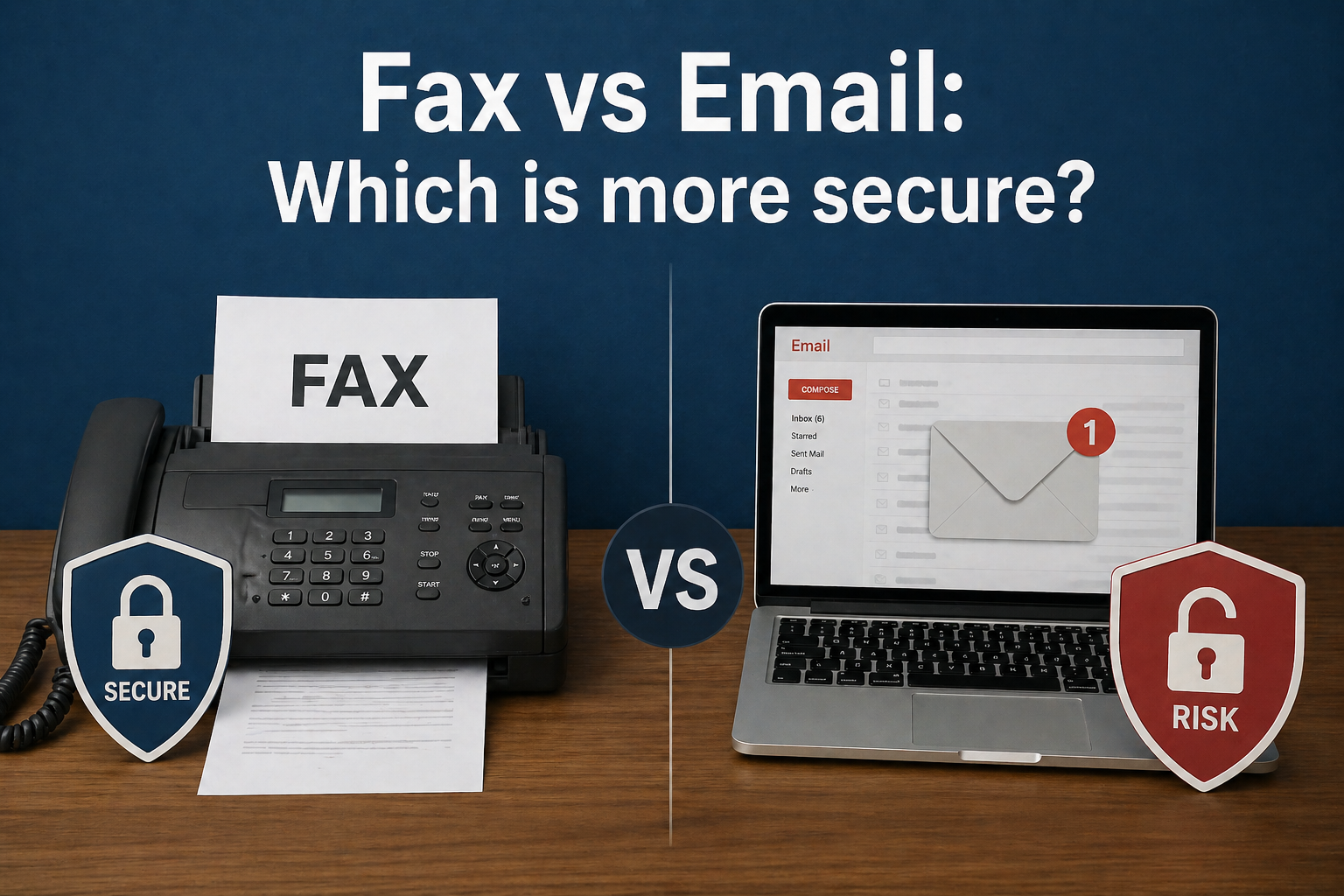
In the following blog, we are going to discuss which is more secure, Fax vs Email.
The importance of Email or Fax.
The email is now the foundation of business communication. And it is the best means that we are used to communicating with one another nowadays.
Email consumes more time than any other application for most individuals. Nevertheless, not everyone is aware that it is not a secure means to transmit and receive information unless you implement certain measures.
Email is not only a personal-use tool but is widely used in organizations and this is what results in complacency. Proprietary information is also vulnerable to email because email attachments can easily contain spyware or other malware that can be injected.
Faxing, more so online faxing, as an alternative, is therefore a safer medium of conveying sensitive information.
Knowing the contrast between email and fax, businesses can make decisions concerning the way their data should be protected, and communication becomes secure.
Is Faxing better than Email Communication?
Due to the massive hacking issues that feature in the news every now and then, most companies have installed robust filters that scan and forward messages to junk mail or spam mail. This is why an email recipient can wait in order to receive a non-appearing attachment.
Attachments are often filtered due to mere omissions. As an example, the attachment is excessively large, incorrectly named and numerous other reasons. When such filters make the false assumption an email is spam, it is a false positive. Although filtering may help in preventing hacking into organizations, it may negatively affect productivity of employees, lead to a late project or even spoil a sale.
Internet faxing gets rid of these problems. Let us have an example where you transmit document by online fax. Then, a spam filter will not detect it, and the recipient will be able to get the document.
You have to send documents by fax rather than by email in that they need to be viewed by someone in haste. You are sure that your communication will reach the target person when you use fax. This is not the case with email where there is no guarantee.
Fax vs. Email.
A few key differences between fax and email can be linked to the technological, security and compliance characteristics. Knowledge of these differences can help you in the process of choosing the best communication channel that will fit your business and apply to your security requirements.
- Advantages and Disadvantages of Email.
The use of emails presents advantages such as instant global communication, easiness, multi-device, affordability and easy storage, which enhances business interactions. They, however, have major weaknesses as well. Emails can be hacked by cyber-attacks like phishing and malware which pose a threat of exposing data. They are capable of flooding users, decreasing output and losing messages. Addiction to internet connectivity also restricts accessibility in places of poor service. Also, due to the informality of emails, there is a chance of a misunderstanding, and they are not legally binding as signed documents or faxes, which is vital in some business and legal settings.
- Advantages and Disadvantages of Fax.
Online faxing takes advantage of internet technology to improve the normal faxing, with a solid security system to guard against cyber-attacks such as phishing and man-in-the-middle. It complies with high regulatory standards such as HIPAA, and it can be used in industries that demand high privacy and security. Online fax (e-fax) is also dependable and offers digital fax transmission receipt, which is recognized under the law and thus guarantees that the integrity of the communications is not compromised even in the absence of the physical records.
Online faxing is also more attractive to modern business because it does not need the physical upkeep of machines and consumables such as paper and toner as is the case in traditional faxing. Nonetheless, it depends on internet connection which might be a drawback in regions with shaky internet connection. Although certain aspects of digital infrastructure are necessary, online faxing remains a viable option in most industries due to its security, legal and compliance.
Is Faxing more secure than email to avoid phishing attacks?
The greatest strength of email is phishing attacks. They are usually sent via email which appears to be sent by an authoritative figure, yet bad actors utilize them to garner any type of data.
At times, hackers are glad to sell your personal and credit card details. On other occasions, though, they also target login credentials or other information to use in more malicious attacks against individual people or a single company by sending phishing emails.
Entering your online accounts and personal information may result into hackers obtaining authorization to alter and tamper with related systems. This may create room to hack important systems by bad actors- point-of-sale terminals or order processing technology. An entire corporate network can be paralyzed by a hack, or even data belongs to it can be stolen. And, even worse, there are hackers who can demand you a ransom to get your data back and still fail to give you back all your information even after payment.
Faxes are not vulnerable to phishing schemes as email, which makes fax usage a better solution for transferring sensitive information.
Fax and email security and privacy.
In a comparison of the security and privacy of fax and email, it is important to know how the two technologies respond to these very important issues. Although both communication modes are common both in business and personal life, the security level inherent to both is highly different in most cases, such that faxing is oftentimes more secure.
- Fax vs Email Security Measures.
Online fax security also has advantages in the form of strong data encryption measures in the transmission process and is therefore less susceptible to other common cyber-attacks such as man-in-the-middle. This approach, based on the conventional fax technology, consists of access controls and audit trails, which increases compliance and monitoring of security.
Contrarily, email security that is usually based on Transport Layer Security (TLS) is intermittent and contains loopholes that cyber-attacks exploit. Moreover, email messages are vulnerable to phishing and spamming because of their popularity, so email accounts are a common source of attack. Therefore, online faxing provides a more secure substitute, which is likely to be useful in the context where the data protection and regulatory adherence are the top priorities.
- Privacy in Faxes vs. Privacy in Mails.
Faxes retain a high level of data integrity, and it is hard to change it. Insecure areas are usually kept away physical fax machines minimizing the exposure factor. Faxes through the internet have an added privacy level with access through passwords. Although email is convenient and can be accessed at various locations and different devices, it poses a high privacy risk. Data breaches may particularly affect email databases, which can be easily accessed and may sustain security problems in case of the machine-related attacks or network security failures.
- Encryption
Fax and email communication is very important in safeguarding data transmission by coding to ensure confidentiality and integrity. Email frequently relies on Transport Layer Security (TLS) to encrypt data on transit, but does not offer default end-to-end encryption, therefore it is exposed to interception. Conversely, contemporary Internet-based fax systems apply high encryption algorithms such as Advanced Encryption Standard (AES) to both encrypt and decrypt data on the fly and at rest to ensure that faxes are encrypted on the transfer to the recipient and offer excellent security over many email systems.
- Compliance (HIPAA, PHIPA)
Security and privacy of communications are strictly regulated in the fields of both healthcare and the legal sphere, and adherence to regulatory practices like HIPAA in the U.S and PHIPA in Canada is obligatory. E-Fax such as online fax and fax services comply with these requirements, by the effective use of security measures such as encryption, access control and audit trail. The features are useful in ensuring that fax transmissions are effective in protecting the confidentiality and integrity of sensitive data in order to meet HIPAA compliance. These may be useful to guarantee that fax transmissions safeguard the confidentiality and integrity of delicate information, which meets the criteria of the HIPAA. In the case of Canadian situations, the PHIPA is also applicable to online fax services, which use secure data transmission and data handling techniques to protect personal health information.
- User Authentication
User authentication is also essential in making sure that only authorized users can access information and transmit such information on communication systems. Email services tend to rely on primitive authentication mechanisms such as passwords and some of them may be optionally configured with multifactor authentication (MFA) which is enabled by the user and maintained. Comparatively, online fax services implement more stringent and obligatory authentication systems, such as MFA, strong password regulations and occasionally biometrics authentication. These are the strict measures that make the security of fax service a lot better, which makes it particularly appropriate when the industry in question is such that any unauthorized access would lead to catastrophic legal and financial impacts.
- Legal and Compliance Fax and Emails.
Law Faxes are generally accepted as legal documents since they can create verifiable transmission reports, which act as evidence of receipt and are often admissible in law courts. They follow rigid compliance requirements such as HIPAA and are thus applicable to industries where security and regulatory compliance are an important aspects. Although they are becoming more legally accepted, emails do not have consistent confirmation receipts, and they may need extra security protocols to comply with legal and highly regulated standards, which can make it difficult to use them in a legal setting.
What is more Secure to meet your needs?
Although faxing was once viewed as a more secure procedure since there are no internet-based security issues, email has now been highly developed and provides efficient security features such as encryption and multi-factor authentication. In most cases, email is the more secure method to transmit sensitive information especially when it is well encrypted and access control measures are enhanced. Nevertheless, fax could be handy in some settings, particularly in less digitally integrated and smaller-sized businesses.
Lastly, the security of both approaches is within the precautionary steps of the transmission and reception process. With this knowledge of the positive and the negative of each, the business can make better decisions regarding which method of communication is best suited to the situation of sensitive information.
In the case of security, email provides more advanced methods of security like encryption, password protection, and multi-factor authentication, which is safer than fax in the majority of situations. Nevertheless, the safety of email depends on the right configuration and user behaviors including shunning of phishing attacks and encryption.
Conversely, in other environments, faxing might be said to be secure due to the fact that it utilizes specific phone lines hence it less susceptible to the threats of the internet. Nevertheless, its unencrypted and unphysically secured nature presents a somewhat less secure solution than a well-secured email system.
Finally, although email can be more secure in the right settings with proper configuration, fax can still be better in this context, particularly when transmitting sensitive legal or healthcare records. Email is more flexible and up-to-date tool among the majority of users, yet the two systems also possess certain dangers that are to be taken into consideration based on the character of the information that is exchanged.
FAQs
Q1. Is emailing safer than faxing?
Faxing is not as susceptible to cyber-attacks; however, it is not encrypted and does not use strong authentication, so it is not as secure as email is to modern security standards.
Q2. Is email secure enough to send confidential information, as a fax is?
Yes, email may be as safe as fax in case it is encrypted, it has multi-factor authentication and it is transferred by means of secure servers.
Q3. What is end-to-end encryption in email?
End-to-end encryption is important in such a way that, only the sender and the recipient understand the contents of an email. It does not permit any middle man to intercept the data in transit.
Q4. What can I do to secure confidential information with fax?
In order to secure fax messages, secure dedicated lines, keep fax in secured places, and do not leave fax unattended.
Q5. Do emails need to be encrypted?
Yes, it is strongly advisable that emails should be encrypted when transmitting sensitive or personal information so that unauthorized people will not access the contents.