The Voice over Internet Protocol (VoIP) telephone system has fast emerged as the new standard in business telephone systems. Businesses of any size are faster, clearer and efficient when they do business over the phone than through landline systems. However, is VoIP safe?
As with any system that sends information over the web, VoIP is vulnerable to attacks by malicious actors – and with 82 of breaches affecting cloud-stored data, companies utilizing VoIP must take special care.
Yet your business telephone system does not have to be the object of stress. The best thing you can do to make sure you are secure is to understand the significance of VoIP security and take measures to get connected with a secure VoIP provider. This detailed blog will discuss all the details related to VoIP security.
Why VoIP Security Matters?
After all, the worldwide expense of cybercrime is expected to reach $10.5 trillion by 2025, so it has never been more important to protect your system. Admittedly, email and data breaches occupy a huge percentage in that number, but VoIP systems are not immune to attacks.
In simple terms, VoIP security is critical. To be more precise, since VoIP technology uses the Internet to place calls, it is susceptible to attacks. Considering that over a quarter of all Wi-Fi networks worldwide are unencrypted, a VoIP provider that does not take security seriously may cause your business some rather major issues.
This may first interrupt the business communication. In addition to that, the customers might lose confidence in a company which has been hacked. This leads to reputational losses and further collaboration with possible clients or partners. Even worse, a VoIP system that has been cyberattacked may lead to the loss of a lot of money and even penalties.
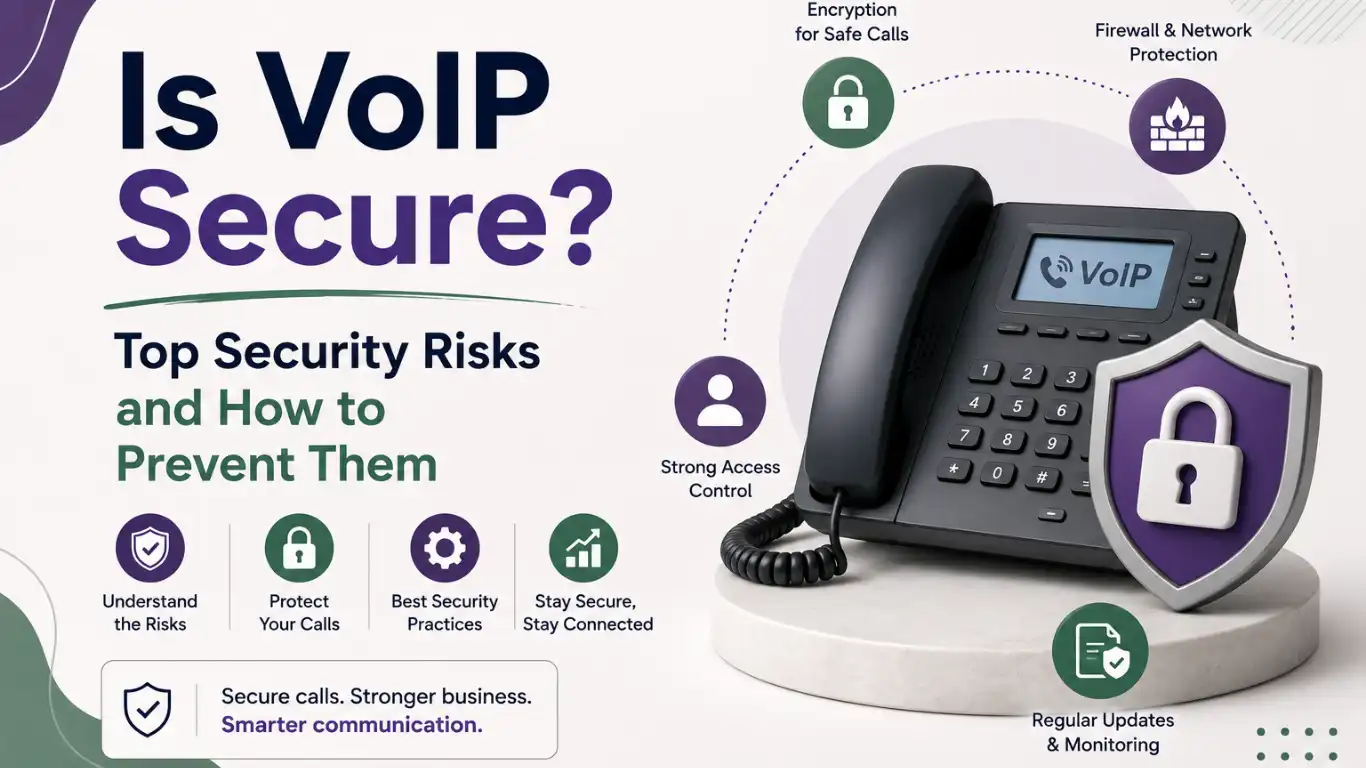
Since these risks are turning out to be more severe and advanced, VoIP security is becoming important. VoIP security, in few words, is safeguarding your business information so that it cannot be accessed, eavesdropped, or altered by an unauthorized user. Such controls involve encryption of data, multi-factor authentication, firewalls, among others.
What are the Security Threats of VoIP?
Sadly, a VoIP vulnerability makes you defenseless against an entire range of inconveniences, all the way up to a security breach. The most effective method of keeping your VoIP system safe is to understand what could be out there. These are some of the most outstanding VoIP security risks and repercussions:
- Malware
Like any other system, which is connected to the internet, VoIP systems are prone to malware attacks, and other viruses, which might slow down or compromise your system.
- VoIP phishing
This type of attack is also called Vishing and is aimed at stealing information by tricking a specific phone user that the call is legitimate by using Caller ID and fooling the user into giving important personal and company data that can be used to cause a security breach.
- VoIP Breaching Applications
There are even specific tools, such as Voice Over Misconfigured Internet Protocol (VOMIT), to prey on unencrypted IP phone calls.
- Denial of Service (DoS)
It is an attack that is specifically designed to affect phone service. It saturates the system and starves it of valuable resources which ultimately results in poor quality of call, uptime and latency.
- Eavesdropping
If your VoIP system is configured over an unencrypted WiFi connection, then you might as well have malicious parties eavesdropping on conversations without any trouble. This may result in a severe case of security breach especially when you are engaging sensitive information.
- Robocalls
More of a inconvenience than anything dangerous but since it has voicemail capability, pretty much anyone can leave a message, as well as robocalls and other spammers.
Best Practices of VoIP Security
When you worry about VoIP security then that is a good start but you need to take the next step which is to do something about it. You can do a lot to make sure your phone system is virtually immune to bad actors and provide your business with some peace of mind.
- Multi-factor authentication and strong password
You will have to choose a secure password that is hard to crack, and easy to remember. According to password best practices, the password must comprise a minimum of 10 characters. In addition to this, you ought to enabled other mechanisms, such as password expiration dates or multi-factor authentication (MFA). They will provide a great deal of security to your system.
A few VoIP providers currently include extensive protection packages that will allow you to enable MFA on a variety of channels, and feature a set of other handy fraud mitigation tools.
- Include your VoIP system into your firewall
Your VoIP system ought to be hidden behind your corporate firewall, just like other devices and systems within the IT infrastructure of your company. VoIP systems in 2025 will still have plenty of security features, but it will not be able to protect everything, and you will need to assume some of the responsibility of securing it at your existing perimeter.
By incorporating your VoIP system into your firewall you will be in a position to monitor – and prevent – suspicious and unauthorized network traffic.
- Keep your system up-to-date
It might sound like an inconvenience, but in matters of online security, having your software updated on a regular basis can do wonders in terms of securing your devices. This is particularly with VoIP phone systems, breach attempts are regularly experienced by providers and could only be shut by timely and efficient software updates.
- Track your call records
The next foolproof method of ensuring that your VoIP system is safe is by simply monitoring it. A VoIP provider of your choice will most likely give you the opportunity to look at the call logs, which will clearly show you who is calling where and how frequently so that you could keep an eye out on anyone acting suspiciously and might cause a security breach. Look out for unusual numbers, weird hours, and anything which appears out of the world.
- Encforce VPN on remote workers
A work-at-home force can create an entire can of worms when it comes to security exposures, especially when you have them accessing the company telephone system via a smart phone or integrated phone system in their house.
The easiest way to prevent any security-related pitfalls is to ensure that your team is obliged to use VPN in all instances of at-home use. This will secure their traffic over the internet even when making phone calls over a VoIP network hence there is no likelihood of an insecure WiFi network causing your business trouble.
- Train your staff
When you are a business owner or a security manager, it is obviously important to know all these best practices regarding VoIP security, but it is far less important than communicating them to your team. As a matter of fact, knowing all the knowledge in the world would not benefit you unless you share it, and that is why training your staff on security best practices, whether in VoIP or otherwise is part and parcel of managing a successful and breach-free company.
How to choose a secure VoIP Provider?
At this point, you know the significance ofVoIP security and how to use best practices, but you must also understand which providers have your protection in mind.
- Encryption
Not to become too complex, encryption can be described as the act of securitizing internet data. Similarly to an unsecured Wi-Fi network giving away your security, providers that do not support call encryption will keep you vulnerable to a vast array of possible infiltrations.
VoIP technology uses Transport Layer Security (TLS) and Secure Real-time Transport Protocol (SRTP) as the most prevalent and required protocols that your VoIP provider should be providing.
VoIP providers are not equal when it comes to encryption. Indeed, take Inum, one of the most feature-complete and popular business telephone systems on the market today, which only gained end-to-end encryption of its phone and messaging communications at the end of last year.
- Support
When the time comes that you will need the assistance of the experts, you will definitely want to read about what the various vendors have to offer. Whether it is sporadic hours, live chat or 24/7 availability over the phone, the level of support provided by different providers differs. Be sure to choose the one which is suitable for your business.
- Compliance accreditation
Due to the excess worries about the safety of their data that exist in the world today, regulations are not in short supply that are meant to offer protection to individuals. Unluckily, these regulations are not adhered to by all providers as they are supposed to bear the responsibility of being compliant with the certain measures. Before you sign off, be sure to check what accreditations your provider has.
Conclusion
It is important that you take strong security measures within your VoIP system to safeguard your business communications. Measures like good password policies or the ability to encrypt your data will protect you as well as help in establishing trust with your clientele since they will know you take security seriously.
With the ever evolving VoIP technology, it is important to remain alert and ahead of your game, in terms of security measures, to ensure that your business operating environment is secure and sound in terms of communications.
FAQs
Q1. Which one is safer VoIP or landline?
On landlines, one is likely to be safer since this form of communication has physical links and therefore not prone to digital insecurities. Nevertheless, VoIP is also secure when the appropriate security systems are implemented. When you are interested in frequent updates, or you use a robust encryption, VoIP may be your steadfast option at the same time.
Q2. Does VoIP require firewall?
Of course, VoIP systems need firewall. It assists in securing your network on illegal access and other cyber attacks. Installing a firewall enables you to regulate traffic and filter possible malicious pieces of data.
Q3. Is it possible to hack VoIP?
VoIP is prone to hacking like any other technology that is internet-related. Nonetheless, this risk can be greatly mitigated through effective security measures like encryption, solid password and multi-factor authentication. Other key measurements are upgrading your system and training your staff on security.
Q4. What are the security standards of VoIP?
VoIP security specifications have methods such as SIP (Session Initiation Protocol) and SRTP (Secure Real-Time Transport Protocol) which facilitate encryption and management of communication. The use of such standards aids in the guarding of your information and messages against tap along with abuse. Ensure that your VoIP provider complies with these protocols to get maximum security.
Q5. Do VoIP numbers offer security?
The numbers by themselves are as safe as the network and the methods that are being utilized to keep them safe. Make sure that your VoIP connection is highly encrypted with regard to calls and data and implement stringent access controls. Frequent inspection and revamping will also ensure that your VoIP numbers are not used by unauthorised parties.