In the current business environment, you cannot risk any dollar of your money on something that does not add any value, and yet here is your business still investing in the old phone systems?
Competition in the world of small businesses is fierce nowadays, and responsiveness, efficiency, and adaptability are the most important factors. Conventional telephone platforms are now expensive, inflexible, and obsolete.
VoIP is a better, less expensive method of communicating innovation. It does not just save money, but allows mobile integration, scalability and unprecedented flexibility.
VoIP is helping companies enhance productivity, increase customer satisfaction, and forget about outdated systems. It’s not only about new technology, but empowering your team, automating operations and future development.
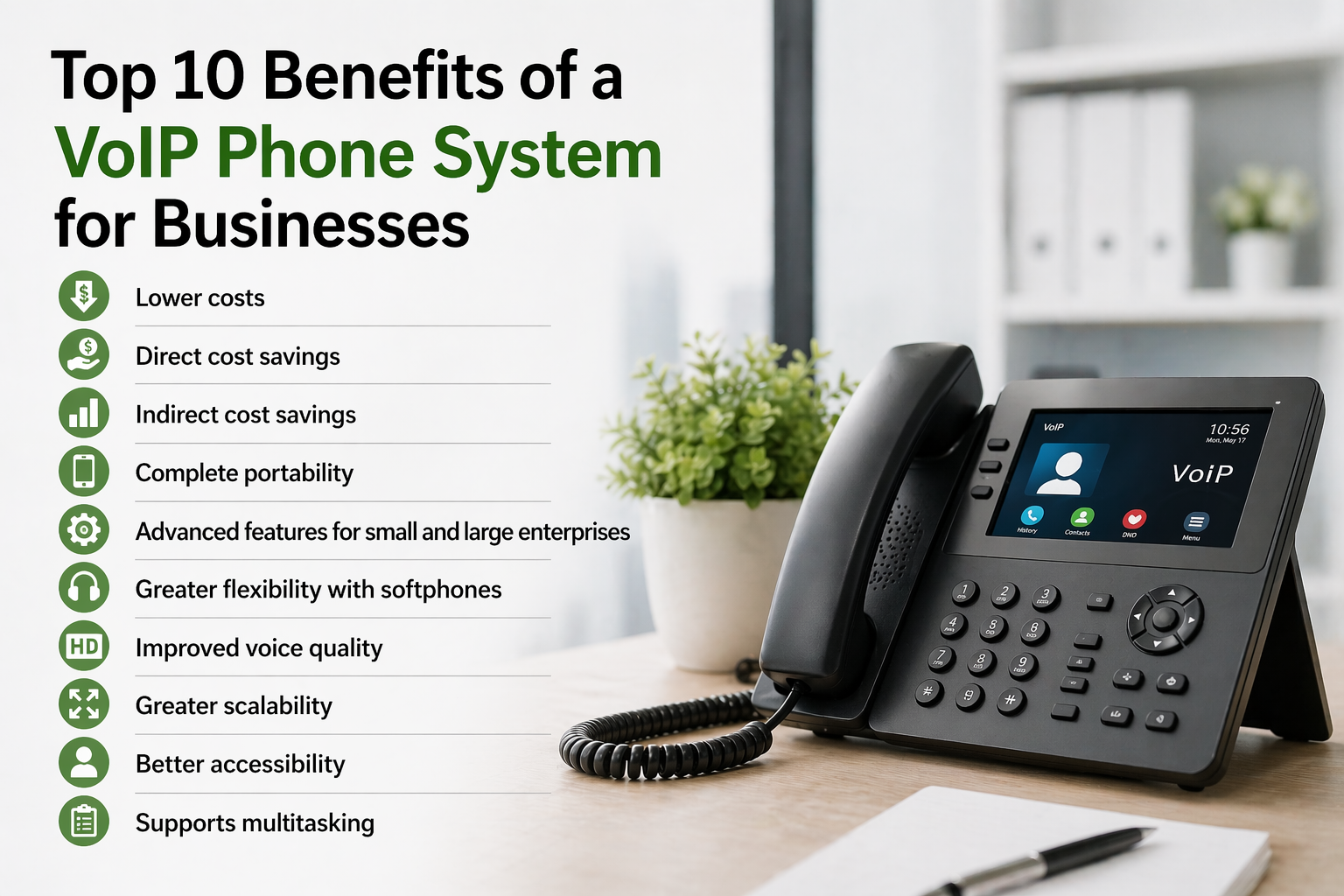
In this blog, therefore, we will take a look at the top ten benefits of a VoIP phone system for businesses.
Benefits of a VoIP Phone System for Businesses
1. Lower costs
Affordability is one of the greatest advantages of the VoIP phone system. VoIP provides numerous benefits of cost savings to small and large companies.
In the case of a landline phone system, the monthly charge per line is approximately 50 dollars. This charge is on local (and sometimes domestic) calls only. VoIP plans, on the other hand, are as cheap as 20 per line.
Yes, you read that right! VoIP will save you half of what you are currently paying on your phone bill.
Remember, changing over to VoIP does not mean that your phone money is going to reduce significantly. The needs of businesses vary.
But one thing you can not be in doubt about is that a transition to VoIP will open the doors to major savings in cost.
2. Direct cost savings
Starting with the huge initial set-up costs to periodical costs, a business incurs a number of costs with regards to traditional phone service. VoIP helps eliminate those. These include:
- PBX costs: PBX is a very expensive hardware to install on-premise that is necessary to connect multiple landlines in an office. VoIP does not require such hardware since the network operates on a broadband connection.
- Calling rates: VoIP is cheaper to make long-distance and international calls than the traditional phone system.
- Copper wiring costs: VoIP networks are capable of carrying data and voice on the same path. This does not require any additional wiring.
- Recurrent costs: A VoIP service saves the company recurring costs such as repair, tax, and maintenance costs.
3. Indirect cost savings
Some of the most common places to quantify your long-term savings are as follows.
- Remote work savings
Employees can work at home by using VoIP phone capabilities such as auto-attendant, conference call, instant video call, and so on. This increases the output of the employees and reduces office space and utility.
- No additional cost for add-on features
A typical PBX system would force you to pay individually in add-on applications such as group ringing, call transfer, call queuing, etc. VoIP phone services can provide a lot of these features without an additional fee.
- Repurposed manpower
You can save up to 45k per year by waiving the salary of an in-house secretary with the auto attendant feature.
4. Complete portability
This is good piece of news to those who enjoy traveling. The VoIP number or virtual number is completely portable. This means that you can make use of the same number everywhere you go.
Your company may change the address but you can still keep the same VoIP number.
One of the most significant benefits of VoIP is portability among highly mobile, hybrid or remote working teams. VoIP keeps executives, teams and customers in touch regardless of their location and allows 24/7 instant access to files, features, and contacts.
This satisfies the demands of the current on-the-go workforce and reduces operating expenses without compromising communication.
5. Advanced features for small and large enterprises
VoIP has the ability to make even a one person business look like it has a large organization with more than one department due to other functions such as call transferring and auto attendant.
This is also one of the greatest VoIP advantages to small businesses.
The Virtual Assistant is capable of engaging with the callers through conversational AI, responding to all incoming calls, menu selections, call forwarding, and providing solutions- all without the assistance of a live agent. All the activities of the call center can be monitored in the real-time and the efficiency of the agents, customer satisfaction rates, and queues can also be evaluated by managers to improve communication strategies further.
Multi-party features of Business VoIP providers allow a large group of individuals to participate in the same call.
6. Greater flexibility with softphones
Softphones, the programs installed in the smart gadgets like smartphones, tablets, or computers. Microsoft Teams is an ideal example.
Enterprise VoIP providers, however, can customize their applications to suit the requirements of various businesses.
Having a softphone benefits your business communications in a number of ways:
- Enables even better portability
- Reduces extra equipment costs
- Promotes constantly-connected workforce
- Frees up office space
Besides this, softphones are more flexible. They give you access to features that improve your style of working remotely.
7. Improved voice quality
VoIP telephony is crystal clear and sharp provided that you have a good and high-speed internet connection without any call drops, lag and latency problems. All you need to achieve an excellent voip call quality is a good bandwidth connection.
When your office makes simultaneous calls, everybody might have to deal with background noise, delays and even echoes. VoIP phones avoid such interruptions that would enable you to work on the agenda of the meeting. They provide the best sound and have some groundbreaking features such as advanced audio compression and noise-cancellation microphones.
8. Greater scalability
VoIP also has another great benefit; it can be scaled easily and quick. A VoIP phone system eliminates the need to purchase additional lines, or special hardware as you expand.
Consider situations such as the expansion of a new branch office or getting ready to increase demand over the holidays. Such scenarios allow adding more user seats and lines online in real-time by buying the new phone number only (no wiring or complicated installation).
You also have a choice of various VoIP virtual phone numbers that include international, local, vanity, and toll-free numbers.
9. Better accessibility
VoIP is also portable and wireless, so you can make your business flexible. Cloud-based VoIP service is an advantage in an increasingly remote workforce, as it allows them to make calls anywhere.
And in situations where you cannot pick up a call, voicemails can be emailed to you or the call forwarded to someone.
The greatest thing is that your employees will remain productive wherever they are. They do not need to be at the office. They are able to operate their tablets and smartphones anywhere.
Most VoIP providers also feature multi-lingual call center and live translation services to ensure employees can talk to their colleagues even when language barriers exist.
10. Supports multitasking
The VoIP network can also be used to transmit images, videos and documents in addition to phone calls, all at the same time as participating in a conversation. So you can easily conduct more integrated conferences with employees or clients located globally.
Consumers now desire that businesses connect with them on at least 3 channels. Omnichannel platforms and business VoIP allow you to talk to customers in multiple channels, view communication history, and customer data anytime, and change channels during a conversation.
This helps accelerate resolution rates, and the customers do not repeat themselves.
Bottom Line:
Today, it is possible to make phone calls anywhere, anytime, using a headset, any Internet-connected device, and VoIP. Companies in all industries are abandoning the old phone lines in favor of new and modern technologies and capabilities. And with a glance at all the VoIP advantages, it is not difficult to see why. VoIP services can save them approximately 75% in the amount of money they spend in communicating.
As the global VoIP market is expected to reach up to $102.5 billion in 2026, any business that takes up VoIP today will be well positioned to achieve success ahead of the competitive future. So why wait? VoIP is the future of communication and it is time to upgrade your business to the next level.
FAQs
Q1. What are the benefits of business VoIP telephone system?
A business VoIP phone system is a calling system used by a business that uses the internet to make calls. It encodes sound into digital information and transmits it through the Internet in blocks. One of the numerous advantages of VoIP to small businesses is that it can support remote working, since users can make and receive calls even when working in various locations.
Q2. What is a VoIP business?
Business voice over IP is equivalent to Voice over Internet Protocol which is a calling system to make and receive calls via the internet.
Q3. Why use VoIP phones?
Businessvoip phones are an affordable, versatile and feature-rich way to upgrade communication. Other applications, including CRM, email and SMS platforms, will also integrate with voIP phone systems.
Q4. Why is VoIP better?
VoIP will always be superior to the traditional phone systems. VoIP is cheaper and more flexible, which is the best reason. VoIP business solution provides various options that are not provided by other normal phone systems.