In the complex business communication world, selecting the right phone number is a detail that does not matter much, yet it can make a huge difference to the success of the company. A phone number is not merely a way of communicating. It is a necessary component of your brand.
This detailed blog will make navigating through the plethora of different types of phone numbers, understanding their unique advantages, and how to decide which type of number is useful in your particular case. In this blog, we will discuss different types of numbers.
Different types of Phone Numbers.
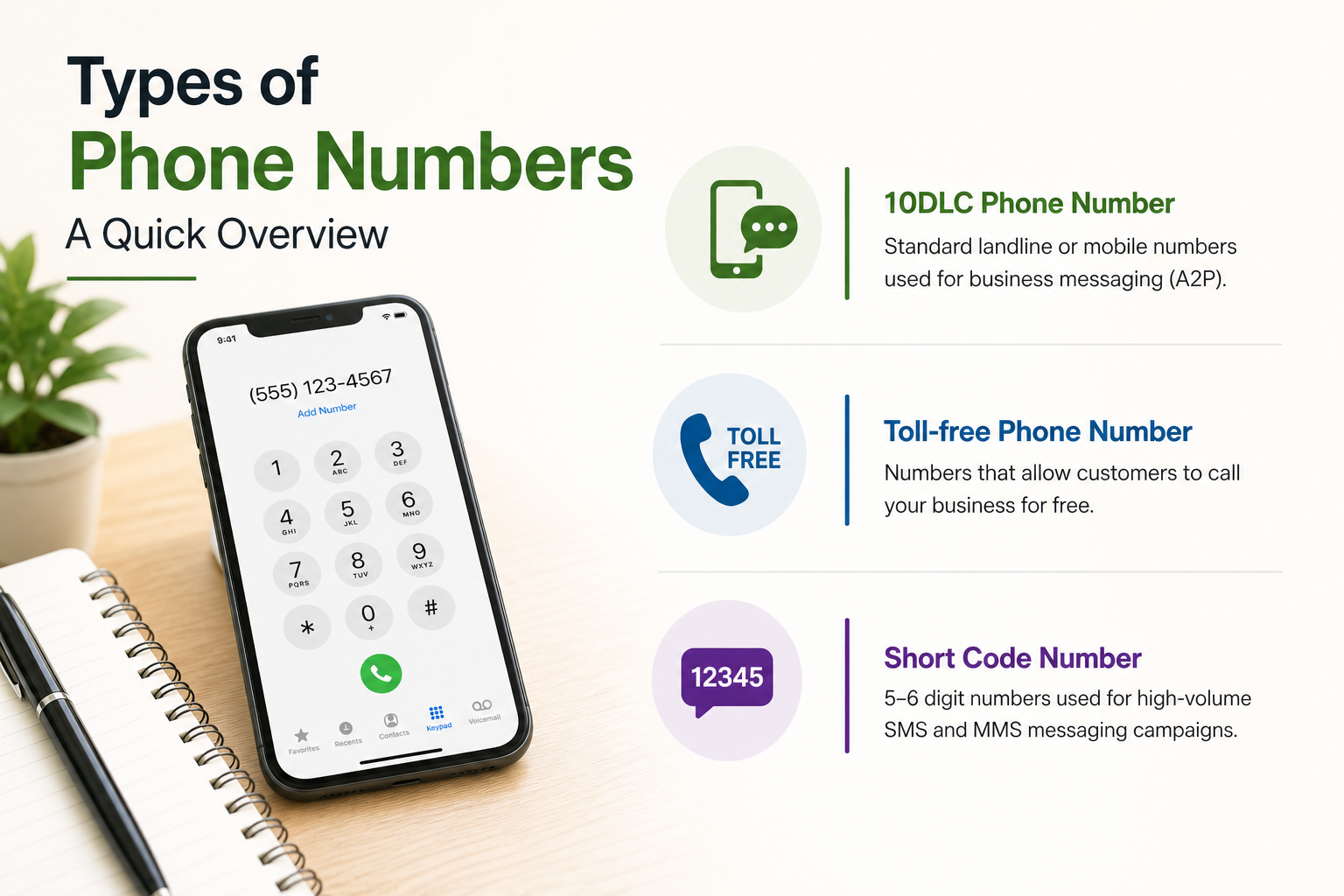
Businesses can use three major phone number types to text, which include short code, 10-digit long code, and toll-free numbers. These will be explained below, their definition, advantages/disadvantages, and common applications.
1. 10DLC phone number
A 10 digit long code (10DLC) is a local number that is allowed to be used in business texting. The phone number can be described as 10 digits as the name implies and just like your regular cell phone number.
Pros of 10DLCs:
- Local area code. 10DLCs are local area codes and recognizable area codes and as such, are familiar to your customers and easier to remember than a smaller number.
- Cost effective. DLC 10DLC costs less per month as opposed to dedicated short codes. They are cheaper to get registered and the maintenance cost is only $15 per month. Short codes are minimum of 500 dollars every month.
- High throughput. Registered 10DLC numbers have a large messaging throughput. This assists in making sure that your messages get to people fast.
- Voice capabilities. Majority of business long codes are text enabled. As an example, Textline enables businesses to utilize their current voice only number such as a landline or VoIP. This is advantageous when you are aware of a phone number already used by customers.
- International texting. In case you need to send or receive text messages to customers who are located in different countries (not in Canada), a 10-digit long code can be the most successful. The 10DLCs are compatible with the majority of international numbers in terms of sending texts.
- Conversational SMS. 10DLCs facilitate conversation texting. A 10DLC is better than a short code especially when you need to have real two-way texting.
Cons of 10DLCs:
- Carrier filtering. Most mobile carriers censor messages to ensure that customers are not spammed. This implies that carriers will be able to censor or block business messages considered to be doubtful. In cases of blocking of messages by carriers, they do not necessarily give clear reasons of blocking a message.
- Monthly fees. Though 10DLCs cost lower than short codes, it has registration charges and a monthly service fee of 15 dollars. On the one hand, toll-free numbers do not include these fees.
Common use cases
Considering their high throughput, conversational messaging capability, and local appeal, the following reasons are commonly used when 10DLCs are utilized:
- Customer service or customer support.
- Texting among healthcare providers.
- Internal communication
- Sales follow-ups
- Lead generation
- Reminders on appointments or bookings.
- Requesting feedback
- SMS marketing campaigns
2. Toll-free phone number
The 10-digit numbers with a unique three-digit prefix of 800, 833, 844, 888 etc. are called toll-free numbers. These are toll-free telephone numbers since a customer can call these numbers using his or her landline without fee. This form of phone number is the recent popular form of business text messaging.
Pros of toll-free numbers:
- Cost. The most affordable type of phone number is a toll-free number since there are no registration and monthly maintenance costs associated with it.
- Registration requirements. Even though this might not be the case in the immediate future, there are less strict rules of registration with toll-free numbers. In particular, through a web site or a social media page, businesses can create a registration and do not require a tax ID number, which may be attractive to smaller businesses.
- Voice capabilities. Toll-free numbers are a good choice in case you want to provide a phone number that is textable and callable by the customers. They favor both voice and SMS.
- Conversational messaging. Toll-free numbers facilitate two-way, conversational messaging which is fast.
- High throughput. High throughput with brand and use case supported by Toll-free numbers is also possible.
Cons of toll-free numbers:
- International texting. International messaging is not connected to toll-free numbers. This is a type of phone number that is used in the United States, Canada and also in Puerto Rico.
- Group messaging. Toll-free numbers do not facilitate a real group messaging. Textline also provides this feature so that groups of people are on the same page.
Common use cases
There are numerous applicable use cases of toll-free numbers, as it is with 10DLCs. Toll-free numbers have as many potential use cases as do 10DLCs. This is because they integrate conversational messaging and throughput that supports two way conversations and mass texting campaigns can be easily transmitted. The following are the daily applications of toll free numbers:
- Customer services and customer experience.
- Order updates
- Shipment and transportation management.
- Insurance texting
- Employee communication
- Sales outreach
- Sending SMS surveys
- Alerts (reminder about appointments, events, meetings, or bookings)
3. Short code number
A short code is a 5 digit or 6 digit phone number that is used to do a text blast in large numbers. These are commonly used to carry out large-scale text campaigns via brands. Organizations have option of using vanity short code or random one.
Pros of short codes:
- Highest throughput. The different phone numbers types have the highest throughput with short codes. They assist brands in sending and conveying a great deal of text messages at the same time.
- Easy to remember. Short code being only five or six digits can be simple to recall by customers and identify with your brand.
- Less carrier blocking. Due to the extensive registration procedure, short code messages are less prone to blocking and filtering by the carriers.
Cons of short codes:
- Cost. The most expensive type of phone number is the short codes. Random short code will cost 500 a month and vanity short code will cost 1000 a month. Also, in most cases, setup and registration fees are involved.
- Limited two-way messaging. Bulk one-way messaging was done by short codes. Although they will accept the replies, they are not conversation oriented SMS.
- Long registration procedure. Short codes take long to be registered and approved. Sometimes the process can take months. Every carrier must approve all brands and short code numbers that are vetted by a third party.
- No voice. Short codes are not voice enabled. This implies that they are only applicable in text messaging.
Common use cases
Mass texting with a huge number of recipients are best done using short codes. Consequently, the following are some of the most widespread uses of short codes.
- SMS marketing campaigns (promotions, sales, discounts, or product launches) on the large scale.
- Two-factor authentication
- Gaining SMS subscribers
- Time-sensitive alerts
- Reminders of events or appointments.
In Conclusion
Phone numbers have become an essential feature of the modern communication system, and they have multiples of uses beyond call. Since there are mobile and landline numbers that are used personally and there are toll-free, premium, and virtual numbers that are used in the business, each type is tailored to fit a certain need in communication. VoIP, satellite and short codes also contribute to the possibility of communication through more ways and it is easy to connect around the world, to reach customers and deliver services with efficiency.
Knowledge on the various categories of phone numbers assist individuals and businesses to select the most appropriate phone number depending on their usage such as personal connection, customer services, advertising, or emergency services. The appropriate type of number will make your access to be better, less expensive and more reliable with the help of the use of the suitable type of number.
FAQs
Q1. What is a mobile phone number?
Response: A mobile phone number is a special number that is allocated to a mobile phone enabling it to make, receive calls, send text messaging and access the internet. These figures are associated with cellular networks and can be applied globally generally with roaming facilities.
Q2. What is the distinction between landline and mobile phone number?
A fixed phone line is one with a landline phone number, and is usually in a house or office, is location specific. A mobile phone number on the other hand is linked to a mobile phone that can be used in any part of the network of the service provider thereby being portable and flexible.
Q3. What are toll-free numbers?
Toll-free numbers are phone numbers through which people are in a position to access business or organizations without having to pay any fees. The cost of the call is taken by the business or organization owning the toll free number. These are numbers that are normally prefixed with 800, 888 or 877.
Q4. What is a high rate telephone number?
Premium rate numbers are the phone numbers which charge the callers high rates compared to that of normal calls. They tend to be applied to such services as voting, technical support, or adult content. The owner of the premium rate number is given a share of the money earned in the number of calls.
Q5. What is a virtual phone number?
A virtual phone number is one a number that is not allocated to any particular phone line nor device. It can be sent forward to any phone and it will enable companies or any person to establish a local presence in many locations without having to have a physical phone line. Businesses tend to use virtual numbers either in customer service or marketing.
Q6. What are short codes used for?
Short codes are short and compressed numbers (generally consisting of 3 to 6 digits) which are used to transmit as well as receive SMS or text messages. They are typically applied in marketing campaigns, contests, emergency notifications and customer service messages.