Communications Platform-as-a-Service (CPaaS) allows developers to directly add real-time communication capabilities to their existing applications and eliminate the need to develop expensive backend technology.
Incorporating robust communication features into their technology stack assists enterprises in creating an experience of a more connected and engaging customer experience.
CPaaS appeals to the growing firms, which have an existing cloud-based technology stack and wish to tailor their communications infrastructure.
CPaaS functions require coding compared to a virtual phone system, in which the technical installation is handled by the VoIP service provider. That is, CPaaS is potentially highly beneficial, yet it needs technical skills.
We will also explore the world of CPaaS, its meaning, and functionality and discuss some of its advantages and crucial features in this guide to enable you to scale voice and messaging.
What Is CPaaS?
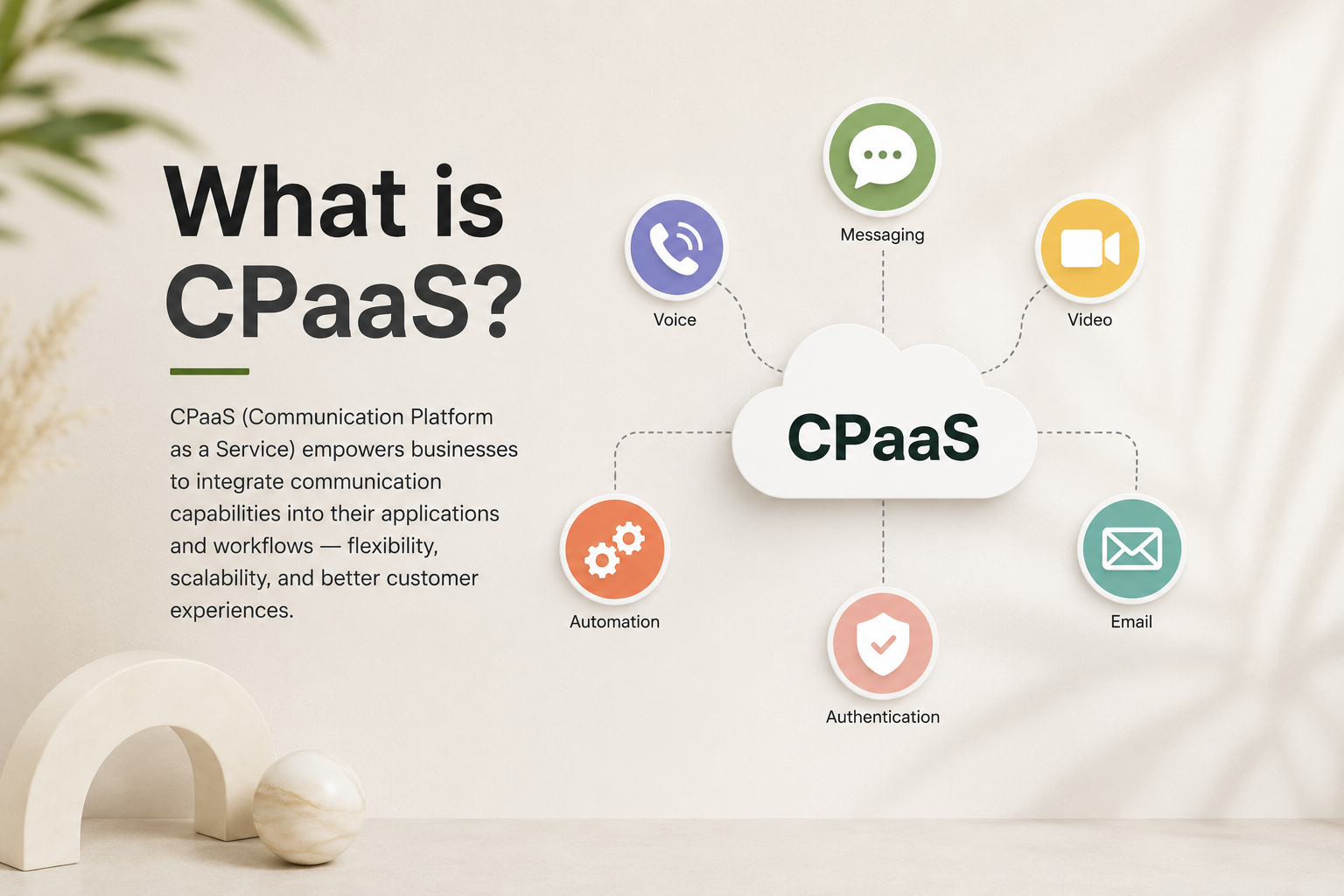
CPaaS stands for Communications Platform as a Service. It is a cloud solution that offers companies Application Programming Interfaces (APIs) to incorporate real-time communication services such as SMS, voice calls and video chat among others, in their applications.
CPaaS enables you to completely configure your stack of communication. You can combine the chosen communication channels with the software that you use with the complete solutions which have the already predefined features.
CPaaS service provider provide product documentation, software development kits (SDKs), and technical support to allow you to take advantage of the APIs using the CPaaS to add real-time communications features and channels to your ecosystem.
CPaaS is a communication Lego set. As an alternative to bulky, pre-built solutions, there is a box of building blocks: the SMS, voice calls, video chat, chatbots, interactive voice Response (IVR) and so on. These blocks are built by the developers through snapping them together to customize forms of communication that best meet your business requirements.
There is no longer the need to juggle between different platforms or have to endure complex integrations. Flexibility, control, on-demand, and in the cloud, but without the hassle of infrastructure management is all CPaaS.
How Does CPaaS Work?
CPaaS operates at its fundamental level due to communication APIs.
Application Programming Interface (API) is a framework of intermediaries between two endpoints, e.g. devices or software applications. These endpoints can communicate effectively with each other through them.
Consider an example of a ride-hailing application such as Uber. The app applies CPaaS when you request a ride.
CPaaS activates several communication functions: it makes an SMS notification to make sure your ride is received, enables the driver to call you via the app, and provides information on the position of the driver in the form of a map. It is all because of CPaaS that makes this seamless communication experience possible.
APIs typically use Voice over IP (VoIP) networks in the back-end to receive data packets within one endpoint to the other endpoint.
Some of the examples of actions that cause these interactions are:
- Making a phone call and dialing a phone number.
- Sending a text message
- Asking the status of a package that you are waiting on.
Therefore, CPaaS requires an experienced team of developers who will build a custom App that will utilize APIs. You also require the devices and /or software that understands how to communicate with API endpoints.
Benefits of CPaaS
CPaaS solutions are flexible, scalable, and cost-effective over the traditional communications services. Businesses can create voice-based, video-based, and messaging-based channels of customer engagement to address the demands of the ever-changing business environment.
These are some of the main CPaaS advantages.
- Speed and Agility: CPaaS also speeds up the development process by providing ready-made APIs so that it can easily add communication functions to web and mobile apps and thus supporting the addition of new features in a shorter time.
- Cost Savings: CPaaS pay-as-you-go consumption pricing model is cost-saving, in contrast to the investment needed to install equipment, such as PBX phone systems, on-premises. Businesses do not need to know how it will be used in future or spend more money upfront.
- Scalability: It is able to scale up and down immediately to meet higher demand and then back to the previous level to guarantee economical utilization of the resources. This ensures that the cost of CPaaS is directly proportional to the business volumes.
- Innovation: CPaaS supports new innovative products and services that include embedded omnichannel communications that can be adjusted to the customer tastes.
Key CPaaS Functions
CPaaS platforms comprise a single or multitude of voice and SMS, fax, online meeting, team messaging, and analytics API to extend business software.
The following are the blocks to deploy CPaaS to your communication system.
1. Outbound voice calls
Voice API places outgoing calling within your communications stack. It is excellent in upgrading and downgrading depending on your requirements. New phone numbers and calling features are almost instant.
Outgoing call voice API is a perfect solution when you have to adjust to the changing environment and add or reduce the calling capacity.
2. Inbound call routing
Call routing makes inbound call processing easy. It works through webhooks. Once a call comes in, the system triggers a webhook and receives a list of instructions for the call.
On the contrary, inbound call center platforms can do all this without programming. Such instructions may be directed on how to divert the call to a specific destination so that you may personalize and streamline the process of receiving incoming calls, other useful in busy seasons.
3. WebRTC-based calling
WebRTC is a free open-source platform of the web that permits real-time communication (RTC) through web browsers and mobile applications via APIs.
There are some CPaaS providers who provide WebRTC solution.
You can use it to incorporate voice and video communications into your communications configuration. In that manner, you can include such features as conferencing, recording, encryption, call queues, and so on.
4. Text messaging (SMS)
By integrating SMS communication into your application, you can send notifications, alerts, and similar messages under your business number.
You can also add a two-way messaging to your arrangement in case you need to where the customer is able to respond easily to you. SMS API will also enable you to send group text messages and automatize your workflow, as well as monitor the delivery and opening of individual messages.
You should also have your phone number registered in order to offer A2P 10DLC functionality. Although this may be a little bit cumbersome with most CPaaS providers.
5. On-demand SIP trunking
SIP trunking provides access to your IP based communications infrastructure. In case your call capacity requirement varies, on-demand SIP trunking is adaptable and it is easy to add or reduce the capacity as and when your requirements vary.
The features and functionalities that you will receive with the SIP trunking will depend on the CPaaS provider that you select.
6. Multimedia and video messaging.
SMS API also enables image, video, and numerous other media and file transfer.
MMS is not the solution offered by all CPaaS providers. The ones that do tend to vary in their international number service offers in sending and receiving MMS and media storage facilities, file conversion service and file size.
7. Social media messaging
Many other functions of CPaaS can be brought together through social media platforms such as Facebook, X and WhatsApp.
As an illustration, one can use it to send and receive multimedia messages and files, share locations, and check whether your message has been delivered and read. You are also able to automate and scale your repetitive customer care functions.
8. Number masking
Phone number masking allows two parties e.g. an agent and a customer to be connected without publicizing the phone numbers.
In fact, disguising the number is one of the best ways to keep the identity of your customers secret, keep privacy of sensitive information safe, and to make sure that all parties are safe and their privacy is not violated.
A situation where the user makes a call using a virtual phone number and the number masking is provided means that the only people who access the phone numbers of the participants of the call include the CPaaS platform.
CPaaS Use Cases
CPaaS assists companies to go omnichannel in their communications. In so doing, they will be able to effectively communicate among themselves and establish an uninterrupted customer experience.
The following are some instances of CPaaS implementation.
1. Confirmation of appointments and updates of fulfillments.
CPaaS works best with such types of messages like appointment confirmations and reminders, order confirmations, and information about tracking delivery.
Application of these messages can be accompanied with numerous advantages. They are able to minimize missed appointments, enhance customer communication and satisfaction, as well as eliminate the necessity of manually reminding and updating in order to send them.
Confirmation and update messages are effective in the healthcare, food delivery, e-commerce, and any other industry that is based on subscription business model, and periodic payments.
2. Fraud and abuse mitigation
CPaaS will give you an opportunity to provide additional security to your customers. Text messaging is another way to do this to your customers:
- OTP as user identification.
- The use of two-factor authentication to confirm logins.
- Protect mobile payment data.
This application is applicable to any industry where the customers possess accounts of their personal information and/or pay online. Some of them include online shopping, consumer and business software tools and personal banking.
3. Scalable voice and messaging.
CPaaS can be used to implement voice and messaging in your front-end applications. It will become easier to reach them at crucial points in their buying process.
To cite an example, your customers can reach out to you when they are:
- Buying products or services
- Got plans of visiting one of your physical locations.
- Viewing their purchase or account history on your site or within an app.
- All these are important instances that influence the customer experience.
CPaaS allows you to scale voice calls and messaging to make sure you can be at the fingertip of your customers in no time. This is effective with the travel industry, financial services and other industries in which the customer can significantly benefit by receiving your immediate service.
4. Automated customer interactions
Chatbots and other automated customer engagement represent one more way to leverage CPaaS. This will assist your customers in having answers to themselves.
Chatbots apply conversational artificial intelligence (AI) in responding to the questions accurately, depending on the information given by the customer, the questions they posed, and past interactions.
Automation can be applied to any industry where there are repetitive customer queries with the use of chatbots, WhatsApp, and other messaging platforms.
In Conclusion
CPaaS is transforming the way businesses interact with each other to the extent that it is now easy to integrate real-time voice, video and messaging into applications. It connects the old telecoms with the new digital experiences-enabling businesses to find customers in a smarter, quicker and more personal manner.
Through the use of CPaaS, companies can gain more interaction, improve communication processes, and keep pace in the world where time-sensitive, integrated communication is no longer a luxury- but a necessity.
FAQs
Q1. What is CPaaS?
CPaaS (Communications Platform as a Service) is a cloud service that allows developers to add communication features to their applications (though APIs) voice, SMS, chat and video and does not require them to develop complex infrastructure on the backend.
Q2. What is an example of CPaaS?
The functions and capabilities of CPaaS are SMS,(MMS), social media channels (WhatsApp, and Facebook Messenger), chatbots, and IVRs.
Q3. What are the best CPaaS companies?
The best CPaaS vendors are Twilio, Vonage, Bandwidth, Sinch, Infobip, Avaya, and 8×8. The majority of them have a worldwide coverage and a range of tools to use in both common and emerging applications. You may visit this list of the best CPaaS providers and see the real user reviews.
Q4. What are some of the issues with CPaaS?
The vulnerabilities that might affect the security such as unencrypted platforms and grey routes disclose sensitive data, whereas few communication stacks and integration issues compel companies to deal with multiple vendors. Older systems that are not easily integrated and IT overhead of constructing code-based journeys compound digital transformation and annoy developers.
Q5. Who typically uses CPaaS?
CPaaS is also applied in industries such as healthcare, e-commerce, logistics, banking, and customer support to engage customers better and automate their activities in real-time.