Since the onset of the 2000s, wireless communication has become the default option among businesses. Wireless connectivity has also led to more advanced networks like 4G and 5G networks that have helped organizations perform their operations at maximum speeds and reach their customers.
Yet, simpler networks and protocols using 3G connections and below are required in the regions that are not yet covered with advanced coverage.
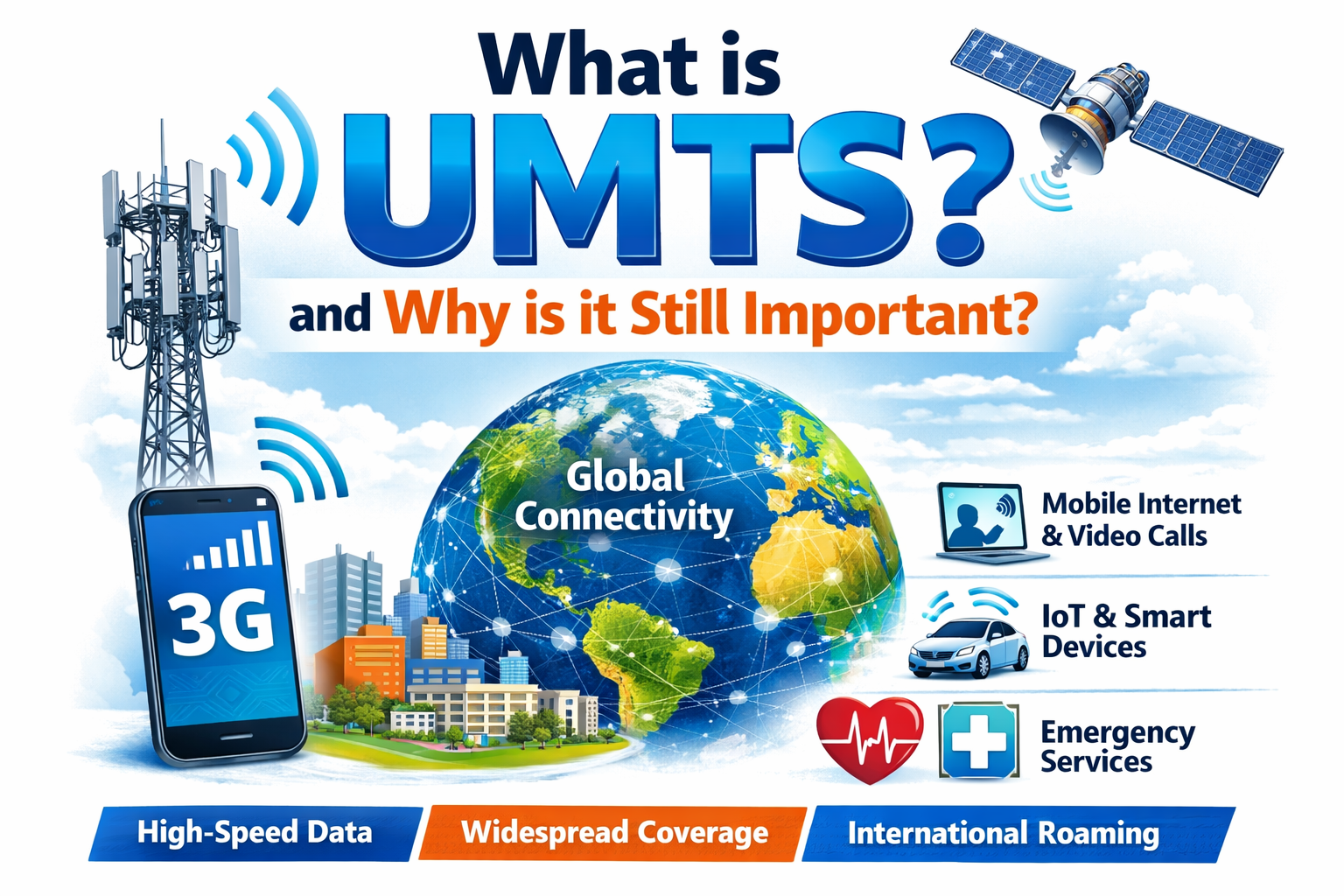
Other businesses may be more interested in using the latest, shiny-looking network solutions but organizations aiming at a truly global audience and striving to be an entity that can operate in any corner of the globe would benefit greatly by keeping in check with less advanced and still efficient methods of connecting with the global community, like 3G. In this blog, we are going to discuss what is UMTS and why it is important.
What is UMTS?
Universal Mobile Telecommunications Service UMTS is a cellular radio technology operating at 3G and is based on the Code Division Multiple Access (CDMA) network standard. The access technologies provide a mobile connection to a mobile network, and this is achieved by the wireless transmission of signals in the air to and out of a cell phone.
UMTS was designed to upgrade older GSM networks to 3G, and also provided a faster download rate of up to 2 Mbps, which was high at the time it was initially released over 20 years ago. UTM, compared to its predecessors allowed a broader scope of implementation of IoT applications that were data-intensive. Despite being overshadowed by more appropriate IoT-oriented technologies or, in certain instances, 4G, there are numerous deployments that still depend on it.
Core components of UMTS
UMTS is constructed on an advanced collection of elements which are all designed to deliver smooth connectivity and better communication services. Here we are going to discuss the major elements that enable UMTS to be incorporated in the contemporary telecommunication world and how they all combine to facilitate all the activities such as high-speed internet connections as well as the sophisticated multimedia services.
The UMTS network comprises three major parts:
- User equipment (UE) is any device which is compatible with UMTS including smartphones and tablets.
- The radio access network serves the radio communications between the mobile devices (UE) and the network, which is the UMTS Terrestrial Radio Access Network (UTRAN).
- The core network (CN) is in charge of call and data routing as well as other administrative tasks.
Key benefits of UMTS
UMTS was a massive improvement over the former connectivity solutions such as 2G. Even though 4G and even 5G have become more popular, UMTS has a number of advantages that improve the communication and wireless connectivity in the fields where more advanced networks are unavailable to a considerable extent:
- High-speed data transfer
UMTS supports high speed up to two Mbps thus making it suitable to transfer video streams and big files. By giving a capacity to transmit more data within a shorter period of time, high-speed data transfer facilitates faster communication, effective remote working, as well as fast access to cloud services.
This further improved speed also ensures real-time exchange and collaboration of data. Lastly, it provides a broad spectrum of mobile applications and services, which is critical to the business world of today which is becoming more mobile and connected.
- Better bandwidth and capacity.
UMTS networks are capable of supporting a larger number of simultaneous users per cell and the possibility of network congestion is minimized. Increased bandwidth is particularly important to those businesses that need to deal with large amounts of data, such as those that support video conferencing, cloud computing, and real-time analytics.
Faster speeds also imply that a greater number of devices can be connected without performance degradation, to support increased business demands of both large IoT deployments or large, mobile workforces.
- Global roaming
UMTS uses frequencies that are internationally accepted thus it can be easily connected to various geographical locations. The businesses that have a global presence cannot be without this feature. It does not require numerous devices or services to facilitate international communication, travel and operations.
It also guarantees that the employees are able to maintain contact and use business important applications and information even when they are on the go, to enable business continuity and co-operation. This international connectivity is one of the major motivators to businesses that engage in more than one market, providing flexibility and business continuity in the international business environment.
- Enhanced security
UMTS networks have enhanced security capabilities such as enhanced encryption of voice and data transmission. Improved level of security protects sensitive corporate information and communications. It also lowers the chances of information leaks and online attacks, which is important in an age where electronic data is a precious tool.
Lastly, it guarantees the safety in the transmission of information in cellular networks and this offers some relaxation to the businesses that handle confidential information. This security measure is especially valued by companies that accept remote working and mobile operation, where data is frequently transferred between different networks and devices.
The adoption of UMTS to enable high-speed data transfer and multimedia applications transformed the way people can utilize mobile devices and hence they can stream videos, play online games and access the web at speeds that were previously unimaginable over mobile platforms. Today, UMTS still has the potential to ensure that businesses and consumers can be connected wirelessly anywhere in the world.
Challenges and limitations
The use of UMTS is still associated with a number of challenges, even in cases when individuals utilize UMTS to build and operate a UMTS network on their own:
- High infrastructure costs
In case you do it yourself, the UMTS network construction and maintenance is costly. These expenses involve new hardware and software, and implementation of more base stations in order to guarantee vast coverage and quality service delivery. Such costs may be high, particularly to an organization that requires a large network coverage or in an area where the infrastructure required is yet to exist.
- Compatibility issues
UMTS is incompatible with certain older devices of the 2G variety and hence needs users to upgrade their devices. On top of the price of implementing necessary upgrades to the current infrastructure and devices to make them UMTS-compatible, the process of overlaying UMTS with the older systems may result in additional expenses and complexity. Also, the interoperability between dissimilar network requirements and regions may create a technical challenge that affects international operations and communication effectiveness.
- Spectrum licensing
Acquiring the relevant licenses to work within the relevant frequency bands may be expensive and complicated. Spectrum is a scarce resource, and when it comes to acquiring the rights to utilize particular frequency bands, competitive bidding or auctioning of the same is usually a part of the process that one who plans to establish his or her UMTS networks undergoes.
Also, the regulatory environment and the compliance issues in various countries or regions create more challenges, particularly to those businesses that have an international presence. These barriers have the potential to affect the scalability and feasibility of the UMTS-based service deployment at the global level.
A lot of these hurdles are only experienced in the process of trying to install a UMTS network. The possible solution is one of the ways to evade the shortcomings of UMTS, or any other network of mobile connectivity: find a partner with which an organization has already established a stable network.
In conclusion
With the newer technologies in place, in most regions of the world, UMTS is still useful since newer technologies have not been adopted completely yet. It continues to provide quality and reliable mobile communication services that are a bridge between the old and new technology.
FAQs
Q1. What is the major difference between UMTS and 4G?
The main difference is speed. 4G LTE is also faster in data transfer as compared to the UMTS (3G) which provides the user with a sluggish internet connection and is used to stream high-definition video and search the internet at a faster rate.
Q2. Is the UMTS in use?
Yes, UMTS still reigns supreme in majority of the world especially in rural areas and in areas that are yet to have network of 4G or 5G network.
Q3. What does UMTS mean to 4G and 5G networks?
UMTS is also backward compatible and even in places where 4G or 5G service is not so widespread, mobile devices can still use basic services.
Q4. Does it still use UMTS in mobile phones?
Yes, most mobiles are still usable with UMTS especially older phones or low end phones. The usage of 4G/5G is relatively recent in mobile phones, but UMTS is still necessary in the regions where more advanced technologies are not implemented or by users who cannot use the 4G/5G.
Q5. What is the advantage of UMTS to the operator?
In the case of mobile operators, UMTS offers a more affordable option of keeping the service operational in the regions where 4G or 5G can as yet not be implemented. UMTS infrastructure is already established in most of areas where operators are able to serve their current customers without significant investments. It further provides compatibility to old devices which utilize 3G networks.