Copper phone lines that traditionally have been used will be phased out by the end of 2025. This implies that companies throughout the UK must install a VoIP phone system as an alternative prior to the specified date in case they are not willing to discontinue service.
Communication in the legal profession has to be efficient and secure as a way of being helpful to customers and as a lawyer, you may be handling confidential cases, communicating with your colleagues or taking care of an emergency client. The increased number of firms adopting a hybrid work model will necessitate the need to have consistent communication tools that will connect the parts of in-concert and remote working harmoniously.
Thankfully the VoIP technology (Voice over Internet Protocol) which uses your internet connection as opposed to using your traditional phone lines to receive phone calls and to make phone calls is not only a possible alternative but a solution that comes with many other side benefits many law firms are already enjoying.
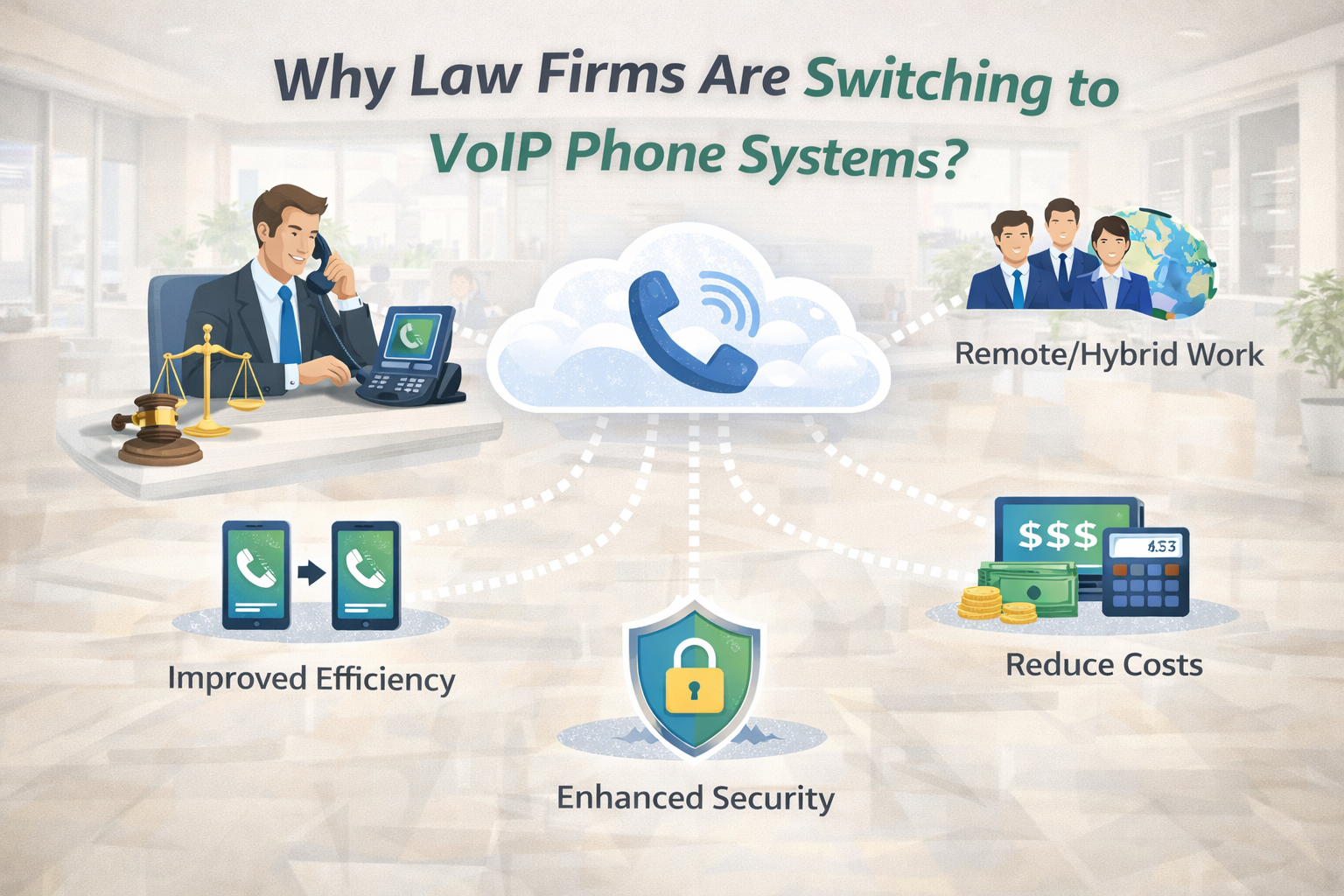
In this blog, we are going to see what are the five advantages that an VoIP phone systems offer the law firms.
What is VoIP in a law firm?
VoIP systems provide unparalleled flexibility in the legal field due to the busy schedules and constant necessity to leave the office to meet a client. VoIP does not require an attorney or anybody to be in a specific location unlike in traditional phone systems where one had to be at the office to speak. You remain connected with clients and colleagues in court, in the office, or at home.
Why You Need VoIP in Your Modern Law Firm?
The personal facility to connect anytime, anywhere is no longer a luxury (in the legal profession) but a requirement. VoIP helps the law firms serve their clients in a timely and quality way without the restrictions presented by the antiquated phone systems. VoIP enables law firms to work smarter rather than harder, as it is flexible, cost-effective and has features.
Best Advantages of VoIP to Law Firms
- Cost Savings
VoIP does not require heavy investments in hardware and other maintenance costs incurred with landline technology. Law firms can also enjoy using low-cost, per-user pricing models, as well as accessing good premium features such as voicemail-to-email transcription and call forwarding at no extra cost.
- Improved Client Communications
Advanced features available in VoIP systems include call recording which can prove useful in recording client communications accurately. Voicemail transcription provided by a service that uses automated speech recognition, will provide your staff members with easy access to essential client information, increasing their organization and efficiency.
- Scalability to support Firm growth
No matter what size your firm is, whether you are a boutique firm or growing practice, it is easy to add new users or lines with VoIP which can save you the trouble of installing new hardware. Such scaling enables law firms to be flexible as they grow in size.
- Easy Integration with the Existing Tools
VoIP easily deploys with case management, emails and other platforms law firms have been using. Through such connectivity, there is ease in workflow and enhanced co-ordination of overall productivity.
- Sensitive Information Security Communication
The information which is represented in legal communications is highly confidential. VoIP systems are taking the security measures to the highest level such as security and encryption, and identity management to protect the privacy of clients so that it meets the expected data protection guidelines.
- Cross-device Unified Communication
Communication channel merges a VoIP system which gives law firms a chance to utilize voice, video and messages to text services in the same platform. Not only will this enhance teamwork but also make it easier to manage communication within your team.
How to choose the best VoIP provider for your law firm?
Choosing a VoIP provider to fit your law firm, it is important not to focus only on the monthly fee. Your solution must match the specific needs of the legal industry, particularly in the area of security, integration and reliability. Here are some of the things you need to consider carefully when making your VoIP selection.
- Compliance and Security
Daily law firms handle confidential information of clients and therefore the phone system should be able to provide a heavy level protection. Use those providers who support secure protocols such as SRTP (Secure Real-Time Transport Protocol) to send voice, and TLS (Transport Layer Security) to send data over the wire. They must also provide user-based control access to their platform so that only the approved personnel may view sensitive call history or client details. What is most important is that the provider must show that they comply with such legal and data rules as GDPR, HIPAA, and ABA requirements. These certifications should be of special concern to firms handling international clients or medical-legal cases.
- Legal integration with tools
An integrated voice-over-IP system that is easily linked to your legal practice management software will enhance efficiency to a great extent. Select a provider that is compatible with services such as Clio, MyCase, LEAP, PracticePanther, or Smokeball. Such integrations must enable automatic logging of calls, labeling of calls to a particular client matter, time tracking against billing, and synchronization of communications with client files. The gap between the native integration and the third-party workaround is enormous; native ones are more stable, faster, and well-supported. An integrated system minimizes changes in repetitive operations and guarantees that your communication history is always correct and in real time.
- Billings and analytics assistance
Your provider must have elaborate call reporting functionality which enables you to monitor the duration of the calls, frequency of calls and users activity. The feature to print exportable reports, connect calls to particular client cases, and track time spent on the phone can significantly increase the billing accuracy of your firm. This is particularly beneficial to time-based billing.
- Mobility and omni-channel access
Lawyers and support personnel frequently have to perform from home or go to court, and it is not feasible to have a desk phone in that situation. The best VoIP service must provide quality softphone software on desktops, laptops, and phones as well as iOS and Android phones. It should also be able sync easily between different devices such that you can receive a call on your mobile and continue on where you left on your computer. Better still, the sites that can provide SMS, video conferencing, and live chat services are the most suitable to ensure your firm can embrace more than one communication media to communicate with its clients.
- Customer service and networks stability
Law firm cannot have any unaddressed technical problems or downtimes. Seek out providers who provide such a service level agreement (SLA) that ensures 99.99 percent uptime, regional data centres (ideally UK or EU based should you operate in that region) and to have 24/7 customer care responsive to various forms of communication such as phone, chat and email. An extra bonus is a provider who will provide you with a dedicated account manager or even legal specific onboarding assistance.
In Conclusion:
VoIP is more than a technical transformation, it is a strategic Collaboration move that is ready to modernize the law firms, cut costs and improve their service. As the law is changing, communication must also change. As an individual practitioner or the president of a multistate practice, VoIP may transform how your firm communicates with clients, staff, and the future.
FAQs
Q1. Is VoIP secure enough to handle confidential calls by clients?
The contemporary VoIP systems are end-to-end encrypted and designed to achieve legal confidentiality standards, yes.
Q2. Is VoIP going to save my law firm and costs?
Absolutely. VoIP usually saves you up to 30-70 % on your phone bills, and this is particularly true when you happen to make long-distance calls regularly.
Q3. Does my existing case management software make VoIP work?
The most VoIP providers are compatible with well known law tools such as clio, practice panther, my case.
Q4. Does VoIP have better or worse call quality than landlines?
When using a decent internet connection, VoIP calls, in some cases may be better than ordinary landlines.
Q5. How fast would my law firm change to VoIP?
Most transitions can be done in a few days to a few weeks depending on the size of the firms.