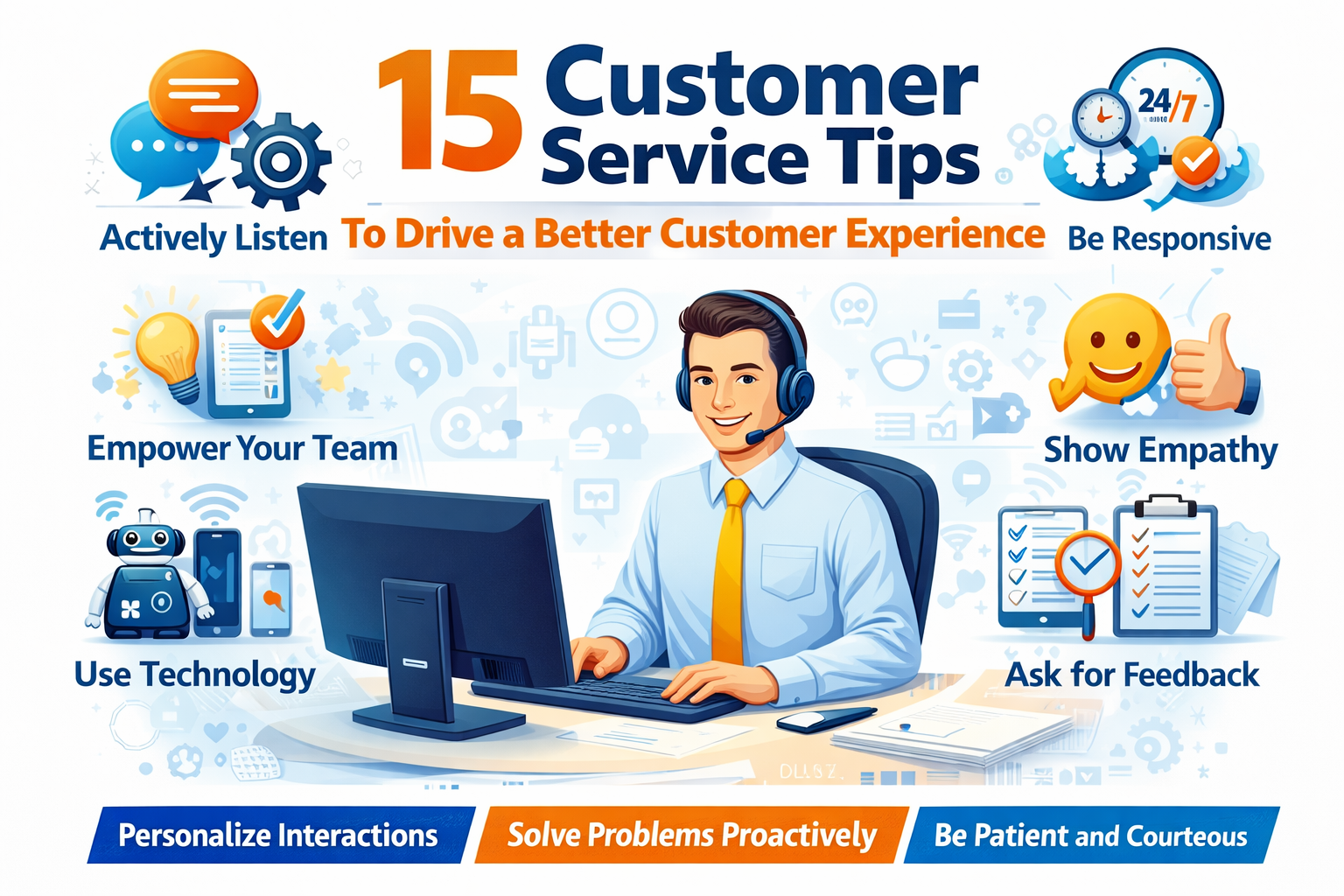
We all know that satisfied customers are the backbone of any successful business, because most of your business depends on customer service. Negative customer experience can ruin the image and reputation of your brand in the eyes of the public, but proper customer service can generate loyalty and drive business growth. Customer service is some good investment that can help to grow your business and develop your customer relation with positive word of mouth.
In order to build a good relationship with your customers you should understand the problems, solve their queries and answer their question. This comprehensive blog will briefly describe tips for enhancing and developing your customer service.
What is customer service?
Customer experience is a cumulative set of opinions and feelings which customers develop regarding your brand as a result of their interactions with you in various points of contact. It is the overall set of experiences that your customer has had with your business along their way. The process starts when customers first hear about your brand, and goes through product/service purchase and use, along with continual after-sale support and reconciliation.
Consider that people meet your brand regularly on multiple channels, such as websites, social media channels and emails, before and after their purchase. Make sure that customer data can flow easily in between channels providing a cohesive and uninterrupted customer experience.
Positive customer experience is an integral part of the foundation for developing lasting customer loyalty and continuous purchases. Poor interaction commonly leads customers to end the business.
Tips to Improve Customer Experience
Put these helpful tips into use regarding your customer experience approach.
1. Identify your customer persona.
If you are therefore to truly improve your customer experience, then you have to start by knowing who your real customers are.
The development of your customer persona allows you to know the way your customers go and what you need to do for them. With this information, you can tailor your services and products to deliver very personalized interventions.
By generating customer personas, you can predict what customers will demand and act to remove any obstacles to their workflow.
To understand how to build a detailed customer persona, follow the tips mentioned below:
- Carry out interviews and surveys: Gain customer insight through making existing and potential customers respond to questions on the products or services they have used or expressed interest in.
- Analytics: With analytics of your site and social media, you can know what your audience reads, what their geographic composition is like, and their sentiment.
- Sales and customer service teams: These teams will introduce you to the causes of purchases, the challenges customers encounter, and their principal aims.
2. Map out the customer journey.
Mapping all customer interactions that take place from brand awareness to post-purchase is highly advisable in determining and eliminating friction in your customer journey.
Creating a customer journey map will assist you in understanding where your customers encounter grievances as they go through your process.
Now, we will discuss customer journey mapping:
- Break down the journey into steps: Divide the customer journey into the following stages: awareness, consideration, purchase, retention, and advocacy. The number of stages can be modified to add or increase based on your business requirements.
- Identify touchpoints: Simplify the relationships and points of contact that clients experience during every stage of the process of their interactions with your brand.
- Design a visual representation: Chart or diagram the customer journey to better understand it, using charts or diagrams or infographics. Determine the points at which the mapping is not working and where you can improve customer experience.
3. Develop a culture of customers.
The support team is frequently considered to be the sole department that is responsible in the provision of customer experience.
The reality is that achieving a seamless and outstanding customer experience across all touchpoints requires the individual efforts of each department of an organization.
Customer service professionals support customer issue resolution and collect important feedback. This feedback is helpful to the product development teams in fine-tuning and upgrading their products. The IT team keeps the technical systems up and running so that the product can work well. Finance teams deal with customers’ timely invoice processing.
As it is apparent, every department helps in forming an impression on the customers of the company. That’s why one should keep in mind that customer experience is not an undertaking of one department; it is the responsibility of all. These are the below strategies that would be required in order to establish a customer-oriented environment:
- Lead by example: Leaders at all levels need to be models who live customer-centric values. An example would be customer needs and patience and tolerance of the staff.
- Train employees: Provide continuous training to your employees to hone skills, such as, active listening, effective communication, and problem-solving.
- Automation: Time savings through automated processes will allow the personnel to pay greater attention to customer-oriented objectives.
4. Personalize customer interactions
The whole purpose of the personalization is that every interaction a customer experiences should be in line with the previous interactions. This approach is likely to create a psychological connection and also ensure that customers feel that they are valued.
Providing products, services and contents that are compatible with the interest of a customer will contribute to an increase in engagement and conversion rates.
There are several approaches to personalize customers’ experience.
- Personalized communication: Deliver personalized recommendations in terms of products and contents personalized to individual customer’s interests and behaviors. A subtle way of sending a message after a customer made a transaction is to send a personalized email to such customer giving him a special discount to make a repeat purchase.
- Dynamic website content: Personalize your landing pages by passing parameters in the URL, so that the content or offerings can be personalized based on each visitor’s preferences as he/she interact with your site.
- Personalized onboarding: The best strategy for winning new customers is by adjusting onboarding processes to accommodate specific interests and desires of new customers. Under this strategy, your new customers are given information that is the most relevant and compatible with their particular needs.
5. Implement loyalty programs
To develop loyalty programs, you may use point schemes, discounts, offers, customized benefits, and extras. Providing incentives reflects to the customers the fact that returns are being made often and encourages the feeling of being valued.
Loyalty programs make your customers want to shop with you more regularly. By offering additional benefits or rewards, they induce customers to use your brand instead of discovering substitutes.
This will encourage customers to invest more, thus increasing their lifetime worth to the company.
6. Set realistic expectations
Trust of the customer is a fundamental element of delivering a positive experience for the customer.
Managing expectations with customers regarding products, services, and support is a distinct role of organizations. It is possible that not meeting customer expectations will cause the customer to be frustrated and disappointed.
An easy example is communicating transparent and precise delivery dates to customers. Provide a correct time-frame for delivery either to the product listing itself or when the order details are established so that the customer knows when they should expect it. Let the customer know in case of delays in delivery.
In case you want to provide realistic expectations to your customers, the following are a few tips that will guide you:
- Make it simple: Use direct point-to-point communication so that customers can be informed of the product features, delivery date or when the service is going to be performed.
- Set service hours: It’s important to share your working hours or days when your support team is on duty with the public.
- Under-promise, over-deliver: The setting of realistic tones and a flexibility factor in your talks to avoid disappointments. This prepares you to overcome any obstacles that could bust up your schedule.
- Status updates: Hence, provide automated ongoing notifications to customers to keep them updated regarding relevant changes to their orders or services.
7. Take advantage of social media channels.
On the contrary, a pinch of originality allows them to create engaging rechanges which will leave a positive impression on clients.
The successful brands do not limit themselves to basic social media marketing and branding, they utilize a range of engagement approaches.
Below are a few strategies to raise your social media game to pitch level:
- Act fast: Social media users can hardly stay active on social networks too long. Always reply promptly to all comments, mentions and direct messages that you get. Recognize positive or negative feedback. This demonstrates that you are concerned about customer satisfaction.
- Utilize social listening tools: Utilize social listening tools to monitor discussion trends, mentions, and key keywords. This will provide you with information on the perception of customers towards the brand.
- Build communities: It will be possible to form personal forums or groups on social sites and make your customers and potential brand followers to communicate with your company. Further, this provides customers with an area to interact with one another and obtain support from peers for addressing issues.
Bottom Line:
Doing well in customer relationship management is not an easy task. For people, it is normal to send customer services requests not minding problems and dissatisfaction. You can reverse this expectation and provide your brand with a unique corner on the market leaders.
Proper implementation of the right strategy will increase your customer lifetime value and customer satisfaction. Use the techniques provided by the present guide to win your customers and keep them loyal.
FAQS
Q1. How important is good customer service?
Good customer relationship helps to foster trust, prompt more business and good word-of-mouth. Superior service can be a differentiating factor that will serve as customer retention and long-term success factor in competitive markets.
Q2. What are the most prominent features to have among a great customer service representative?
Good communication skills, ability to empathise with customers, patience, strong product knowledge as well as problem solving skills, and a perpetually positive and professional attitude is also seen as most critical.
Q3. How do I analyze the work of the customer service?
Some criteria in performance measurement that can be used with metrics include Customer Satisfaction Score (CSAT), Net Promoter Score (NPS), First Response Time (FRT), Average Resolution Time (ART), and Customer Retention Rate A frequent customer feedback collection is also necessary.
Q4. How frequent should customer feedback be requested?
It is best to ask for a feedback after every important interaction like support cases or purchases in regularly time intervals. Such surveys as customer satisfaction checks every quarter also help trace long-term trends.
Q5. What is the best way to train my customer service team?
Training that works will involve onboarding in real-life cases, frequent refreshers, product updates and role-playing exercises and continuous coaching. The prospects of using peer feedback and fundamental customer interactions can be used to improve learning.