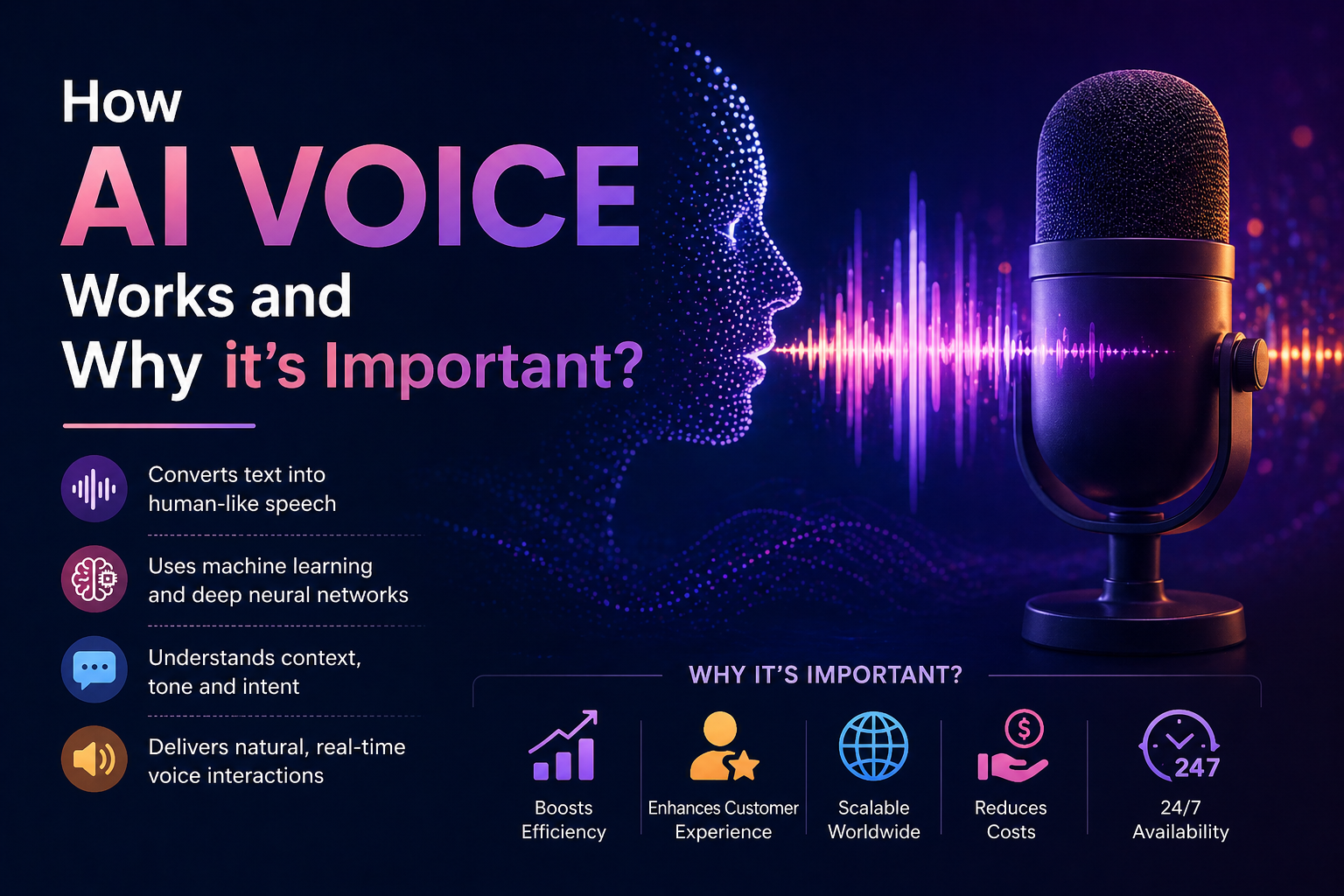
The voice AI technology is projected to lead to a 12 billion dollar market that is expected to multiply by four times by 2029. Its potential is already proven by major companies like Amazon, Apple, and Google. Voice AI is far more than merely command systems, canned responses today it is capable of complex conversations, can understand context, and can talk to you as a human being can.
As a business leader and developer, there is a difference between automated customer support, multilingual communication and easy digital experiences. Increasing to 157 million users likely to be relying on voice agents by 2026, companies must incorporate Voice AI to remain competitive.
The following blog will discuss how your voice AI works, what it can do, and what it is doing to business.
What is an AI voice?
AI voice is the technology that can produce human-like speech through text input or other sources by use of deep learning models that are trained on actual voice data. It generates natural-sounding voices that can be manipulated according to the gender, age, accent and emotions.
By having AI voice agents in the business, you would reduce the support fees, as well as provide 24/7 service.
Through AI voice, customer service can be automated, high call volumes can be managed, and uniform service delivery can be achieved to all customers with voice bots and IVR systems. The modern AI voice assistant has behavioral features that allow analyzing the context of speech, comprehending the user’s intent, and creating the appropriate response without the involvement of a human operator.
How do voice generators based on AI work?
A computer screen with a text-to-speech interface incorporating sound wave graphics, a microphone, and a cup, a keyboard, a mouse and a desk lamp.
The voice generators of AI are based on deep learning algorithms which are also a form of artificial intelligence that learns through large volumes of data. They work by text-to-speech conversion, and this is a multi-step process:
- The first step involves training the system with a large amount of words through speech. This training consists of voice recording analysis, in which the algorithm becomes familiar with the speech patterns, like the intonation, pace, and accents. The larger and more varied the data set, the more flexible and realistic the voice generator.
- Once the AI is trained, it can then generate speech text using text-to-speech (TTS). The AI breaks down the speech text that is entered into phonemes. It then combines all these components and assembles them into words and sentences.
- Some advanced AI voice generators apply techniques such as Natural Language Processing (NLP) in order to be more realistic. NLP involves getting the language in the system to know the subtext of the language and apply changes to the speech output in the system. This involves ignoring sarcasm, questions or excitement which makes the synthetic voice sound more natural and human-like.
These voice generators keep on advancing with the evolution of AI technology. They are becoming more skillful in dealing with some complicated linguistic attributes and gifting speech that is notably human, not only in its sound but also in its nuance.
AI voice advantages to businesses.
This is what an AI voice can do to your business:
- Optimized customer support: Smart voice routing enables the customer support teams to deal with cases in less time. The system verifies leads, categorizes emergency cases, and makes calls to special agents depending on the intent identification.
- Delivering a refined customer experience: Customer support teams are assigned priority call queues which are assigned based on voice sentiment analysis in real-time. The NLP engine uses every interaction to learn how to improve responses and increase customer satisfaction (CSAT) scores.
- Custom and automated customer experience: The platform learns to create customer profiles after every interaction. Patterns of voice and history of conversation influence responses such that every conversation becomes natural and informed.
- Lower Customer Support expenses: Voice automation saves on training expenses and time used in training other agents. With the system, new team members respond to complex queries in a shorter period because it is used to manage regular conversations using NLP engines.
- Customers with disabilities: With integration of the screen reader and voice commands, your services will work with everyone. ASR technology is used by customers with varied abilities as they complete transactions on their own.
Trained on the knowledge base of choice, AI Voice Agents can help businesses manage all tasks that are easy to schedule appointments and send reminders to providing personalized financial advice. Increase your sales using AI-driven shopping assistance, improve the process of language barriers in education by real-time translation, and offer excellent customer service without a problem.
To your customers, it will mean:
- Self-serve: Customers are able to get things done by mere voice command. They monitor the status of orders, make updates to accounts and resolve problems without touching a keypad or monitor.
- Single point of data collection: Once the customers provide the information, you utilize it everywhere. The voice system is a safe way of storing customer details and sharing it with your support team so that no one tells the same story.
- Fewer obstacles to communication: Voice AI eliminates the barriers to communication, as it allows customers to speak their language. They can receive immediate responses 24 hours a day without having to go through a complicated phone menu and can also avoid language issues.
The fundamental elements of AI voice systems.
It is essential to understand the key components of AI voice; automatic speech recognition (ASR), natural language processing (NLP) and text-to-speech (TTS) to comprehend how AI voice works.
- Automatic speech recognition (ASR)
Automatic speech recognition refers to a system that translates into written language. ASR works with the audio input and uses audio processing to give out the patterns of speech when defining speech and the words spoken to accurately transform letters into the speech. The key stages in ASR include:
- Voice input: Read out the verbal message by use of a microphone.
- Signal processing: Improving voice signal and noise reduction.
- Feature extraction: Extraction of the audio in order to detect the important features like pitch, frequency and length.
- Pattern recognition: The use of these features to compare with the patterns in a database and decode speech into text.
The basis of most voice-activated technologies is ASR, which is used to give input to NLP systems.
- NLP: Natural language processing.
The AI element that processes human language and understands it is known as natural language processing. After ASR has transcribed the speech to text, NLP algorithms are used to extract meaning and intent in the text. Key aspects of NLP include:
- Analysis of syntax: An analysis of the syntactic structure of sentences.
- Semantic analysis: Interpretation of meaning of words and phrases in context.
- Sentiment analysis: Determining the feelings of the speaker and his attitudes.
- Intent recognition: This involves identifying the intent of the user that is associated with the spoken words.
Final Words
The uses of AI voice are limitless, whether in the context of increasing accessibility and efficiency or providing personalized user experiences. The significance of the understanding of how AI voice works cannot be overassessed as businesses keep utilizing it to narrate videos, drive virtual assistants, and conduct conversations with AI.
As machine learning and natural language processing improve, it can be expected that the AI voice interactions will become even more realistic.
FAQs
Q1.How realistic are the voices created by AI voice generators?
The quality (realism) of the AI voices has improved. The speech generated by modern AI voice generators is close in terms of its resemblance to the human speech, with its tone, rhythm, and emotion nuances.
Q2. Do AI voice generators exist as an option to one or to a business only?
The application of AI voice generators is available to individuals and companies. They are common in many industries either as part of personal projects and content generation or in the workplace in such areas as corporate communication and e-learning courses.
Q3. Are AI voice generators also capable of different contexts and emotional adjustments in speech?
Yes, advanced AI voice generators use Natural Language Processing (NLP) to understand and interpret the text and the sentiment. This allows them to generate speech to a certain extent based on the emotion or style, such as casual chatting, presentation or dramatic narration.
Q4. Are there any ethical concerns about using AI voice generators and voice cloning?
The main ethical concerns are consent and the possibility of misuse. When it comes to voice cloning, the raw material for the voice (the person) must provide consent. And, there is a risk of misuse of AI-generated voices and such rules and regulations should be set to ensure misuse.