SMS and MMS messaging have been effective business communication tools for directly contact the customers. But what about getting your messages delivered effectively and in a compliant way?
Application-to-person (A2P) texting enables companies to message high volumes without the inconvenience of manual texting. However, with the increasing demand for A2P, more efficient, compliant and economical solutions become necessary.
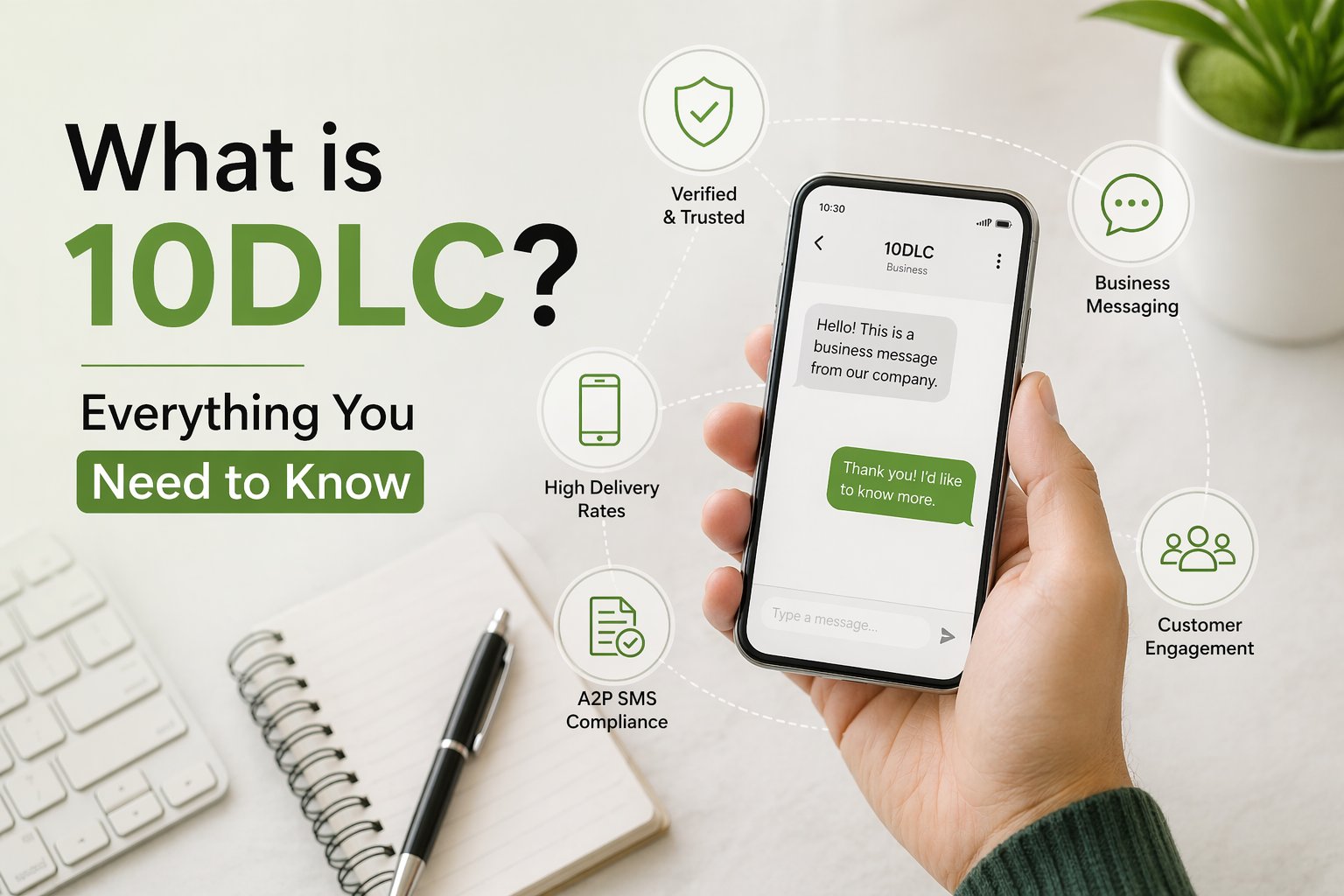
That is where 10DLC comes in. 10DLC is an evolution of A2P messaging, created in response to the industry’s demand for efficient, compliant, and cost-effective solutions. By using 10DLC you will be following a model that aims to streamline A2P messaging. The result? Improved reach, increased delivery rates, compliance and reduced costs.
It is important to note that 10DLC is the key to every business messenger. In this blog post, we will point out its centralized role in the A2P communication context, its benefits and everything you need to know.
What is 10DLC?
Mobile network operators approve local long code numbers that can be used in A2P messaging, referred to as 10DLC (10-digit long code) numbers. This is approved through the registration of the local long code number with an approved 10DLC brand and campaign.
A long code number that is 10DLC registered can support fairly large amounts of text messages. U.S. carriers are requiring that all A2P messaging use numbers registered by 10DLC on their networks.
In order to comprehend 10DLC and its advantages entirely, we should cite a glimpse of how business text messaging has changed through the years.
What is the evolution of Business messaging?
Until the late 2010s, most types of phone numbers were not specifically configured to send mass SMS messages, which posed such challenges as:
- Limited reach
- Possible compliance problems.
- Weaknesses in communication.
In later years, telecommunications companies and regulators resolved these issues by joining hands to allocate phone numbers that are conducive to bulk messaging.
As of today, A2P (application-to-person) texting is the most popular and most affordable method through which businesses can send SMS and MMS messages to their customers. A2P eliminates the process of texting manually and allows companies to text in large quantities. It is then simple as apple pie to send PDF links and other promotional materials through sms and mms.
Most American organizations are capable of sending messages using three types of numbers:
- Toll-free long codes
Another relatively cheap alternative to two-way SMS is the use of toll-free numbers when it comes to moderately large volumes. Toll-free long code numbers are capable of sending and receiving many thousands of messages at high throughput rates. They can also be used to brand. Number search tools provide businesses with branded vanity toll-free numbers (e.g. 1-866-FASHION).
Toll-free long code numbers have to be registered and registration is complicated and takes a lot of time by some carriers. You need to make sure that you pick a carrier that will provide you with an easy time registering and verifying your numbers. Also to be considered is that in some instances the toll-free numbers may seem to be international (non-US) numbers to your customers, which limits the success of your campaign.
- Short codes
Short codes are best suited in ultra-high volume traffic such as large market awareness campaigns using a recognizable custom number. They have great throughput but are very expensive to install and maintain.
Also, poor phone call management may be a constraint to businesses that require multi-channel communication. Although this offers a two-way messaging service, the cost and limitations usually make companies find alternatives.
- 10DLC numbers
Although short codes are designed to handle very high volumes of traffic, they also have high setup costs and cannot support phone calls. And local long code phone numbers–mainly intended to be used to text to people (P2P)–are constrained in the amount of messages they can send. Compliance issues can also arise when they are used to send A2P messaging because doing this violates CTIA guidelines.
10DLC was developed to fill those gaps. It overcomes local long code volume and compliance issues and avoids the prohibitive cost and capacity of short codes. By using 10DLC, companies can embrace the power of both without their natural limitations, making 10DLC the best option in the modern world of A2P messaging.
Benefits of 10DLC
The 10DLC number provides businesses with an excellent integrated solution: they can send mass text messages inexpensively and maintain low overhead costs. Here’s what sets 10DLC apart:
- Increased amounts of SMS messages and throughput.
The volumes of SMS messaging sent over 10DLC numbers can fill in the spread between the restrictions set by short codes and by toll-free long codes. This maximizes throughput and gets your messages delivered quickly to your audience at the right time.
- Reduced cost and increased flexibility.
Compared to other types of numbers, 10DLC numbers cost less, and this makes them the best option to use when the business can not afford a short code or does not even require it. Better still, companies can upgrade their pre-existing landlines to 10DLC numbers, which will enable them to send more messages without necessarily buying another number.
- Improved deliverability and compliance.
The benefit with 10DLC numbers is that they will be pre-authorized with the mobile network operators. Pre-approval gives you greater delivery rates and increased adherence to carrier rules so that your messages are delivered to the target audience with no glitches whatsoever.
Who should consider using 10DLC?
10DLC is not the solution that fits everyone, but it supports businesses with different needs.
- Organizations that are interested in volume and cost.
When your business has a set of messages that is not too large to utilize short codes, but not too large to require 10DLC. It provides the flexibility of higher throughput at low prices like the short codes. In order to guide you through the maze of messaging solutions, take a look at this detailed list of various types of numbers and their throughput potentials.
- Business that requires affordable messaging.
10DLC is also a low-cost option that many companies can afford, given that dedicated short code costs are too high to purchase for them; 10DLC is cheap relative to dedicated short code.
- Companies that desire to be compliant.
With the increasing number of regulations regarding messaging practices, companies should ensure to be in compliance or risk punishment. The mobile network operators pre-authorize 10DLC numbers and therefore, they are less likely to be caught up with non-compliance.
- Brands that want a more affordable delivery.
There is a unique benefit to 10DLC to businesses that have continuously faced message delivery issues. The fact that it has been pre-approved by mobile network operators does away with the usual delivery challenges associated with other forms of messaging. By bypassing those obstacles, you will have fewer messages that are not delivered, fewer messages that will be treated as spam and an increased chance that your messages will be delivered straight to the inbox of your recipient, so 10DLC is a game changer in the realm of business messaging.
- Companies that need flexibility.
With 10DLC, businesses with existing landlines are offered a smooth migration into a format that can be used to send bulk messages. That way you will be able to keep your current number and enjoy the features of 10DLC.
In case of varying levels of messages being received by your business, 10DLC will also give you the option to scale up or down as required without paying prohibitive charges.
10DLC is among the best players in terms of cost, volume, deliverability and compliance. To determine whether to adopt 10DLC or not, however, you should first consider your needs, the amount of messaging, and budget to ascertain whether this service fits you.
What is the registration and implementation of 10DLC?
To be able to use 10DLC, one must register his/her 10DLC number with The Campaign Registry (TCR). It is also an important hub of A2P 10DLC message campaigns by large mobile operators in North America like AT&T, Verizon, and others to allow businesses to better and more securely communicate with their customers.
When you are a reseller and intend to book a messaging campaign on behalf of a third party, you will be required to give details about the recipients of the messages. This contains information on their company, and the messaging plans that they have adopted.
We have prepared a step-by-step 10 DLC registration to assist you further with all the vital bits you have to fill out to complete your 10DLC registration.
Step 1: TCR vetting process
In cases where a brand would like to relay messages via a carrier, they are limited to the number of messages they can relay by the score they would have received during the vetting process.
The undisclosed algorithms of third-party vetting partners, including Aegis Mobile, Campaign Verify, and WMC Global, calculate vetting scores that certify brands according to the type of organization account and other company information.
TCR charges a one-time fee of a brand license plate number to evaluate a brand and the brands campaigns.
Step 2: 10DLC Costs
In the case of standard brands, registration costs $4. Also optional vetting charge of $40, which increases throughput. Each campaign will cost you $10 per month, you are allowed to use 100 campaigns and 49 long code numbers per campaign.
The throughput reaches a maximum of 4,500 TPM depending on the brand and score of the campaign.
Step 3: Messaging throughputs
US operators have established levels of messaging throughput in terms of transactions per minute (TPM) and transactions per day (TPD). Depending on your TCR assigned vetting score, you are assigned message rate limits and throughput.
In Conclusion:
As far as SMS messaging campaigns are concerned 10DLC ticks all the right boxes. It provides rapid delivery rates, increased throughput, enhanced security, and compliance at the same time as a scalable solution and affordable to the business.
Having the capacity to transmit and receive messages in real-time safely will become increasingly important as the demands of consumers evolve and companies compete to attract their attention and involvement; that is where 10DLC will be applicable.
FAQs
Q1. Who is supposed to enroll in 10DLC?
You should apply to get 10DLC number in the case you are a business that intends to use A2P messaging services in the United States. Adhering to the carrier regulations is very important so that your messages can reach your target group effectively.
Q2. What will happen when I fail to register a 10DLC?
You run a risk of having your messages blocked or marked spam when you fail to properly register your 10DLC. It may lead to additional costs and damage to your reputation as a sender. To avoid this undesirable outcome, make sure your messages are registered properly.
Q3. How do I get a 10DLC number?
Service providers such as Plivo can help businesses get a 10DLC number and help with the registration and set up process.
Q4. Why is 10DLC different than short codes?
Short codes are used in high-volume messaging campaigns, and deliver at a higher rate, however, they are more expensive. 10DLC, in turn, is a cheaper option with better delivery and compliance.
Q5. What is the distinction between 10DLC and toll-free?
Toll-free numbers can be used to facilitate high-volume and two-way SMS messaging relatively cheaply, which in turn benefits brand perception, but may not be as deliverable and compliant with messaging policies of carrier networks as 10DLC numbers. The latter are carrier-network optimized to perform effective and large-scale SMS campaigns, and are compliant with the A2P messaging policies of mobile carriers.