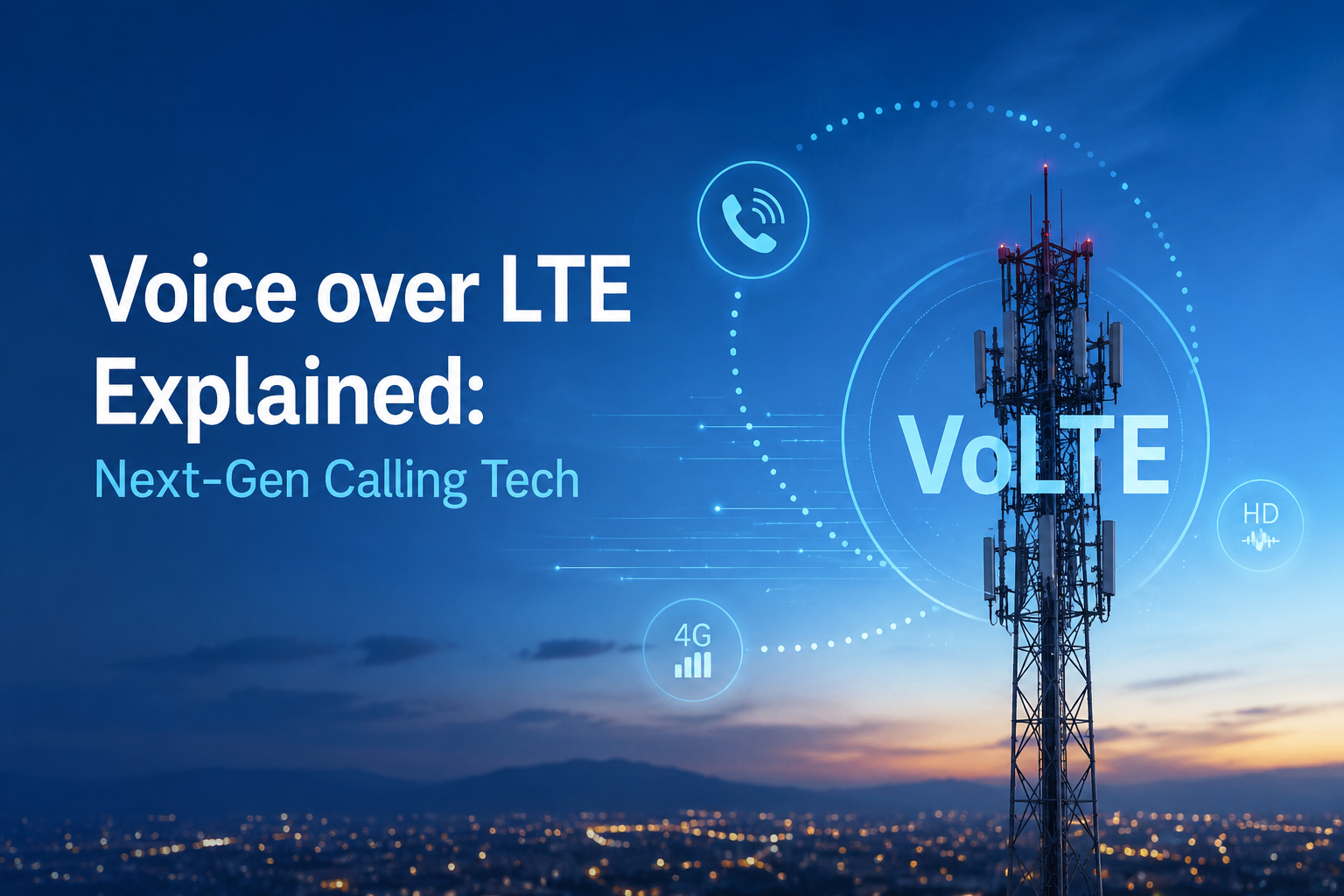
Have you ever thought about why some calls sound like you are speaking face-to-face while others do not sound crisp and clear, but rather mostly noise or echoes? The solution is a revolutionary technology known as Voice over LTE or VoLTE.
VoLTE is not another technological acronym. It is an innovative product that has brought about quality, crystal-clear sound and an array of exciting features that have been transforming our communication experiences ever since 2012.
VoLTE is a strong business tool that enhances the efficiency of operation and standards of communication among business owners. Its ability to provide extraordinarily clear, realistic voice calls makes communication both internal and external smooth. In addition, the rapid call setup times offered by VoLTE remove the time lag, creating rapid, uninterrupted business transactions. VoLTE is the new standard in the industry at this stage and it is altering the business calling environment, where organizations can communicate effectively.
The following blog will discuss everything you need to know about VoLTE.
What is VoLTE?
Voice over LTE is a high-speed wireless communication standard that enables voice communication to be transmitted over a 4G or 5G LTE (as opposed to the legacy voice network) data connection of a device. The technology has tremendously enhanced the quality of calls, the time taken to place a call and data usage during a call.
VoLTE is a network operating on IP Multimedia Subsystem (IMS), and there are control and media plane voice service profiles on LTE. This is an invention that allows one to transmit a voice call as data packets, like emails, social media content and websites are transmitted via the internet. This is a drastic change to the traditional voice calls which are relayed over a dedicated line in a mobile network.
How does VoLTE work?
The idea itself may look very simple. It is merely a VoIP call on the LTE network, right? VoLTE is much more complex, though. There are a lot of things that happen in the background to make an LTE VoIP call possible.
We’ll discuss this process in stages for a better understanding.
1. The caller makes a call.
A user can either dial a number or make a call to an individual in their contact list. As soon as he does so, the phone connects to the closest cellphone tower using the LTE frequencies.
Since it is a VoLTE call, the call request packet is transmitted in the form of a data packet on IP. The call is taken by the cell tower and it starts processing the call.
2. The Cellular Tower answers your call.
The cellular tower verifies the data packet and retrieves all required information to pass the call. Like any other VoIP communication, VoLTE uses the session initiation protocol to link the caller with the desired recipient of the call.
SIP on its own is a significant protocol which supports IP-based communication. Although this may sound easy, it entails several procedures that are to be carried out to form a connection to facilitate a VoLTE call.
3. Your Call is connected via IP.
The magic of SIP takes place and creates a direct contact between the caller and the target of the call. The receiver of the call is now ringing their phone and the caller would have to wait until the receiver picks their phone and responds.
4. Your Call is answered.
The targeted receiver picks up his phone and at this point the two-way flow of voice data may commence. Prior to VoLTE, voice data was represented as an analog audio stream, and had to occupy specific channels in order to enable a voice call.
VoLTE involves the transmission of the voice data as data packets via internet. This results in an improved user interface and quality audio.
In the case of telecom operators, this feature implies that they can make more calls with each telecom tower in their possession.
Top Benefits of VoLTE
Although the technical advantages of VoLTE are numerous, we are going to discuss only those advantages that are most beneficial to the end consumers.
- Superior Call Quality
The use of technologies like 2G and 3G makes it easy to make calls but it is incomparable in terms of audio quality. This is in part due to the data transmission throughput capacities of the two mentioned technologies.
The 4G can however support 3X and 6X data throughput as opposed to 3G and 2G respectively. The ability to transmit more data means the quality of audio is greater.
In addition, the connections are more reliable than legacy connections since they are IP based. Such enhancements lead to much better call quality and experience.
- Improved Battery Life
The calling without VoLTE enabled option lets your smart phone use 3G or 2G network for making a call. After a call is finished, your smartphone needs to re-establish a connection with the 4G network.
Therefore, this changing process consumes the battery because of the extra workload. Since the 4G network is not optimized to directly make voice calls, it can only be avoided with VoLTE. However, when you activate VoLTE, you are consuming much less battery.
It is claimed that the battery life will be almost doubled. But the gains have not been reported by users and some even have refuted the charges on the basis of experience.
- Better connectivity and better coverage.
Do you remember those days when we used to walk out to make calls? Or lose connectivity when you are in your bedroom? The issue of connectivity existed with regard to 2G and 3G technology. VoLTE and the 4G technology, which forms its basis, are based on the 800MHz spectrum. It has more coverage in the 800MHz spectrum than 2G and 3G.
The penetrative values of 4G signal are also significantly high. This implies that you will be able to have 4G connectivity over the house, behind several walls.
In addition, 4G has the ability to deliver calls twice the speed as the old technology. In this way, the callers have an opportunity to make more calls hence improved user experience for those calling.
- Ability to Multitask
This is probably not what Gen Z have experienced but the Millenials are well aware of this. Use of the internet was no longer possible once you had made a call in 3G.
Therefore, when you have to send a very crucial email when you are on call, share a document, update or even view maps, you cannot do it with 3G.
On 4G and VoLTE, you are able to multi-task. Since VoLTE involves the use of data packets, a call does not consume the entire network bandwidth. VoLTE and 4G can be used to continue working or do important things using internet.
- Video Calling
The introduction of Direct Video calls in the 3G days was quite primitive in terms of the way it was handled and the usefulness it was providing to the users. With the advent of 4G and VoLTE, this is no longer the case.
4G technologies were available for making VoLTE-less video calls, but required special applications such as Skype, Zoom, Google Meet, etc. However, VoLTE brought 4G the ability to enable direct video calling.
VoLTE allowed direct video calling with the 4G technology by offering a new stream of data in the form of video. The user experience and utility provided were comparable to any other independent video calling application.
- Support for VoLTE
The 4G wireless networks are largely based on LTE technology and can therefore support VoLTE. The Global Mobile Suppliers Association report on May 2026 estimates that there were 375 network operators globally that had invested in VoLTE technology and 320 network operators that had deployed VoLTE networks.
VoLTE is available in the majority of cellular devices, such as all subsequent iPhones since iPhone 6, all Google Pixels, and all Samsung Galaxy devices since 2015. VoLTE is normally turned on and off by the user via the device settings. To conduct a VoLTE call, all the communicating devices should be VoLTE compatible, the functions should be active and they should be within a supported region.
Final Words
VoLTE has been a potential technology for the better half of the past decade. Though we have mentioned some of its limitations, they shall be addressed in the coming years.
Older networks are also being replaced with newer and cheaper 4G and 5G networks. Network interoperability and network availability will not be an issue once the uptake of 5G takes momentum.
Considering the recent news, 5G enabled smartphones have taken over 51 percent and beyond in regard to new devices sold. The last limiting factor is that all these devices are VoLTE capable.
FAQs
Q1. Does Volte support all mobile phones?
No, not every phone is compatible with VoLTE. VoLTE can be disabled on older models or budget phones and usually is enabled on newer and more expensive smartphones.
Q2. What is the way to check whether VoLTE is turned on in my phone or not?
To find out whether your phone has VoLTE on and is enabled, you can check the settings of your device or call your carrier. The VoLTE can be switched on or off in the mobile network of many phones.
Q3. Does VoLTE consume higher data as compared to traditional voice calls?
No, VoLTE calls consume less data as compared to traditional VoIP calls since there is they use the same network for voice and data. It has a small amount of data consumption as compared to other data-intensive actions such as video streaming.
Q4. Is it possible to use VoLTE when abroad?
It is based on the fact that your carrier provides VoLTE in the country you are traveling. Your carrier will have to verify that your carrier supports VoLTE roaming.
Q5. Will VoLTE work if I’m not on 4G?
VoLTE is a network that uses 4G or LTE. You will be redirected to the correct network of voice calls in case you are on a 2G or 3G network.