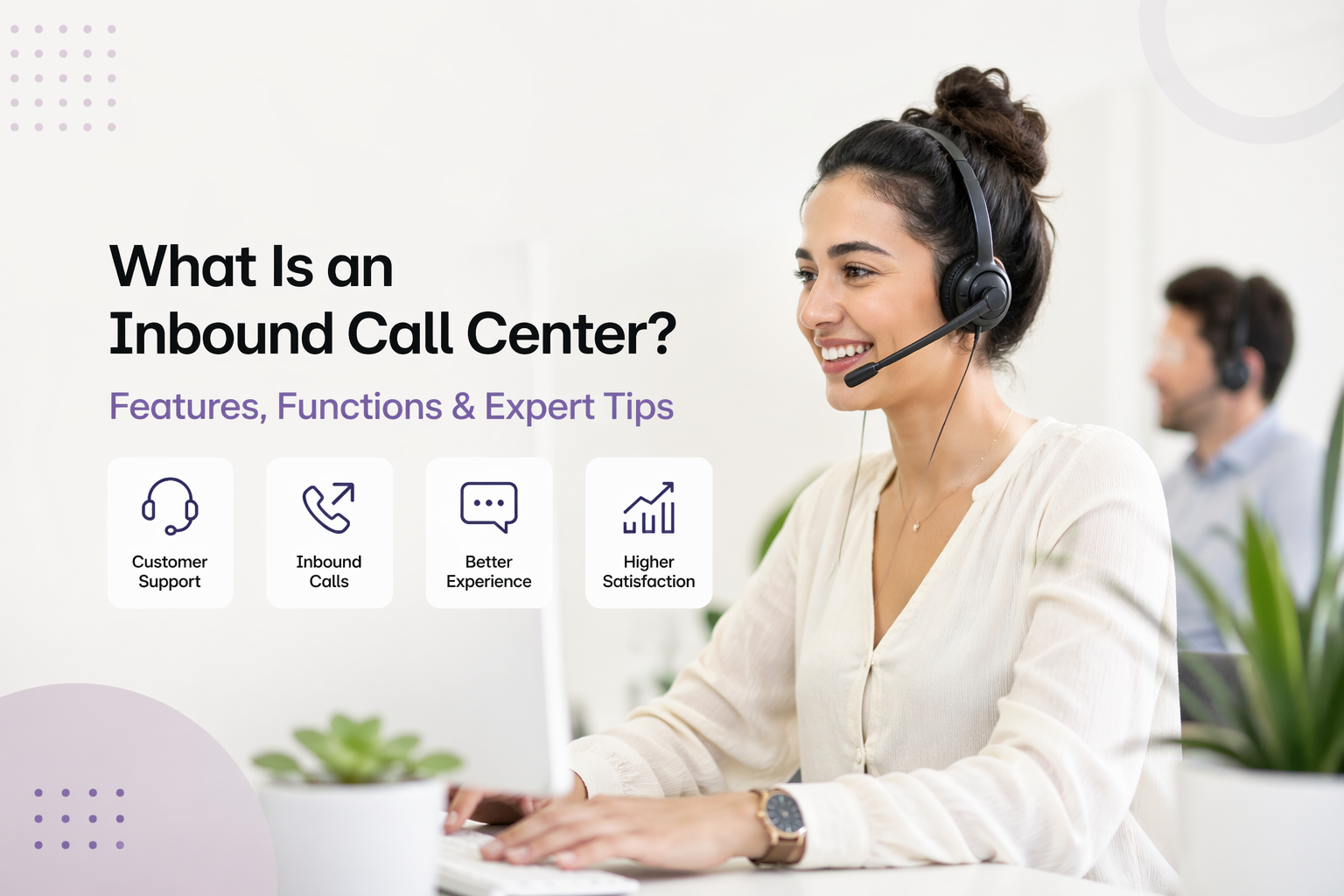
Inbound call centers are not new and are meant to help businesses communicate with their clients. Using inbound call centers, businesses can offer customer support, promote their products and make sales. Before planning an inbound call center, businesses ought to find a reliable solution provider that matches their goals by conducting research.
This detailed blog will help you to understand what is inbound call center, how it works, benefits and how to right solution for your business.
What is an inbound call center?
An inbound call center deals mostly with phone calls that are coming into the center. Many businesses that answer numerous calls such as tech support, customer service and appointment scheduling teams, tend to use them. Good inbound call center services can help customers feel satisfied because they get answers and support fast.
An inbound call center software is a business phone system that takes care of all your incoming business calls and directs them to the right department or individual based on what the caller provides. You will be able to track agent performance in real time to help increase efficiency all the time.
What are the functions of an inbound call center?
Inbound call center works in many different ways, but the basic process is genuinely the same. When an incoming customer call appears on screen, it is routed to the appropriate team of agents or single agent.
Sometimes, calls are routed to the next agent if they match certain factors such as their type and when they happen.
Sometimes, the department’s system sends the calls automatically to the first available agent based on when the call comes in and what it is about. Some times, the customer is asked to wait until there is someone able to assist them.
Most inbound call centers rely on several technology tools to handle the calls and manage customer data. The mentioned tools include the call routing software, customer relationship management (CRM) and reporting and analytics capabilities.
What is the difference between inbound and outbound call centers?
It’s normal to find it hard to identify when a call center handles incoming or outgoing calls. Most individuals are unfamiliar with the variety of call center services available. Basically, inbound contact centers deal with calls made by existing customers and outbound ones concentrate on reaching out to possible new customers.
An outbound call center means that the center makes most calls to reach customers. Sometimes, outbound call centers go by the term telesales centers. Every outbound call center aims to collect leads and then offer and sell products.
It is important to have knowledge of the unique differences between inbound and outbound call centers. The basics are the following:
- In an Inbound call center employees resolve issues raised by customers and respond to customer queries whereas in an outbound call center employees attempt to sell products or services by calling people randomly (cold calls).
- An Inbound call center often becomes part of a company’s customer service setup. An organization’s sales teams are generally linked to outbound call centers.
- The inbound calls in call centers are usually managed using VoIP or related technology. The majority of outbound call centers rely on predictive dialers to make calls.
- Inbound call centers aim to make customers happy. Outbound call centers concentrate on producing leads and making sales.
- You should keep in mind that call centers can perform both inbound and outbound call functions. Such centers that receive and make both incoming and outgoing calls are usually known as omnichannel or multichannel services.
The main features of inbound call center software
Inbound call center software is known to supply lots of useful features. Some of the most usual reasons are:
- Interactive Voice Response Systems (IVR).
An IVR system allows customers to interact with a computer by speaking to it. IVR can respond to simple questions, provide information and forward callers to the appropriate locations or individuals, making the workload of the live agents lighter and addressing issues more effectively.
- ACD technology
The ACD system sends an incoming call to the appropriate employee by considering their skills, if they are available and how urgent the customer’s needs are. Consequently, the customers can connect with the appropriate staff member immediately, which saves them time and makes them happier.
- Call Monitoring
Managers can watch over customer calls by listening in to them in real time. Using this feature is commonly done for checking product quality. The customer service manager can use call monitoring as a way to detect issues agents need help with. Agents may be trained in handling customer issues by using call monitoring.
- Call Recording
Customers’ conversations are recorded using call recording. This tool works in much the same way as call monitoring for quality control and training reasons. Businesses may record their calls to build protection from legal risks. It is also possible to save customer interactions in a library to guide the training of new call center agents.
- Call Reporting
Using call reports, managers can determine how their call center agents are doing. Examples of this information are the amount of calls an agent fielded, their call duration and how many complaints from customers they have received. Using historical reports allows one to see how trends and patterns have developed.
- Real-Time Wallboard
A real-time wallboard lets both managers and agents quickly see how the call center is doing at any time such as the performance levels of every agent and the overall number of calls ongoing. Information gathered this way can show where the call center can improve.
- Skill-based Routing
Skill-based routing sends calls to the agents that possess knowledge on how to address the issue of the caller. As a result, the customer will have a better chance of having their issue fixed during the first phone call.
- Omnichannel Support
Most call center software today usually includes the ability to talk over the phone, send messages by email, use SMS and engage on social media through WhatsApp and Facebook Messenger. When a business practices omnichannel messaging, customers can use any channel and still get the same helpful service everywhere.
- Waiting Limit Reports
You can help customers feel more important by adding personal touches to their time in the queue. Frequent updates about how long they must wait and where they stand in the line lower customer stress and irritation. Personal music and messages can improve how long a customer waits. Also, let your customers choose to get a call back, rather than wait in line.
- Self-Service Options
Offering automated IVR with self-service support means customers can handle things themselves, meaning calls take far less time. As a result, the number of calls declines, so agents can pay more attention to complicated matters.
Advantages of having inbound call center systems
using service from an inbound call center can offer your business many different advantages. Having an Inbound call center can help your business improve customer satisfaction and cut down on running costs. Let’s look at five advantages an inbound call center can offer to your business.
- Enhanced Customer Experience
A customer wants to feel valued from the moment they meet anyone from the business. The right system in a call center will guide calls to the proper employee, allow for call monitoring and enable recorded conversations for later review. It helps support your customers by making waits shorter and calls clearer which also leads to more retention since customers enjoy dealing with your business.
- Better Efficiency in Operations
When employees use the right tools, they can devote more time to helping customers which raises service quality and speeds up service, keeping customers loyal. Having a properly designed inbound call center system can perform two valuable functions: it can help you pay less for agents because turnover is reduced and it can allow your agents to work more productively thanks to improved training.
- Businesses Can Manage More Calls Quickly
A high volume of calls in your business can be addressed well by an inbound call center. That’s possible because they can take on many calls at once and still produce high-quality service. Your customers will always be able to get support, despite the extra work for your team during peak periods.
- More sales and more leads
Though sales leads and increases in revenue are often the main reason for using outbound support, inbound support can also have similar results. This allows them to get to know your business better and leads them to work with you again. Having a positive experience usually encourages people to recommend your business and assist with your expansion.
- Cost Savings
An Inbound call center may save your business money as well. When they manage their resources more efficiently, companies can reduce their costs. In addition, businesses can use a cloud call center to help keep operational expenses down. Cloud solutions have become popular with the capability of being cheap and scalable.
How do you identify the right inbound contact center solution for your company?
Before investing in an inbound contact center, here are points you should think about:
1. Make a list of what you need.
To start with, you should take some time to define the object of your contact center. Does your team have someone in charge of technical support? Answering queries? Taking complaints? A mixture? Depending on what you would like your contact center to accomplish, the appropriate integration will vary.
2. Choose the right location for your needs.
Which would be the most beneficial to you, hosted, cloud or global? Do not decide without considering the advantages and disadvantages of each.
3. Consider scalability.
Scalability is higher for some solutions than for others. For instance, growing a cloud-based contact center is very easy, but expanding an onshore or offshore center may cost more and require more work.
4. List the main things that are important to you.
What are the main features that your business needs? AI? Call recording? Automated placement of calls? Strong analytics? Come up with a list of the things you absolutely need.
5. Make sure that the security is strong.
Taking care of security is critically important in any contact center solution. Always check the security credentials of any solution you are considering.
In Conclusion:
Any successful business benefits from making contact with its customers. Your customer service’s quality can play a big role in how people see your brand, how satisfied customers are, how many customers stay with you and much more. The system of an effective inbound call center is not a luxury anymore, it is a necessity of the businesses. With the ability to respond to all customer interactions quickly, professionally, and personally, businesses will increase customer satisfaction, attract more leads, and build their brand presence.
FAQs
Why is an inbound contact center established?
The main reason an inbound contact center exists is to receive requests from clients and/or customers. Such customers might want to: speak with support, ask questions, register a complaint, pay, and so on. Agents and AIs in inbound call centers will handle these customer problems.
How are outbound and inbound contact centers any different?
People who want to connect with your business call an inbound contact center. Outbound contact centers let your company connect with people outside the business. Customer support problems are handled in inbound contact centers, but outbound contact centers work on promoting the business and getting new leads.
Do I need an inbound call center or an outbound call center?
If customers get in touch with your business, an inbound contact center will help you best. To reach your customers and prospects in additional ways, outbound call centers are what you need.
What makes call centers different from contact centers?
A big feature of call centers is that calls are handled over the telephone. They depend on the telephone and networking infrastructure. Customers at contact centers can reach out using several mediums, especially voice, email, SMS, instant messaging and the like.
What channels are used most frequently in inbound contact centers?
Most of the time, inbound contact centers focus on Voice calls, SMS, Email, Instant messaging, Social media and AI chatbot.